The company's sales in the first quarter (Q1) of 2026 decreased 6 percent to 905 million euros (~$1,058.85 million). However, EBIT fell to €35 million from €61 million in the prior-year quarter, with the EBIT margin narrowing to 3.9 percent. Earnings per share (EPS) fell to 0.24 euros from 0.51 euros.
Hugo Boss has reported a subdued start to 2026 as strategic realignment affected performance. First-quarter sales fell 6 percent, while EBIT and profit declined. The company cited macroeconomic and geopolitical pressures, including tensions in the Middle East. Despite this, gross margins improved and cash flow strengthened. Hugo Boss reaffirmed its outlook for 2026, expecting a drop in sales.
Commenting on the performance, Hugo Boss CEO Daniel Grieder said: “Following our successful finish to 2025, we start the year with a clear roadmap. However, the market environment has become more challenging over the course of the first quarter, due to recent developments in the Middle East.”
Despite revenue pressure, Hugo Boss improved top-line profitability. Gross margin increased 110 basis points (bps) to 62.5 percent, driven by sourcing efficiencies, pricing discipline and optimized freight utilization. Operating expenses decreased 4 percent, supported by lower sales and marketing costs.
Free cash flow before leases improved significantly to €33 million, compared to negative €66 million a year ago, supported by disciplined inventory management, with stock levels falling 13 percent year-on-year.
Performance was impacted by deliberate measures to strengthen long-term brand value amid a challenging macroeconomic and geopolitical environment, while continuing to prioritize profitability, cost discipline and operational efficiency, Hugo Boss said in a press release.
Sales of its flagship brand, Boss, declined 3 percent, while Hugo fell sharply by 21 percent amid ongoing repositioning efforts.
Regionally, revenue from Europe, the Middle East and the Americas (EMEA) fell 8 percent, with similar trends in key markets such as Germany, France and the United Kingdom, along with a decline in Middle East demand due to geopolitical tensions. Sales in the Americas fell 5 percent, while Asia-Pacific returned to growth with a 1 percent increase, supported by recovery in China and strength in Japan.
In terms of channels, retail sales decreased by 3 percent and wholesale sales fell by 10 percent, reflecting a more selective approach to partners and assortment, as well as cautious ordering behavior. Comparable brick-and-mortar sales showed relative resilience, falling just 2 percent.
“In this context, we are focusing on what is within our control and moving decisively into the execution phase of CLAIM 5 TOUCHDOWN. We made tangible progress in implementing our target brand and channel realignment, including streamlining product assortment and refining our global distribution footprint,” added Grieder.
Grieder noted that these actions were expected to weigh on sales in the short term but strengthen the business structurally.
At the same time, the company continued to invest in brand value, including the Boss Fashion Show in Milan and the launch of the Spring/Summer 2026 collections. Marketing investments accounted for 7.3 percent of sales, while its global customer membership base grew around 20 percent to almost 14 million.
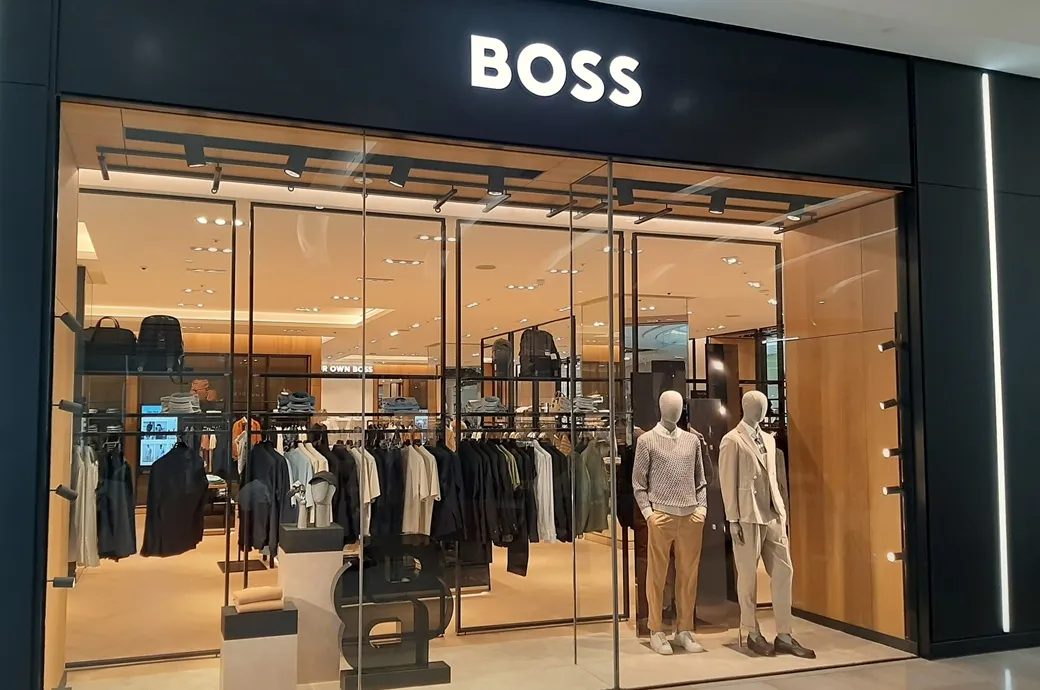
Operationally, Hugo Boss maintained strong discipline, reducing inventories to 22 percent of sales and optimizing its distribution network, including closing 15 standalone stores around the world.
Meanwhile, the company expects 2026 to remain challenging, with sales forecast to decline in the mid-to-high single digits and EBIT of between €300 million and €350 million, as macroeconomic volatility and geopolitical tensions continue to weigh on global demand.
Looking ahead, Grieder reaffirmed his confidence in the company's strategy: “In light of our performance in the first quarter, we reaffirm our outlook for the full year 2026. In an increasingly challenging external context, we remain firmly focused on executing our strategy, actively managing the business with flexibility and discipline.”
The company reiterated that 2026 will be a transition year focused on elevating the Boss and Hugo brands, strengthening distribution quality and improving operational efficiency, while closely monitoring evolving geopolitical risks and consumer sentiment.
Fiber2Fashion News Desk (SG)