to the editor: Columnist Jonah Goldberg gives surface-level credence to both the Equal Protection Clause of the United States Constitution and the Voting Rights Act of 1965, which in his opinion “can go in opposite directions,” thus implying that they are in conflict with each other (“Cory Booker should be ashamed of himself” May 12). But are they?
Does the Equal Protection Clause require that black voters lose the impact of their vote simply because of their address? Congress answered that question by enacting the Voting Rights Act. Goldberg responds that the Voting Rights Act was intended to be “transitory,” as if there were some sort of sunset clause inherent to it. And then Goldberg ignores the current and growing racial hostility by proclaiming that “nothing… nothing – in the court’s decision makes Jim Crow more likely, legal or constitutional.”
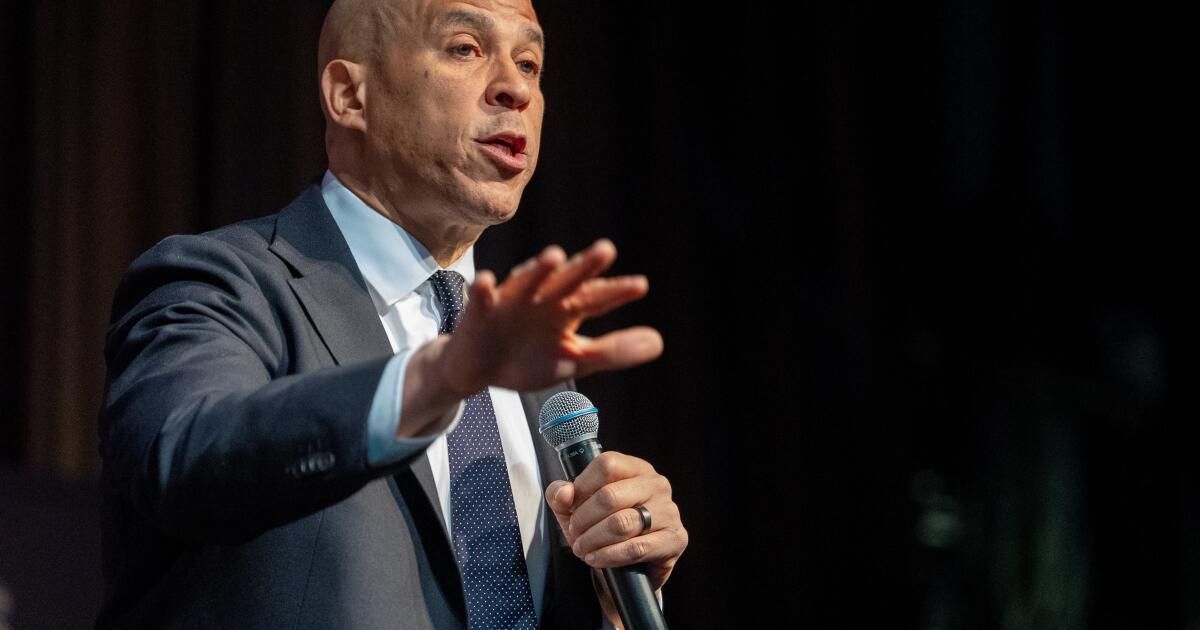
If that weren't presumptuous and arrogant enough, he stoops to attacking Senator Cory Booker ad hominem, accusing him of demagoguery and implying that he is a hypocrite because he is black and most of his constituents are not black. Where did that come from, other than a desperate attempt to validate the Supreme Court's decision on Louisiana v. Callais?
Louis Lipofsky, Beverly Hills
..
to the editor: While I don't necessarily align myself politically with Goldberg, I find his comments, both in the Los Angeles Times and when he appears on CNN, to be mostly thoughtful and pragmatic. Your criticism of Booker's comments and the accompanying argument that the Voting Rights Act does not require majority-minority congressional districts are valid. The recent Louisiana v. Callais decision is nothing more than a logical extension of the 2019 Rucho v. Common Cause decision, which eliminated federal judicial oversight of partisan gerrymandering claims. the court opinionHowever, he pointed out that partisan manipulation is incompatible with democratic principles.
The current redistricting frenzy is a race to the bottom by both parties, while recognizing that President Trump started the process with his redistricting request to the governor of Texas. The solution to partisan gerrymandering is legislation to establish independent redistricting commissions, something California had before it was temporarily sidelined in response to redistricting in Texas.
Michael Sanders, Los Alamitos
..
to the editor: Lately I've been feeling numb from cognitive dissonance. And yet, Goldberg's final question about why electing a black senator in a majority non-black state is not the same as gerrymandering US congressional districts made me stutter.
The entire state's population votes for senator (reminder: each state gets two), while for the United States Congress, voters only have the options offered in their home district. When these districts are artificially gerrymandered, voices and votes are diluted, if not silenced entirely. There is a difference between an apple and an orange, although it could be argued that they are both fruits.
Paula Rudnick, Los Angeles
..
to the editor: So Booker is elected in New Jersey by white and black residents. New Jersey is in the north. The states leading redistricting efforts toward more majority-white districts are in the South. Read their history and you will understand the regional difference (obviously).
Whether or not the Supreme Court is intellectually correct, I am not convinced that it made the best decision at this time and place in our history. By the way, I grew up in the south.
Larry Furman, Woodland Hills