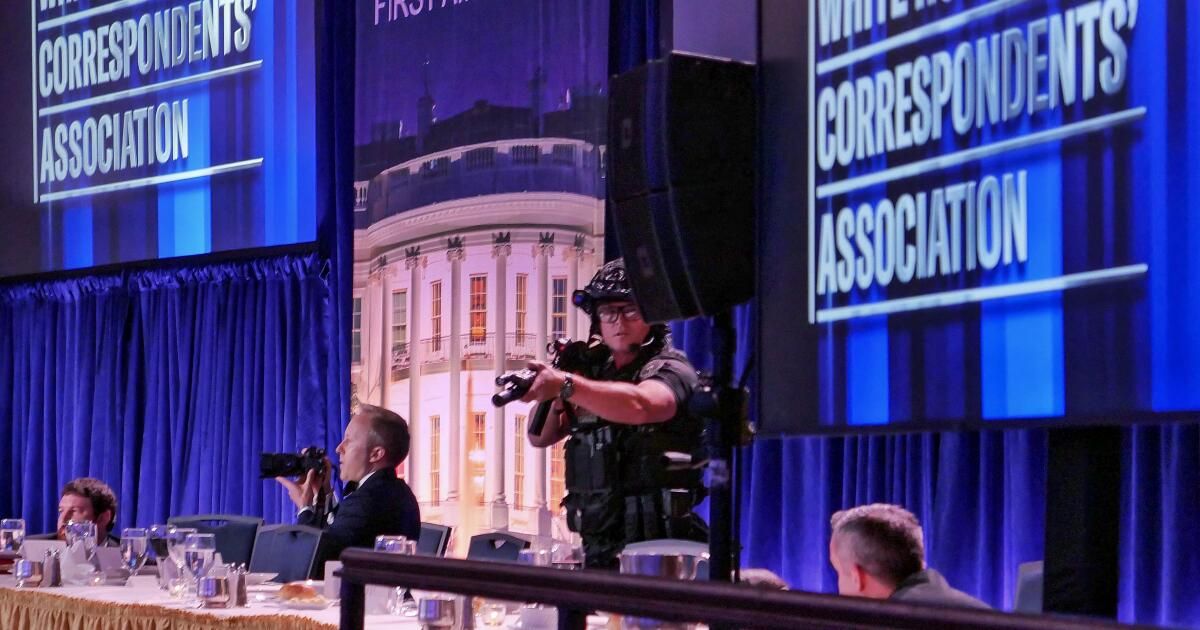
Violence at the White House Correspondents' Association. Saturday's dinner underscores how dangerous this political moment is in the United States. Over the past few years (certainly since January 6, 2021), the United States has been experiencing a period of increased political violence.
Researchers at the Polarization and Extremism Research and Innovation Lab have documented an increase in the U.S. in recent years in political violence, generally defined as violence motivated by politics or intended to communicate a political message or achieve a political goal. Several recent examples come to mind: the January 6, 2021 insurrection at the United States Capitol; multiple assassination attempts on President Trump; the deadly attacks on Minnesota legislators Melissa Hortman and John Hoffman that left Hortman and her husband dead; the attempted assassination of Paul Pelosi; the murder of Charlie Kirk. In my home state of Pennsylvania, Governor Josh Shapiro was the target of an attack on the governor's mansion.
There are several important factors driving political violence in the United States today, according to my own research and that of other scholars. The United States is currently highly polarized politically, meaning that Americans are sharply divided among themselves along partisan lines. They are distrustful and hostile to each other, and this produces a tense and volatile environment for politics and public life. This has produced a “zero-sum” environment in which every election and political contest is perceived as a moment of life or death.
There is also a moral dimension to polarization in the United States. Each side views members of the other party not simply as having a different view of politics, but as evil or immoral. The polarized environment has made political violence more normalized. It has also tempered public reaction against political violence when it occurs. This makes political violence more likely.
Political rhetoric has become much more divisive and violent in nature. This goes hand in hand with polarization and helps to further normalize political violence. In particular, when politicians use demonizing or dehumanizing rhetoric to attack their opponents (for example, using words that describe them as subhuman), this encourages extremism and helps motivate extremists to physically harm their opponents.
Misinformation is also a major driver of political violence. Several people who have participated in recent acts of political violence appear to have been motivated by conspiracy theories and other forms of misinformation, often gleaned from social media. Misinformation plays a particularly important role in the context of social media communities, where people are exposed to large amounts of misinformation and are isolated from other sources that could challenge their worldview. This facilitates radicalization and has been shown to fuel political violence in some cases.
A final major factor in the current wave of political violence is the attack on democratic norms and institutions in the United States. American democracy is experiencing pressures unprecedented in the modern era. This has damaged Americans' trust in government, trust in democratic institutions, and opinion of democratic government itself.
People who are skeptical about democracy are much more likely to express support or tolerance for political violence.
While the United States is currently experiencing an uptick in political violence, it is unfortunately unprecedented. An example would be the highly polarized period of the 1850s in the run-up to the Civil War. At this time, there was a marked division between abolitionists and defenders of slavery. This culminated in political assassinations, an assault on an abolitionist member of Congress by a pro-slavery member of Congress, and a bloody civil conflict in Kansas between armed pro- and anti-slavery groups.
In the early 20th century, just after World War I, there was another surge in political violence caused by labor issues and violence from the second generation of the Ku Klux Klan. And the 1960s brought intense political violence over opposition to the Vietnam War and a backlash to the civil rights movement.
Although current political violence has some unique characteristics (namely the influence of social media), we can look for some parallels in these earlier periods.
It is absolutely critical that both Democratic and Republican politicians – politicians on all sides – come together to condemn Saturday's attack and all political violence. Political commentators and influencers should also condemn this and all use of political violence.
Research widely shows that what political elites (politicians, political leaders, media commentators, online influencers) say in the wake of these types of events has an enormous effect on citizens' attitudes. Political elites should adopt rhetoric that does not normalize this type of behavior.
If the message comes from across the political spectrum, it will be much more effective in reducing public attitudes that fuel political violence.
James Piazza is a professor of political science at Penn State. This article was produced in partnership with Conversation.
Perspectives
Perspectives from the LA Times offers AI-generated analysis of Voices content to provide all points of view. Insights does not appear in any news articles.
point of view
Perspectives
The following AI-generated content is powered by Perplexity. Content is not created or edited by the Los Angeles Times editorial staff.
Ideas expressed in the piece.
-
Political polarization in the United States has created a “zero-sum” environment in which Americans view political contests as existential struggles, with each side increasingly viewing its opponents not only as having different political preferences but as fundamentally evil or immoral.[3].
-
The normalization of political violence in polarized environments has diminished public reaction against such violence when it occurs, creating conditions where political violence becomes more likely.[3].
-
Divisive and dehumanizing political rhetoric, particularly when politicians describe their opponents as subhuman, directly encourages extremism and motivates people to commit violent acts against their political adversaries.[3].
-
Misinformation and conspiracy theories distributed through social media communities create echo chambers that isolate people from alternative viewpoints, facilitating radicalization and fueling political violence.[3].
-
The erosion of trust in democratic institutions and norms has made citizens more likely to tolerate or support political violence, as those skeptical of democracy itself are significantly more receptive to violent political action.[3].
-
The United States has a historical precedent of periods of intense political violence during times of severe polarization, including the antebellum era of the 1850s, the labor conflicts of the early 20th century, and the Vietnam War of the 1960s and the civil rights period.[3].
-
Strong bipartisan condemnation of political violence by political elites (including politicians, commentators, and influencers) has substantial effects, supported by research, in changing public attitudes away from support for violent acts.[3].
Different points of view on the topic.
-
Aggressive personality traits, rather than political ideology or partisan affiliation alone, represent the strongest predictor of support for political violence, suggesting that personality-based interventions may be more effective than focusing solely on reducing partisan polarization.[1].
-
Research indicates that affective polarization (emotional dislike between partisan groups) is unlikely to cause democratic backsliding or political violence without additional factors, challenging the notion that polarization itself is the primary driver.[5].
-
Interventions designed to reduce perceived threats and misperceptions about the other party's willingness to break democratic norms are more effective in preventing political violence than programs aimed simply at improving inter-party dialogue and understanding.[5].
-
The most compelling voices for countering violent extremism come from internal ideological groups rather than external political leaders, suggesting that defecting members of extremist movements and community leaders should take primary roles in deterring violence rather than broad political condemnation.[2].
-
Creating accessible “exit ramps” for radical ideologies through prosocial rehabilitation and reintegration programs, rather than relying solely on political rhetoric, offers a more sustainable approach to reducing political violence by addressing complex processes of radicalization.[2].
-
The most effective long-term solution to domestic political violence involves preventing politicians from catering to violent constituencies through political realignment, which could require constitutional or legislative reforms rather than appealing solely to bipartisan condemnation.[4].