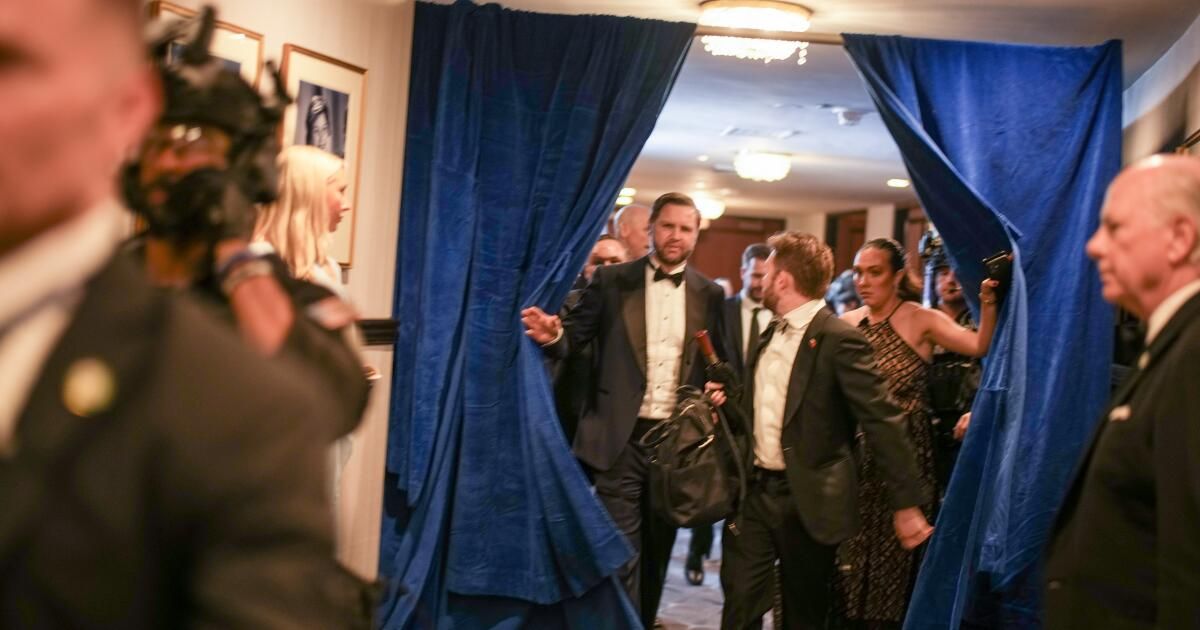
A heavily armed California man was caught trying to break into the White House correspondents' dinner on Saturday with the apparent intention of killing the president.
It didn't take long for Washington to start arguing. Democrats denounce violent rhetoric from the right, but the alleged attacker seemed inspired by his own rhetoric. President Trump, after initially offering some unifying comments about defending free speech, soon began accusing the press of encouraging violence against him. Critics pounced on the hypocrisy.
The hypocrisy argument is not about mere inconsistency. The objective of the accusation is to say that the condemnations of violence are not sincere. “Your team says it is against violence” or “your side says my side encourages violence,” but look at what inspired your language!
The hypocrisy is bipartisan.
In fact, for two decades now, it seems that every time political violence breaks out, there is a moment when partisans hope to learn the perpetrator's motives so they can start blaming the other side for inciting it. Sometimes they don't even wait. Jared Loughner, the man who shot former Democratic Rep. Gabrielle Giffords and killed several others, was instantly tagged as an agent of the tea parties and Sarah Palin. The truth is that he was such a paranoid schizophrenic that a court declared him incompetent to stand trial.
I don't have space to go through the dozens of examples: the Congressional baseball shooting, the Charleston AME Church massacre, the Walmart massacre in El Paso, the recent assassination of Minnesota legislators, the January 6 riot, or the failed attack on Saturday night. But in the wake of these bloody crimes, supporters on the left and right will scour the killer's social media or read his “manifestos” and blame the rhetoric of the team closest to the aggressor's ideology.
Now, what I mean is not to say that blaming the rhetoric of nonviolent people for the crimes of violent people is wrong. Of course, this is incorrect, especially from the point of view of the law. yes I quote Shakespeare and I write: “Let's kill all the lawyers”, I am not responsible for someone shooting a lawyer (neither is the Bard). But that doesn't mean that violent and extremist rhetoric is laudable, healthy, or blameless for the sorry state of American politics or society or that it never plays a role in inspiring bad actions.
As much as such rhetoric may encourage violence, it certainly fosters a sense that something is broken in American life. More specifically, it fuels the idea that our political opponents are existential enemies.
“Outgroup homogeneity” is the term social psychologists use to describe the very human tendency to think that the groups to which one belongs are diverse and complex, but the groups to which one does not belong are not. A non-Asian person might think that all Asians are the same, but for Asians the differences between (or between!) Chinese, Japanese, Koreans, and Indians are obvious and significant.
American politics right now is almost defined by outgroup homogeneity. Many Democrats and progressives think that all Republicans and conservatives are the same and vice versa. That would be bad enough, but the problem is compounded by the fact that each side tends to think that the other side's consensus is defined by its worst actors and spokespersons. This is sometimes called “picking at nuts.” You find the most extreme person on the other side and present them as representing all Democrats or Republicans.
Partisan media amplifies this dynamic at scale. Pew considers Republicans (who watch Fox News) to be further familiar with the term “critical race theory” than the Democrats, the supposed devotees of it. Democrats recognize the term “Christian nationalist” further than the supposedly Christian nationalist Republicans.
Consider recent debates about Hasan Piker and Nick Fuentesboth prominent social media influencers, one from the extreme left and the other from the extreme right, who say grotesque, indefensible and stupid things. Arguments within the two coalitions do not revolve around whether they should be spokespersons for their respective sides, but rather whether their “voices” (and their supporters) should be welcomed within the broader Democratic or Republican tents. Few accommodationists support the worst rhetoric of Piker or Fuentes, but they oppose it.purity evidence.”
On the substance, I think both should be avoided and condemned. But even if the issue is purely political, they should still be ostracized. Because? Because people outside the respective coalitions – no matter how fair or unfair – will consider the marginal extremists as representative of the whole. The only way for either party to demonstrate that they oppose extremism to people outside the store is to first oppose it inside their own stores. Otherwise, their hypocrisy will continue to define them.
UNKNOWN: @JonahDispatch