Commercial fishing crews will be able to catch salmon along the California coast this year for the first time since 2022, as regulators plan to end a three-year closure after seeing a surge in the struggling salmon population.
The Pacific Fishery Management Council, a congressionally established body that manages ocean fisheries along the West Coast, is expected to vote Sunday on a plan that will reopen the salmon fishing season under strict limits in California.
A sharp decline in the Chinook salmon population led to commercial fishing bans in 2023, 2024 and 2025, the longest closure in state history.
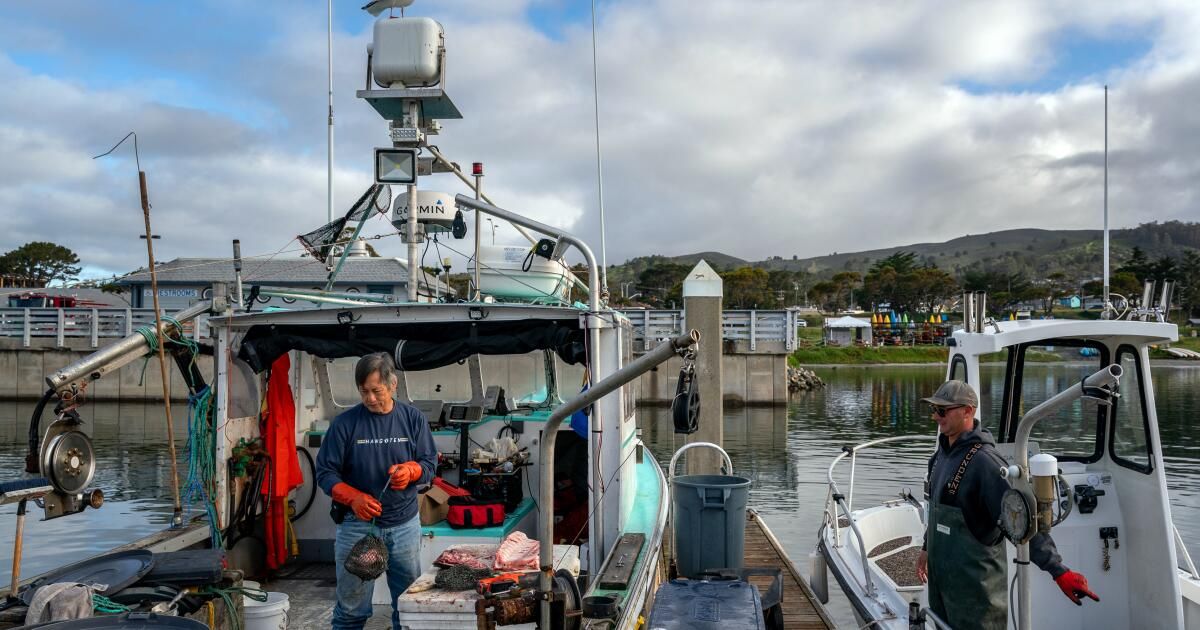
The state's fishing industry has been hit hard by the shutdown, leading many to abandon their boats and look for other work. The planned resumption of fishing this spring will allow crews to catch a limited number of Chinook salmon in the fall on certain dates.
“Limited reopening is a lifesaver. It gives you a little bit of money,” said Vance Staplin, executive director of the nonprofit Golden State Salmon Assn. “There is no way they are getting enough to sustain their businesses the way they were before this shutdown.”
Anglers in the San Francisco region will be allowed to catch a maximum of 160 Chinook per boat during various open periods in May and August, and 100 on additional dates in September. Those fishing in other regions will be given different dates.
The plan also includes limits on the total number of fall Chinook salmon that can be caught during the season.
The suspension of commercial fishing has meant significant income losses for many in the business. Some have managed to get ahead catch crabs or other types of fishwhile others have left the state.
Fisherman Chris Pedersen walks along a pier in Half Moon Bay in 2024. He left California after the salmon fishery closed, saying he could no longer make a living.
(Loren Elliott/Los Angeles Times)
Chris Pedersen, a 66-year-old fisherman, said he could no longer make a living fishing in Half Moon Bay after it closes in 2023, so he moved to Arizona and has been traveling to the Oregon coast to fish for salmon and tuna.
“No one has the luxury of fishing in California,” Pedersen said. “A lot of good fishermen are gone.”
The federal government provided $20.6 million in disaster relief funds for California fishing communities affected by the 2023 shutdown. But for Pedersen, that amounted to $8,000, which he said was far from enough to cover his losses.
“It was terrible,” Pedersen said. “I put everything I have in my boat and we can't fish.”
Some have put their boats up for sale. Others, no longer able to afford maintenance and fees, have abandoned their boats or taken them away for demolition.
Sarah Bates, who runs a commercial fishing boat at San Francisco's Fisherman's Wharf, said the port has become “a pretty sad place” as many have turned to other jobs.
“We've lost a lot of people. And given a lot of factors in the industry, I'm not sure those people will ever come back,” Bates said. “In the bigger picture, I'm quite concerned that we are losing our coastal communities and our ability to deliver marine protein to the people of California.”
Still, he's hopeful that the limited salmon season can give a small boost to fishing businesses.
“It will certainly help, and a lot of us are very excited to get back to fishing,” Bates said. “But this isn't the kind of 'We're back, everything's golden again' season we'd really like to see.”
The closure also affected recreational fishermen and those with businesses that operate sport fishing boats. After a two-year closure, the ocean's recreational fishing season was allowed to reopen for several days last year under strict limits.
Biologists say salmon populations have declined due to a combination of factors including dams, which have blocked spawning grounds, the loss of vital floodplain habitats, and global warming, which is increasingly intense droughts and causing warmer temperatures in the rivers.
The fish suffered their latest decline during the severe drought of 2020-22, when water flowing from dams sometimes became so warm that it was lethal to salmon eggs.
Salmon typically feed in the ocean for about three years and then return to their natal streams to spawn. Over the past three years, the fish have benefited from wet winters and increased river flows. The wet winter of 2023 in particular was a big help.
The long-awaited reopening of the fishing season is a good sign that the health of the state's rivers is improving, said Wade Crowfoot, California's secretary of natural resources. “It shows that nature is resilient and can recover.”
For decades, government-run hatcheries in the Central Valley have raised and released millions of salmon each year to help boost their numbers. Crowfoot said the state ongoing efforts They are also helping to restore vital tidal habitats and remove barriers that hinder fish migration.
The most recent data shows “populations that are recovering very strongly,” Crowfoot said. “It's a big boost for all of us working to recover salmon across the state.”
However, the fall Chinook population is still much lower than it was in the early 2000s.
Staplin, of the Golden State Salmon Association, said the lengthy fishery closure was a “man-made problem” and blames Gov. Gavin Newsom's administration and the federal government for failing to ensure sufficient river flows for salmon.
“Water for agriculture is being prioritized over fishing. It's that simple,” he said.
He noted that as salmon have declined, California's agricultural industry has been planting more pecan orchards, replacing other crops that are easier to leave fallow when water is scarce.
The state's almond orchards have expanded dramatically since 2002 and now cover about 1.5 million acres, while pistachio orchards have exploded from about 100,000 acres in 2002 to more than 600,000 acres today.
“To me, we are destroying our natural habitat to grow snacks for export,” Staplin said.
He said the state should adopt stricter rules to protect river flows so salmon and other fish can recover.
Some who depend on fishing for their livelihood hope this year marks the beginning of a long road to recovering what they have lost. Bates, for example, said he believes California should be able to rebuild a healthy salmon population.
“There is still a lot of work to do,” he said. “I hope this is the beginning of an upward trend in the number of fish coming out of the Sacramento River.”