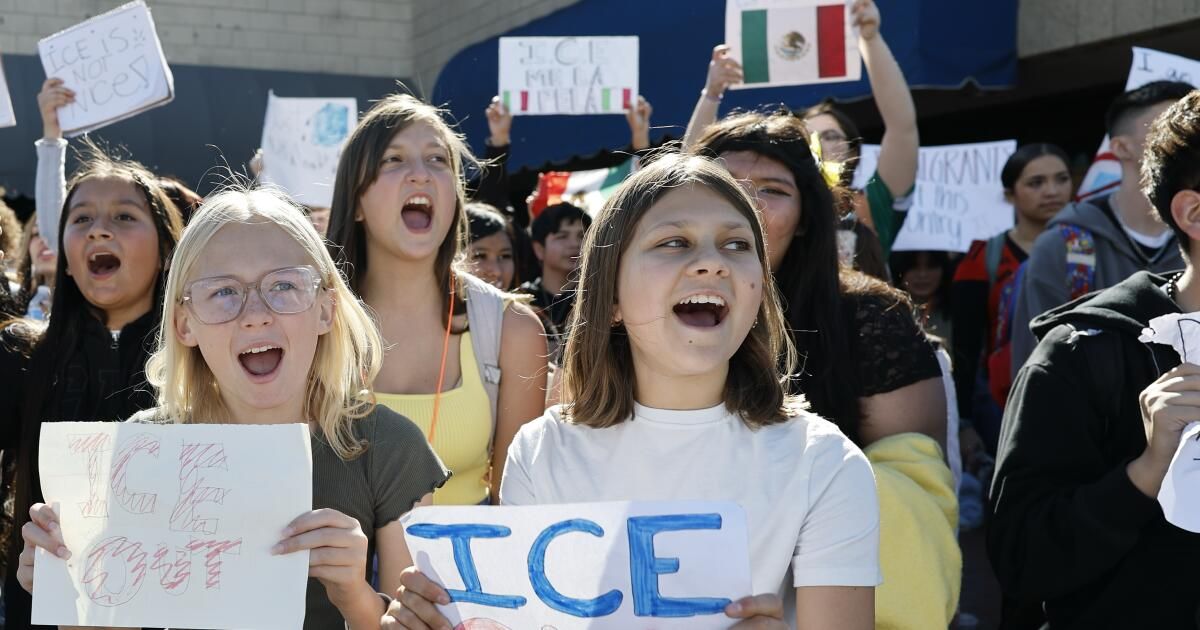
After about 150 students walked out of Redlands schools earlier this month in support of immigrants, they faced an unexpected consequence: a temporary suspension of school privileges while administrators imposed rules prohibiting them from leaving a classroom without permission.
The punishment — the loss of access to sports, dances, shows and other school events — in a school system with a majority conservative board stands in stark contrast to the positive reception student activism has received in some other California school systems, including the Los Angeles Unified School District.
The disparate actions show how school officials in several states and school systems (in blue and red regions) have been dealing with a wave of student walkouts that began in late January as part of national protests over the Trump administration's immigration crackdown.
Redlands school officials said the suspension of privileges will remain in effect until a student meets certain conditions, such as attending a Saturday school session or performing four hours of community service.
“The superintendent's message is consistent: We care deeply about our students and recognize that many young people are grappling with and participating in issues they see in the news and in their community,” said district Public Information Officer Christine Stephens. “Students have the right to peaceful expression. At the same time, the district must assume its responsibility to maintain a safe and supervised learning environment during the school day.”
Districts that expressed support for students' free speech rights included those in San Francisco and Sacramento. In Palo Alto, district officials worked with schools to make sure students could carry out their announced walkout safely.
Los Angeles Unified officials have not established districtwide sanctions for the strikes, and its leaders align themselves with students' criticism of ICE. Superintendent Alberto Carvalho, an immigrant, has pledged to do everything in his power to maintain schools as sanctuaries for children from immigrant families, and activists patrol outside schools to help ensure safe passage to campus for parents and students.
At the same time, LAUSD educators have encouraged students to remain on campus for safety reasons. In Los Angeles, there were reports of physical confrontations between officers and protesters after students walked out on February 5 and on February 13, when three federal agents were injured after some in the crowd threw objects at them.
State and educational leaders in Texas and Florida described the significant consequences for students and educators related to the student strikes. In Texas, state leaders have talked about possible suspensions and expulsions of students, layoffs of educators and state takeovers of school districts.
The ACLU of Georgia sent a letter on Jan. 29 expressing concern to the Cobb County School District after threatening out-of-school suspension, loss of parking and extracurricular privileges and warned of consequences for college admissions for participating in strikes.
The ACLU warned that the school system would be acting illegally if strike participants were singled out for especially harsh treatment based on their views.
The young activists
Student activists at high schools – in Redlands and elsewhere – said they are willing to face consequences, if necessary, to stand up for what they believe in and protest the actions of U.S. Immigration and Customs Enforcement.
“As organizers, we are expected to take the first wave of retaliation,” said Redlands High School senior Jax Hardy. “So while we would be very disappointed in the district for doing such a thing, it is important for us to exercise our right to free speech to oppose a government that is encroaching on our human rights.”
Student leaders see their protests as a lesson in civility in action.
“We need to act, because if we don't, who knows how things will get even worse,” said Redlands High junior Aya F, who uses her initial last name instead of her full legal name. “That's why we think it's important for us to organize this strike.”
Redlands is about 60 miles east of downtown Los Angeles and has about 20,000 students. In November 2024, a conservative majority was elected to the five-person Redlands Board of Education, aligning the board with key Trump administration policies. Redlands joined a handful of ideologically similar California boards to pass policies that would allow parents to question library books with sexual content and ban the display of the rainbow pride flag, which is associated with the LGBTQ+ community.
But the district claimed its actions on the strikes have no ideology attached to them.
“The district's response is not based on the viewpoint, topic or content of a student's expression,” Stephens said.
Students leave despite punishment
Some Redlands students staged another walkout Friday, and organizers said they expected representation from students from seven middle and high schools. Many showed up from Redlands High School. They carried “Stop ICE” signs, Mexican flags and blew whistles as they made a 15-minute walk to a downtown intersection that some refer to as “Peace Corner.”
“I've never seen so many people in Redlands do anything,” said sophomore James Bojado, who also said that for days, administrators had tried to dissuade students with threats of discipline.
Several Redlands police vehicles patrolled the demonstration area, passing slowly.
A man in a sun hat shouted, “Why don't you fly the American flag? Are you ashamed of America?”
“Leave us alone!” responded a chorus.
“My mom and dad are immigrants,” said Carmen Robles, a sophomore. “Why deport families who care about America to where they came from?”
At the rally, students' demands included a strong commitment from the district that ICE will never be allowed on campus. Students also called for the abolition of ICE and spoke of wanting the school board to rescind what they see as anti-LGBTQ+ policies. These include the flag ban and the book restriction policy.
During Friday's rally in Redlands, there were a few tense minutes when a student wearing a MAGA hat was pelted with water bottles. The student spoke to police but also said he was not injured.
A person wearing a MAGA hat has water and pizza thrown at him during a student strike and protest in Redlands.
(Gina Ferazzi/Los Angeles Times)
Adult volunteers were present with the goal of keeping things safe and positive. Parent Toni Belcher said students have the right to be heard.
“I'm happy to see all these kids trying to make their voice matter,” Belcher said. “If it's not like that now, it will be… They're starting early.”
what the law says
Students' right to express themselves begins with the United States Constitution.
“You do not lose your right to free speech simply by entering a school,” according to American Civil Liberties Union guidelines. “You have the right to speak, hand out leaflets and petitions, and wear expressive clothing at school, as long as you do not disrupt school operations or violate the school's content-neutral policies.”
However, a strike could be treated as a disturbance. But a greater punishment cannot be applied depending on the nature of the opinions expressed.
Redlands Unified believes it is meeting that legal standard.
California law offers some additional protection for student protests, but it is not unlimited.
A California law, which went into effect in 2023, allows a middle school or high school student to miss one day of school each year as an excused absence for a “civic or political event.” This includes, but is not limited to, “voting, election days, strikes, public comments, candidate speeches, political or civic forums, and town halls.”
The bill's author, then-state Sen. Connie Leyva, said at the time that the law “emphasizes the importance of getting students more involved in government and their community, prioritizing students' opportunities for civic learning and engagement both within and outside of their education.”
One caveat is that the law requires that “the student notify the school in advance of the absence.”
Students who exercise this right should be allowed to make up missed school work without penalty. There are potential gray areas, such as whether a large-scale school strike, which organizers intend to be dramatic, would fall outside this protection because students do not formally walk out, for example.
A Redlands parent said he notified the school that his son had permission to participate in a previous walkout. after the strike. But his son was still penalized because, the father said, he was not allowed to retroactively grant permission to his son.
State law requires advance notice, but does not say parental permission is required for that one day of protected civic activity each year. The law also provides that schools, at their discretion, may allow additional excused absences for civic participation.
The father, who did not want to be identified for fear of retaliation, said his son was placed on a “Banned List” for extracurricular activities and events.