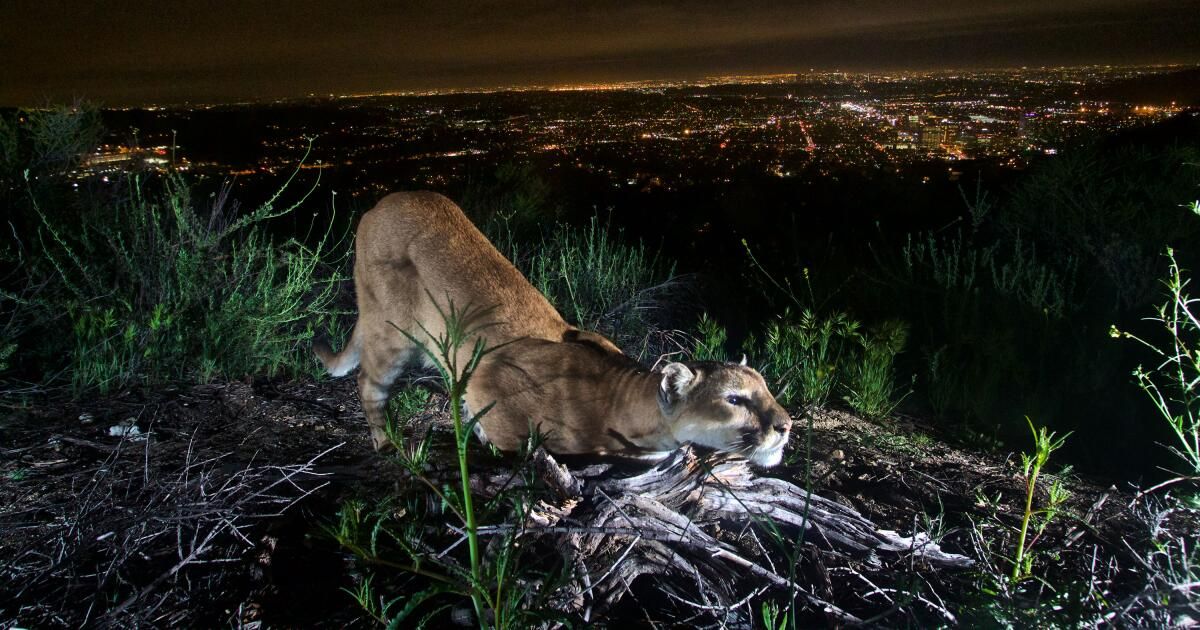
More than 1,400 California mountain lions are now protected by the state's Endangered Species Act.
On Thursday, the California Fish and Game Commission voted unanimously to list six isolated populations of cougars in Southern California and the Central Coast as threatened under state law, meaning they are likely endangered in the absence of intervention.
During the public meeting, Commissioner Erika Zavaleta said it's good that lions are not facing imminent extinction, explaining, “I think it's best for us to take action before we get to that point.”
These lions, which range from the Bay Area to the U.S.-Mexico border, are especially endangered by loss of gene flow due to the fragmentation of their shrinking habitat, compounded by serious risks posed by car crashes, rat poison and disease, according to state wildlife officials.
Scientists and conservationists believe the action was necessary to give these iconic animals a chance to survive. Surrounded by highways and housing, cougar clans in the Santa Monica and Santa Ana Mountains (both listed) have a 16% to 28% chance of extinction within 50 years if they cannot find lions to mate in other areas, providing them with genetic diversity.
However, opponents, including ranchers and farmers, say the protections will make it harder to kill lions that pose a safety risk to people and livestock, and that top predators were already well protected by state law.
Several measures have been implemented or are in progress that are expected to help mountain lions, including a giant wildlife crossing being built over Highway 101 and a law requiring cities to consider connectivity in their land use plans. But its impact will require time that lions do not have.
“Despite these improvements, it will take decades to reestablish connectivity between small, genetically isolated populations” of lions, said Daniel Applebee of the California Department of Fish and Wildlife. Meanwhile, populations are at risk of being wiped out by inbreeding, ferocious forest fires and other factors.
The listing decision comes about seven years after the nonprofit environmental organizations Center for Biological Diversity and the Mountain Lion Foundation asked the commission to consider listing all six lion populations.
In 2020, the commission handed over to the lions temporary protections for endangered species as “candidates” for inclusion on the list. In December, the Department of Fish and Wildlife, charged with advising the commission on policy decisions, recommended granting threatened species status to lions in an area that largely matched what the petitioners requested and included the Santa Cruz, Santa Monica, San Gabriel, San Bernardino and Santa Ana mountains, as well as the eastern Peninsula ranges. It sets aside a proposed swath of southeastern desert and farmland in the Sacramento-San Joaquin Delta.
The protections provide a legal mandate for state agencies to protect lions, give wildlife officials the authority to develop a recovery plan, and require proposed developments in lion habitats to be more wildlife-friendly, according to the Center for Biological Diversity. The conservation group said it could lead to the construction of more wildlife crossings and stricter restrictions on rat poison.
“You have the power to choose coexistence over extinction,” Tiffany Yap, the center's urban wildlands science director, told commissioners before the vote. “You have the power to choose to protect our incredible wildlife and our environment at a time when the federal administration is attacking our environment and rolling back environmental protections.”
Valerie Termini, acting director of the department, said the decision was “overdue” at the meeting, although she acknowledged that mountain lions are polarizing animals.
“They evoke strong and varied perceptions” about how they should be managed, he said, “but the segment of the population we are talking about today is clearly at risk from different threats.”
Adding a layer of complexity to the state's management of its cougars is the fact that several lions are doing well, including populations on the northwest coast and both sides of the Sierra Nevada. Those groups were not proposed for inclusion on the list.
California is home to approximately 4,172 mountain lions, according to wildlife officials.
During the meeting, which attracted 57 speakers during public comments, strong and opposing perspectives on cats were on display.
The National Wildlife Federation, the San Diego Humane Society, Citizens for Los Angeles Wildlife, Los Padres Forest Watch and Project Coyote conveyed their support, among others. Advocates praised lions as a key species that enhances biodiversity and noted the affection they generate, from the late famous P-22 of Los Angeles to the lion that recently strolled through San Francisco.
One San Francisco resident described hearing one of the big cats while camping and said, “I felt very lucky to live in a state that cares about the conservation of these animals and today has the opportunity to protect them even more.”
Opponents included the California Farm Bureau, California Cattlemen's Association, California Deer Association, California State Archery/Archery Hunters Association. and the California Four Wheel Drive Association. Critics said lions were increasingly preying on livestock as their prey, such as deer, had declined, and some expressed concern for the safety of pets and their loved ones.
“This petition is going to hurt the mountain lion more than anything,” said Vince Fontana, a fourth-generation San Mateo County rancher. The reason the lion is in trouble is that “it is overpopulated and the sad thing is that it has run out of food.”
California lions enjoyed certain protections before being listed. In 1990, voters approved Proposition 117, which designated them as a “specially protected species” and prohibited hunting them for sport. State officials will now have to reconcile the differences between the two statutes.