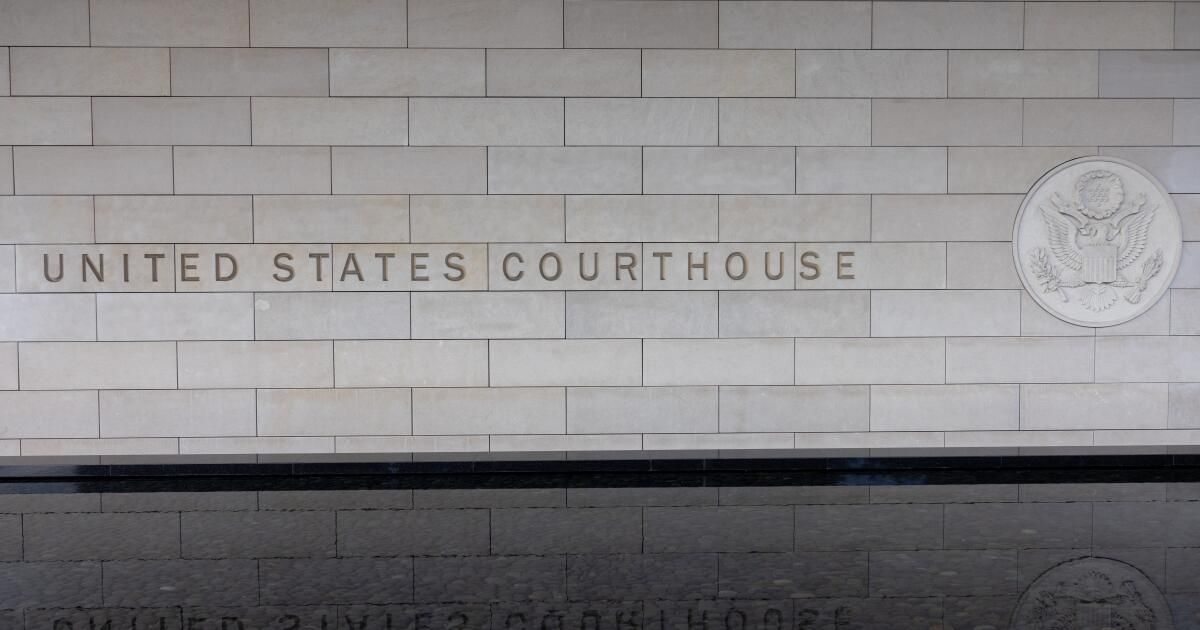
As part of an ICE operation, plainclothes agents removed a man accused of shooting MS-13 from a downtown federal courtroom Thursday, catching attorneys and the judge off guard and raising uncertainty about the fate of his pending criminal trial.
Mark Sedlander, a defense attorney, said agents, and at least one deputy U.S. marshal, surrounded and detained his client, Orlando Olivar, shortly after U.S. District Judge André Birotte Jr. left the courthouse following a pretrial conference Thursday.
Sedlander said the officers backed Olivar up against the wooden railing that separates the public area from where the parties sit. The officers did not identify themselves and did not show or mention any warrants, he said. He asked them to wait for the judge to return, but said they immediately took his client out of the courtroom through the holding cell door.
Sedlander said the prosecutor told him they had no control over ICE. Olivar is now listed on an ICE inmate locator as a detainee at the Adelanto ICE Processing Center.
Prosecutors have accused Olivar of being an MS-13 clique leader, which Sedlander said his client denies. Olivar is charged with conspiracy to racketeering, conspiracy to possess with intent to distribute methamphetamine and distribution of methamphetamine.
Olivar, who has pleaded not guilty and is presumed innocent, will go to trial on May 19. He had been free on bail.
“First, I'm concerned about my client, period, and second, about people's willingness to participate in our justice system, whether criminal or civil, when they know that, unlike in years past, the courthouse is not a safe space,” Sedlander told the Times. “This will prevent people from participating in the system.”
The U.S. attorney's office in Los Angeles declined to comment.
Department of Homeland Security Acting Undersecretary Lauren Bis confirmed that ICE arrested Olivar, whom she described as “an illegal alien criminal from El Salvador.” Bis said his criminal history includes charges of robbery, drug trafficking, drug possession and burglary.
Bis said Olivar was arrested by ICE at the U.S. Marshals Service building “in a controlled transfer between the U.S. Marshals and ICE.”
“He will remain in ICE custody until he is transferred to El Salvador,” he said. “This is a perfect example of police cooperation to ensure that criminal illegal aliens are not released into American neighborhoods.”
According to Bis, Olivar was previously granted voluntary departure by a judge and left the country in 2014. She said he illegally re-entered the United States for the second time that same year and was expelled the following year. She said he then entered the country illegally for a third time on an unknown date.
In recent months, immigration authorities have detained undocumented defendants and, in at least one case, deported them, while federal criminal proceedings were underway. Federal judges have dismissed the charges after defense attorneys cited difficulties accessing their clients in immigration detention centers and, in at least one case, difficulties locating them.
Last January, ICE issued interim guidance stating that officers or agents could make arrests in or near courthouses, but that they must “be made in non-public areas of the courthouse, made in collaboration with court security personnel, and use non-public entrances and exits to the court building.”
Laurie Levenson, a former Los Angeles federal prosecutor who now serves as a professor at Loyola Law School in Los Angeles, called the arrest “alarming.”
“I haven't heard of this happening in court,” Levenson said. “I don't know what to say, because this seems to go even further than what we've seen so far.”
Evan Jenness, a federal criminal defense attorney who has practiced in the Central District of California since 1988, described an arrest inside the courtroom as “very, very unusual.”
Jenness said he had only seen an arrest in court once before, more than a decade ago. He said the judge remained on the stand and told both sides that there was an arrest warrant from another jurisdiction, not ICE.
“Having supposed agents, gentlemen in plain clothes, carrying out an arrest, without identifying themselves, without having previously announced themselves and asking the judge for permission to act in the courtroom is extraordinary,” he said. “In my opinion, this is a whole new level of attack on our criminal justice system.”
“By behaving in this way, they have undermined the functioning of the court,” he added.
ICE arrests have also occurred in Los Angeles County courthouses. In June, ICE agents arrested two women outside the airport courthouse on La Cienega Boulevard. Two months later, a man called for help as federal agents carried him by his arms and legs away from the Clara Shortridge Foltz Criminal Justice Center on Temple Street.
Defenders, defense attorneys and even some prosecutors have long sounded the alarm about the problems that could arise if ICE uses state criminal courts as a venue for federal immigration enforcement. Such tactics have a chilling effect that could make people less willing to go to court or act as witnesses, critics say.
Times staff writer James Queally contributed to this report.