For Michael Miller, getting a project off the ground is often a bureaucratic juggling act.
When building affordable housing like the more than 200 units he is planning in Harbor Gateway and Stevenson Ranch, the president of Bold Communities said he would typically be forced to seek financing through three to five different local and state agencies.
This time, it will go to just one: the newly created Los Angeles County Affordable Housing Solutions Agency.
The agency, known as LACAHSA, bills itself as a one-stop shop for affordable housing financing with offerings for construction loans, permanent loans, rental subsidies and other types of financing products. The bet is that by doing so, developers will be able to build low-income housing more quickly and affordably in a county with an affordability and homelessness crisis.
There is some evidence that this is the case. According to UC Berkeley's Terner Center, each additional public funding source an affordable developer uses, on average, delays a project by four months and increases the total cost by $20,460 per unit—more than $2 million for a 100-unit community.
“We want to build housing cheaper and faster, because that means more units,” said LACAHSA Interim Executive Director Ryan Johnson.
On Wednesday, the agency approved just over $100 million for 10 projects, including the two from Bold Communities.
The Terner Center said going to multiple agencies to obtain the necessary funding adds costs because developers have to endure increased legal, staffing and compliance costs to handle additional applications and contracts.
Each process, of course, also takes time, during which developers pay additional holding costs for pre-development loans, while inflation drives up the cost of materials and wages.
Miller estimated that by turning solely to LACAHSA, he could reduce overall costs by 5% to 10%.
LACAHSA, founded through state legislation in 2022, receives its funding from the recent voter-approved half-cent sales tax Measure A to fight homelessness and build affordable housing.
Until now, the agency had awarded money only for homelessness prevention efforts, such as direct rental subsidies to tenants.
Its first batch of funds to build and preserve affordable housing, approved Wednesday, will pay for 554 below-market units. The vast majority will be new housing, while a small portion will be conversions of existing market-rate residential units to affordable units and the extension of deed restrictions to some existing below-market units.
LACAHSA pointed to data showing that of the best-performing quarter of new construction projects that recently applied for funding, total development costs were below the typical cost to build affordable units in the county. Savings increased to nearly 12% when project proposals relied primarily or entirely on LACAHSA funding, rather than mixing state funding with just one or two LACAHSA products.
Terner Center Managing Director Ben Metcalf said it's unclear to what extent those savings could reflect cheaper projects simply applying for LACAHSA funding. But he hopes that at least some of the savings can be attributed to LACAHSA's structure.
Not only does the agency offer a host of financial products, but LACAHSA said it ranks project proposals based on their efforts to reduce costs and considers that as an important factor when deciding to approve funds.
Metcalf, who previously served as director of the California Department of Housing and Community Development, said that focus on awarding dollars based on the estimated cost of development is not the norm among public agencies.
In part, he theorized that this was because “the rising cost of affordable housing has really only become an issue of visible concern in recent years.”
In 2022, the Times reported that the cost of building just one unit of affordable housing in California routinely cost more than $1 million. Voters have also expressed growing frustration over the lack of progress in reducing homelessness and overall housing costs.
LACAHSA is not the only effort to simplify a complicated funding process, as Governor Gavin Newsom proposes streamlining state funding as part of this year's budget.
Meanwhile, LACAHSA plans to approve another round of affordable housing funding in May.
To apply for that funding and the dollars approved Wednesday, LACAHSA said it required developers to be able to begin construction within 12 months. Developers submitted 127 applications, requesting a total of $1.5 billion to build 11,625 units.
Long Beach Mayor Rex Richardson, who serves as LACAHSA board president, argued that the high interest shows that it is actually a lack of “funding and operational support” holding back the construction of more affordable housing in Los Angeles County, rather than a lack of “places or community will.”
“LACAHSA was built to meet this moment,” he said in a statement.
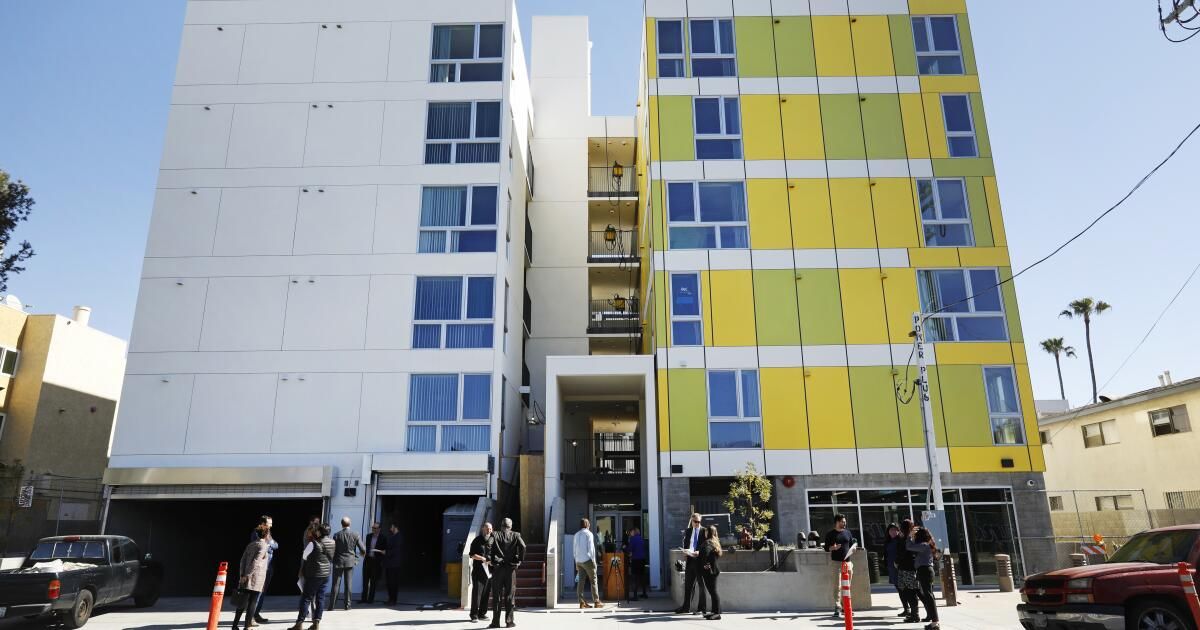
The projects Bold Communities plans in Harbor Gateway and Stevenson Ranch are conversions of extended-stay hotels into housing for low-income seniors.
Now that funding is secured, Miller said he hopes the buildings will be filled with new residents by the end of next year.
“I think they're going to be pretty straightforward, honestly,” the nonprofit executive said.