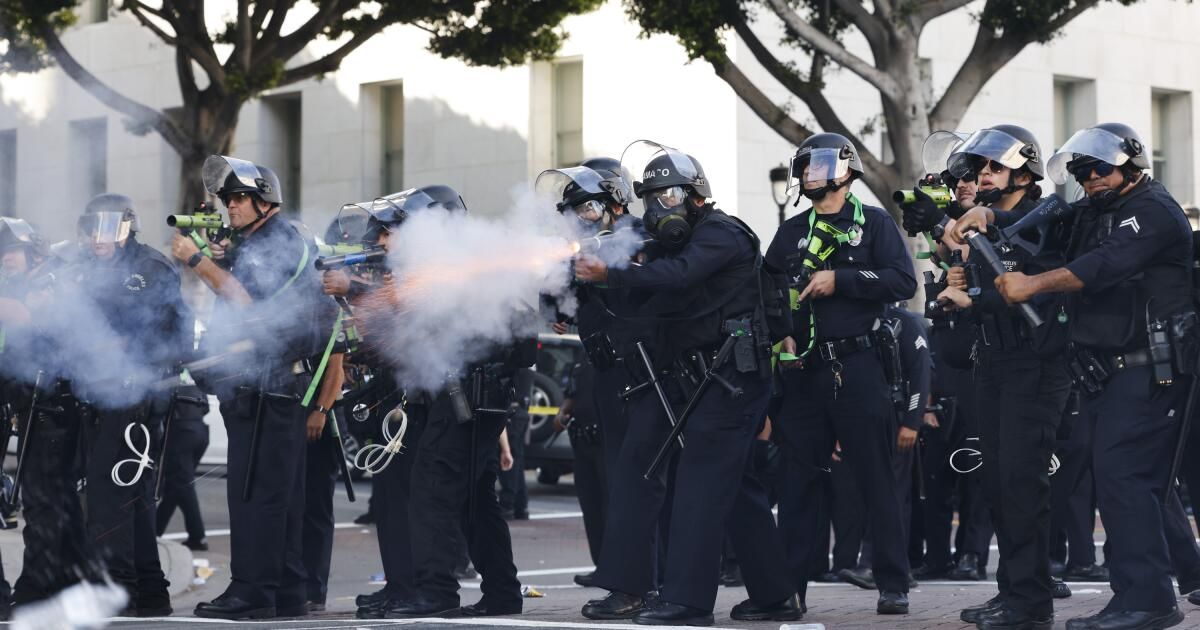
The Los Angeles City Council will consider an ordinance that would prevent Los Angeles police from using crowd control weapons against peaceful protesters and journalists.
Councilman Hugo Soto-Martínez, who represents District 13, is pushing for regulations prohibiting the Los Angeles Police Department from using “kinetic energy projectiles” or “chemical agents” unless officers are threatened with physical violence.
The Public Safety Committee unanimously approved the proposal and sent it to a vote with all council members on Wednesday. The points would be considered by the council in November or December, said Nick Barnes-Batista, District 13 communications director.
The ordinance would also require officers to give clear, audible warnings about safe exit routes during “kettling,” when police push crowds into designated areas.
After the first iteration of the “No Kings” protest over the summer, in which several journalists were shot with non-lethal bullets, tear gassed, and detained, news organizations sued the city and the Police Department, arguing that officers had engaged in “ongoing abuse” of members of the media.
U.S. District Judge Hernán D. Vera granted a temporary restraining order preventing LAPD officers from using rubber projectiles, chemical irritants and stun grenades against journalists.
According to the court order, officers can use those weapons “only when the officer reasonably believes that a suspect is violently resisting arrest or poses an immediate threat of violence or physical harm.”
LAPD Chief Jim McDonnell called the definition of journalist “ambiguous” in a news release Monday, raising concerns that the preliminary injunction could prevent the LAPD from targeting “individuals attempting illegal and violent behavior.”
“The risk of harm to all involved increases substantially,” McDonnell wrote. “Los Angeles Police must declare an unlawful assembly and issue dispersal orders to ensure the safety of the public and restore order.”
The LA Press Club, plaintiffs in the lawsuit that led to the injunction, alleges that journalists were detained and assaulted by officers during an immigration protest in August. The Press Club is also involved in a similar lawsuit against the US Department of Homeland Security.
“This case is about the LAPD, but if necessary, we are ready to take similar steps to address misconduct toward journalists by other agencies,” the organization wrote in a June news release.
Vera ruled in September that “any duly authorized representative of any news service, online news service, newspaper or radio or television station or network” would be classified as a journalist and therefore protected by the court's orders. Journalists who physically impede or interfere with law enforcement are not subject to the protections.
Any ordinance passed by the City Council would apply to the Los Angeles Police Department, but not to other agencies that might be responding to protests that turn chaotic, such as the Los Angeles County Sheriff's Department or the California Highway Patrol, thus complicating operating procedure.
District 13 spokesperson Barnes-Batista said the City Council would have to discuss how to make the rules.
“There are definitely unanswered questions about [how] “The city would not want to be responsible for other agencies not following the policy,” he said. “So that will have to be resolved.”
Last month, the City Council, led by Councilwoman Eunisses Hernández, voted unanimously to deny a request by City Attorney Hydee Feldstein Soto to push for Vera's injunction to be lifted.
“Journalism is under attack in this country, from the Trump Administration's revocation of press access to the Pentagon to the corporate consolidation of local newsrooms,” Hernández said. “The answer cannot be for Los Angeles to join in that attack by undermining court-ordered protections for journalists.”