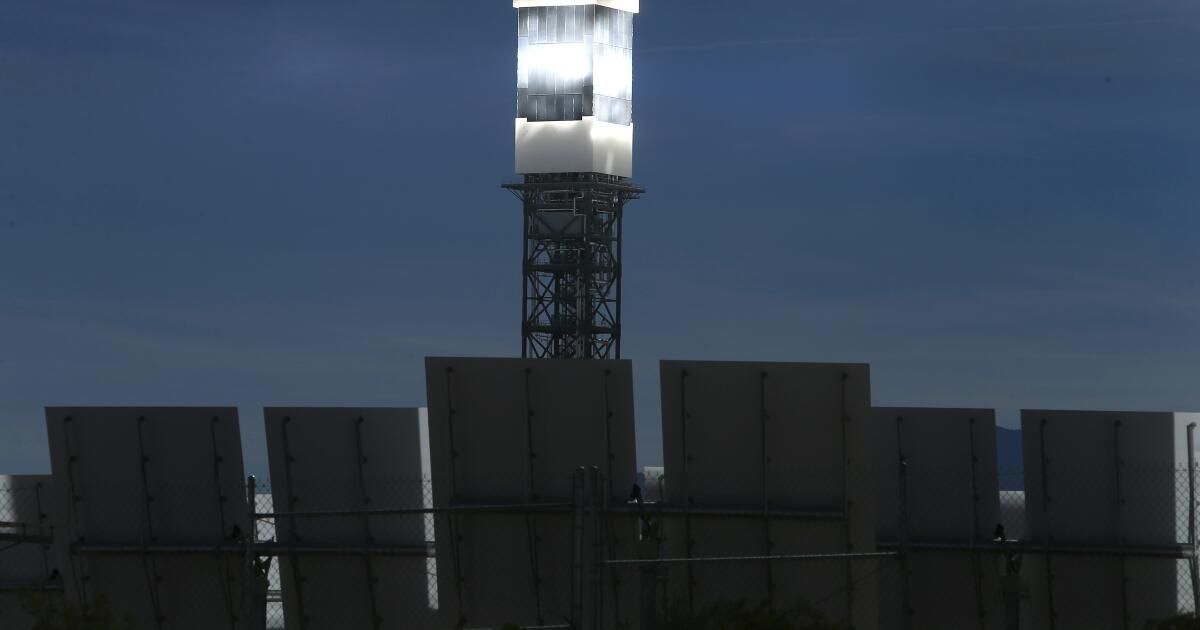
The electricity it produces is expensive, its technology has been replaced and every year it incinerates thousands of birds in mid-flight. The Trump administration wants this unusual power plant to close, and in a rare case of alignment, the Biden administration did too.
But the state of California insists that the Ivanpah power plant in the Mojave Desert remain open for at least 13 more years. It is an indication of how much electricity artificial intelligence and data centers demand.
Ivanpah's owners, which include NRG Energy, Google and BrightSource, had agreed with its largest customer, Pacific Gas & Electric, to terminate its contract and largely close Ivanpah. But last month, the California Public Utilities Commission unanimously rejected that deal, citing concerns about the reliability of the grid to deliver electricity. The decision will effectively force two of Ivanpah's three units to continue operating rather than close this year.
PG&E and the federal government had argued that the shutdown would save ratepayers and ratepayers money compared to paying for Ivanpah's electricity through 2039, when the contract expires. But some experts and stakeholders agreed with the state's call, noting that the troubled power plant is still providing electricity at a time when the state has little to spare.
“We're seeing massive demand for electricity, especially because of the huge need for data centers, and we're seeing grid reliability issues, so overall I think it was a smart decision,” said Dan Reicher, a senior scholar at Stanford. “That said, I think reasonable people can differ on this point: it's a closer call.”
Ivanpah was the largest plant of its kind in the world when it opened to great fanfare in 2014. The 386-megawatt facility uses a vast array of about 170,000 mirrors to concentrate sunlight onto towers, creating heat that spins turbines to generate electricity. This is known as solar thermal energy, because it uses the heat of the sun.
But the plant has been plagued with problems almost from the beginning. The mirror and tower technology that once seemed so promising was surpassed by flat photovoltaic solar panels, which soon proved cheaper and more efficient and became the industry standard.
Ivanpah does not have on the site battery storage, meaning it generates power primarily while the sun shines and relies on natural gas to power its boilers each morning.
The plant also developed a reputation as a wildlife killer, with a 2016 report from The Times About 6,000 birds were found to die each year after colliding with Ivanpah's 40-story towers, or from instant incineration when flying into its concentrated rays of sunlight.
Mirrors wait for the sun on opening day for the Ivanpah solar power generation system in the Ivanpah Valley near the California-Nevada border on February 13, 2014.
(Mark Boster / Los Angeles Times)
Despite these issues, the CPUC determined that the facility must remain online to help the state meet the “stringent electricity conditions” expected in the coming years, including growing demand from data centers and artificial intelligence, building and transportation electrification, and hydrogen production. Ivanpah qualifies as clean energy and California has committed to 100% clean energy by 2045.
The state's most recent Integrated Resource Plan, which discusses how it will meet energy needs, “would dictate that Ivanpah should remain online in light of the current uncertainty regarding reliability,” the CPUC wrote in its December ruling.
The five-member decision came despite PG&E's claim ratepayers will save money if it closes, a conclusion generally supported by a independent review.
It also came despite support for closing Ivanpah from the Biden and Trump administrations, which rarely converge on the energy issue. Construction of the $2.2 billion plant was backed by a $1.6 billion federal loan guarantee that has not yet been fully repaid.
How much remains of that loan has not been made public, but an internal audit reviewed by The Times indicates it could be as high as $780 million.
In the final weeks of his term, Biden's Energy Department helped negotiate the termination of the contract between PG&E and the Ivanpah owners. Trump's Energy Department, which has been adversary towards renewable energies such as wind and solar, urged California to accept that agreement.
“Continued operation of the Ivanpah Projects is not in the best interest of California or its customers, nor is it in the best interest of the United States and its taxpayers,” wrote Gregory Beard, senior counsel for the Department of Energy's Office of Energy Domain Financing, in a Nov. 24 letter to the CPUC.
However, the California agency pointed to Trump's policies among its reasons for keeping Ivanpah open. Trump's tariffs on steel and aluminum will raise prices for new energy technologies and could slow the expansion of the country's energy grid, the agency said. Trump also ended tax credits for solar, wind and other renewable energy projects in a move that could cut up to 300 gigawatts of construction nationwide by 2035, the CPUC said.
In August, Trump's Interior Department effectively halted wind and solar development on federal lands in favor of nuclear, gas and coal. That decision could affect Ivanpah, which sits on nearly 3,500 acres managed by the Bureau of Land Management near the California-Nevada border.
These “changing federal priorities” are creating market uncertainty, the CPUC noted in its ruling. California taxpayers have already paid more than $333 million for grid upgrades to support the Ivanpah project, and terminating their contracts “risks stranding sunk infrastructure costs,” he said.

The Ivanpah Solar Electric Generating System concentrating solar thermal plant in the Mojave Desert in 2023.
(Brian van der Brug/Los Angeles Times)
Reicher, the Stanford expert who also worked at the Department of Energy during the Clinton administration and as director of energy and climate change initiatives at Google, said that from an energy perspective, the decision is a wise one.
“I'm leaning toward keeping it online, operating it well and making improvements, particularly now that we're facing an electricity shortage like we haven't seen in decades,” he said.
Reicher noted that while concentrated solar power has fallen out of favor in the United States, at the time it was considered an attractive investment. Some places are still building concentrated solar power facilities, including China, Mexico and Dubai, and this may have some advantages over photovoltaics, he said. For example, many new concentrating solar installations have a higher capacity factor, meaning they can generate electricity more hours per year.
Stakeholders such as Pat Hogan, president of CMB Ivanpah Asset Holdings and an early investor in the plant, also applauded the CPUC's decision. Although Ivanpah has never met its goal of 940,000 megawatt-hours of clean energy per year, it continues to provide electricity, he said. The plant produced approximately 726,000 MWh in 2024, the most recent year for which data is available, according to the California Energy Commission.
“It's not running at the optimal performance it was originally modeled for, but it still generates electricity for 120,000 homes in California,” Hogan said.
Hogan said terminating the power purchase agreements would leave investors and ratepayers in the dust, benefiting the utility and plant owners. The plan would have turned a “partially callable federal loan into a near-total loss event,” he wrote in a formal complaint filed with the Department of Energy's Office of Inspector General.
Others said solar photovoltaics and battery storage are the best and most cost-effective way to secure California's energy future. the state has invested a lot in both, But Gov. Gavin Newsom's administration and the CPUC should work to ensure more come online quickly, said Sean Gallagher, senior vice president of policy at the Solar Energy Industries Association, a national trade group.
At the same time, bureaucrats in Washington, D.C., should work to stop the federal solar slowdown, which has placed an estimated 39% of California's planned new capacity over the next five years in a “permitting limbo,” Gallagher said.
“The CPUC's decision highlights the precarious energy position California finds itself in, with electricity prices and electricity demand increasing at a historically rapid rate,” he said.
But the Energy Department's Beard criticized the agency's decision as a “continuation of California's bad policies that are driving up energy bills.”
“California's decision to keep this wasteful and costly resource open is bad for taxpayers and worse for taxpayers,” Beard said in a statement to the Times.
He declined to say whether the federal government plans to appeal the decision, but said his office “has been working closely with the parties involved to ensure maximum reimbursement of American taxpayer dollars while boosting affordability through customer savings.”
For its part, PG&E said the company is now evaluating next steps.

Thousands of software-controlled heliostats concentrate sunlight into a boiler mounted on a series of three towers at the Ivanpah power plant in 2014.
(Mark Boster / Los Angeles Times)
“Ending these agreements would have saved customers money compared to the cost of maintaining them for the remainder of their terms,” spokeswoman Jennifer Robison said in an email.
NRG spokesman Erik Linden said Ivanpah's owners have continued to invest in the facility and “remain steadfast in their commitment to providing reliable renewable energy to the state of California.” Existing power purchase agreements remain in effect and the plant will operate under their terms for the duration of the agreements, it said.
It is not the first time that California has delayed the removal of an electrical installation due to concerns about the reliability of the system. Last month, the California Coastal Commission reached a historic agreement with PG&E that will extend the life of the Diablo Canyon nuclear power plant in San Luis Obispo until at least 2030. It was originally scheduled to close last year.