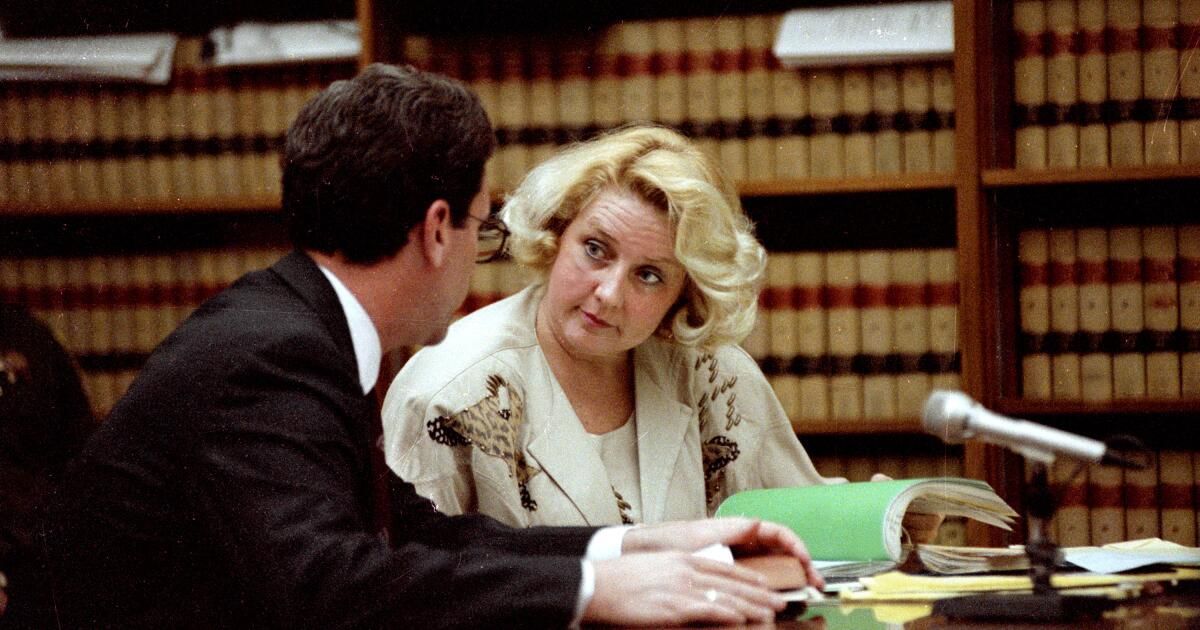
Elisabeth “Betty” Broderick, the La Jolla socialite who infamously killed her ex-husband and his 28-year-old new wife, has died in prison, authorities said. She was 78 years old.
His story of violent revenge captivated and horrified the nation: inspiring several books, a television movie, an LA Times podcast, and an eight-episode miniseries.
Broderick died in a hospital of natural causes at 3:40 a.m. Friday, according to the California Department of Corrections and Rehabilitation. She had been transferred to the California Institution for Women's off-site medical center on April 18.
Before his rise to infamy in the late 1980s, Broderick seemed to be living the suburban dream.
Married to prominent medical malpractice attorney Daniel Broderick, she maintained a position of influence and popularity in the luxurious community of La Jolla, where the couple raised their four children. But their apparent domestic paradise was ruined when Betty began to suspect that her husband was having an affair with his younger office assistant, Linda Kolkena.
The couple divorced in 1985 after 16 years of marriage. The already acrimonious relationship continued to sour amid a protracted and bitter legal battle, and when Dan began dating Kolkena, before eventually proposing to her.
Betty repeatedly left obscene messages on the newlywed couple's answering machine, to the point that Dan threatened to file criminal contempt charges, The Times reported at the time.
Then, in the early hours of November 5, 1989, Betty entered the Marston Hills home Dan shared with his new wife and fired five shots from a .38-caliber revolver, three of which hit the sleeping couple.
Later that day, Betty turned herself in to police and was taken into custody. She has been imprisoned since then.
His first trial ended in a mistrial in 1990, after two of the jurors abstained on charges of involuntary manslaughter, citing lack of intent. A jury convicted her of two counts of second-degree murder after a second trial in 1991. She was sentenced to 32 years to life in prison.
During his nearly four decades behind bars, Broderick was eligible for parole twice: once in 2010 and again in 2017. Both times, the Board of Parole Hearings denied his release, stating that he showed no signs of remorse.