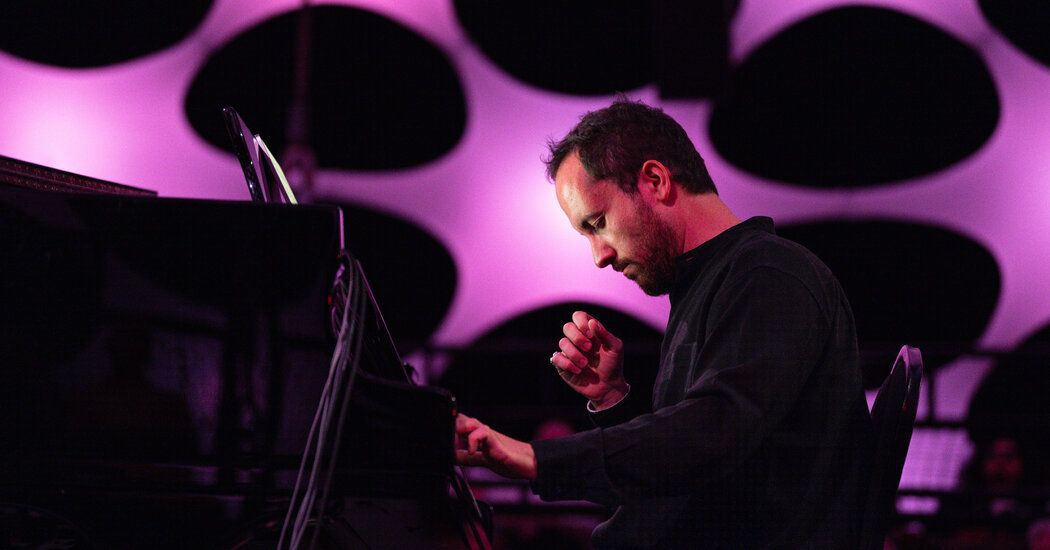
I imagine a foundation, an academy, a festival, perhaps a publishing platform, and inviting great minds, from journalists to thinkers, politicians, artists, etc., in the best tradition. I know it sounds vague and big, but I'm taking a stance that defends who I am. It is the posture towards beauty, curiosity, resistance. With the label I would simply like to meet the biggest and most exciting artists and help them become artistic thermonuclear bombs in the world.
Why did you call it No Silence?
After October 7 [the Hamas-led attack on Israel]I organized the event Against silence, Against anti-Semitism. It was a very beautiful and meaningful event for me. Some colleagues and friends, classical musicians, rock bands, actors, actresses and rappers came and performed. During this time I had emotional problems. I could hardly speak. For a couple of months, I would just stop in the middle of a sentence. Back then I broke several sacred rules in my life, one of them being that I never drink alone. Well, I sure broke that rule in the months between October and March. Anyway, on the bus home after the event, I thought: there is no silence.
Tell me more specifically about the first releases, which will be out this fall.
There are two of mine and one of a young artist I have signed. One of mine is the first release of a new project of mine. I recorded Beethoven's third symphony, the “Eroica”, in a transcription by Franz Liszt, and combined it with Arnold Schoenberg's “Ode to Napoleon Bonaparte”. Both are pieces de resistance, where the soul of “non-silence” is central. In Schoenberg there is also Yiddishkeit, which means a lot to me. One by one, I will record Beethoven's nine symphonies in Liszt's transcriptions.
The second recording I did was fun. I walked into the recording studio, my engineer hit the “record” button, and in one go I played Erik Satie’s “Vexations” – 840 repeats, and it took me about 16 hours. There are no edits. It's a little crazy to do that, but it was actually a lot of fun. It is also a gesture, showing that there is no artistic limit under the roof of No Silence.
The third release is the debut album of an extraordinary young pianist, Lukas Sternath, who entered my life with a bang six and a half years ago. When he first played for me, it was clear to me even then that he is someone who will become an essential artist of our time. He is my friend. He is also my student, but I can't teach him to play the piano anymore. He has recorded Schubert's “Wanderer” Fantasia and Liszt's “Dante” Sonata and some Schubert songs in Liszt transcriptions.
What do you think is missing in the current structures of the label world?
It's not about what I see is missing. I think there will never be enough spaces of this type. I have the network to do it, I want to expand my network and I want to help young musicians find their voices. There can never be enough artistic interventions, let's put it that way. There can't be enough in this world of exploding artistic voices to make the world more beautiful. Very few things make sense today, and this makes sense.