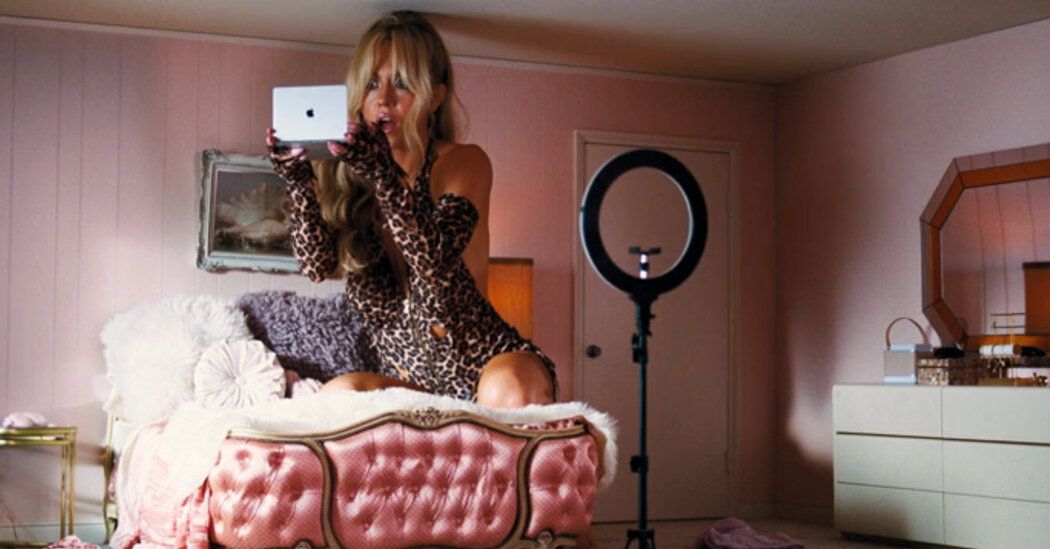
Cassie is following her dreams. From the comfort of her bedroom, she records foot fetish videos, purrs into a microphone, customizes panties, and tries out sex toys until she passes out.
“I'm not a sex worker,” she later tells a Hollywood director. “I am an artist who uses my body to tell stories.” This, he insists, is empowering.
Cassie, a heroine of HBO's spooky, high-style melodrama “Euphoria,” played by Sydney Sweeney, has reinvented herself in the show's third season, which concludes Sunday, as the creator of Onlyfans. She's not alone: While varieties of web modeling and virtual sex work have provided episodic arcs in past series as varied as “Broad City,” “Giri/Haji” and “The Good Fight,” this year the aperture of television cameras has expanded.
Important characters from multiple high-profile shows perform sex work in front of the cameras. Joining Cassie are actors from two recent Apple TV dramas: Margo (Elle Fanning), a teenage single mother who turns to camera work to get money for diapers in “Margo's Got Money Troubles”; and Trevor (Brandon Flynn), a debauched cam boy who drags a frazzled client (Tatiana Maslany) into a murder mystery in “Maximum Pleasure Guaranteed.”
In the fourth season of HBO's raunchy financial drama “Industry,” which premiered in January, a subplot concerns an on-camera character's past. Even the ABC comedy “Abbott Elementary” had fun, in its April season finale, with beloved second-grade teacher Janine (Quinta Brunson) briefly considering a side job at a site called Mostly Fans. And “Cam Boy,” a Canadian comedy-drama, continues its multi-season run on OUTtv.
Sex work of all kinds is already a staple of contemporary television. It was the driving force behind such prestigious shows as “The Deuce,” “P-Valley,” “The Girlfriend Experience” and “Secret Diary of a Call Girl,” some of which explored the relationship between sex and technology.
That relationship is long. Almost every new medium – from photography to film, video, the Internet, live streaming and video calling – has given rise to new ways of selling sex. Onlyfans, which hosts many types of content but is best known for pornography, now has more than 4.6 million creators and nearly 400 million registered fans. Given that proliferation, the migration of camera work into popular culture seems inevitable.
These stories give television creators the opportunity to fuse titillation with social commentary on economic hardship, evolving morality, and technological codependency. Juxtaposing extreme intimacy and necessary distance, capturing both the loneliness and convenience of life online, our screens are a source of isolation and its brief remedy.
“You pay a fee and you get some cuteness,” said David J. Rosen, creator of “Maximum Pleasure Guaranteed.”
a job is a job
Whether selling tenderness or not, sex work is big business.
Onlyfans alone made over $7 billion last year, even though the average creator makes just $131 a month. By taking this business seriously, if salaciously, these series also show at least a little of the work side: the grind of brand management and cultivating fans, even as these more mundane tasks often take a backseat. (Even “Abbott Elementary” gestured toward this, with Janine declaring, “The gig economy is hard work! I can't figure it out.”)
“Each show is pulling back the curtain on the work of content creation,” said Lynn Comella, a professor of gender and sexuality studies at the University of Nevada, Las Vegas.
Gracie Canaan, creator of OnlyFans and co-host of OnlyFantasy, an Audible podcast that explores the platform, wants these series to be stronger.
“Cassie, that's what people think Onlyfans is,” he said. “I'm buying lingerie, I'm building a little outfit, I'm finding my sexuality.” But most of the working hours are consumed by paperwork.
“You're looking at your Google calendar like any other job,” he said.
These shows suggest that it can be a pretty good job, at least for characters who may not have many other options.
Cammers can choose their own schedules, be their own bosses, choose their own work environments and clients, and, for the most part, control the online use of their images and identities. As with any job, there are trade-offs. Lauren Kirshner, author of “Sex Work in Popular Culture,” detailed a few: “Things like having to always be on the go, grueling schedules, the emotional exhaustion of performing, the emotional labor of looking for clients all the time.”
And yet, in these shows, camming is seen as no more exploitative than most gig work and is on a continuum with other aspects of online life, such as social media. Cassie crawling around in a sexy puppy costume? That was for his Insta. The more overtly pornographic work he does is arguably less degrading.
Or maybe it's all at least a little degrading, suggested Flynn, who plays the camera guy in “Maximum Pleasure Guaranteed.”
“There's definitely a conversation there about the times we live in,” he said. “How far does capitalism push us, to the point that we start giving up parts of ourselves?”
Less sensational but still stigmatized
In years past, chamber plots were typically short and presented as a quick side hustle or a way for characters to explore their sexuality.
In the second season of “Riverdale,” Betty (Lili Reinhart) put on a dark wig and turned on her camera. In Season 1 of “Euphoria,” Kat (Barbie Ferreira) briefly reinvented herself as KittenKween. But those characters abandoned webcams when they were matched with suitable boyfriends, painting their web adventures as aberrant.
“Now that she's back with her boyfriend, that's a much healthier option to explore her sexuality,” Reinhart told Vulture at the time.
Recent depictions are less sensational and more sympathetic, although a sense of risk and excitement remains. Although webcams are presented as more socially acceptable, a threat of exposure remains, reflecting reality.
“With a screenshot, you can find someone's identity,” Kirshner said.
“Margo's Got Money Troubles” makes good on that threat in a heartbreaking season finale episode. Comella described that stigmatization as “very, very real, so artists have stage names to protect themselves from some of those repercussions.”
“Which are not just the loss of friendships or family contacts,” he continued, “but the loss of custody arrangements and jobs.”
All of the characters on current shows distance what they do from strict pornography, at least at first, suggesting that a taboo persists. “It's about building a brand,” Margo insists.
“No,” his mother (Michelle Pfeiffer) tells him. “It's about giving people everything they need to decide that you're a piece of trash.”
In the end, Margo is confronted by sex worker friends about what one calls her “prostituphobia,” and they make her admit that her work is sex work, even as it celebrates it as a space for creativity and artistic creation. The question of whether or not webcams should be treated as pornography remains complicated even for some real performers, like Canaan.
“I'm not a porn star,” he said jokingly. “I'm a digital prostitute.”
But if these shows sometimes turn dark, the characters face no real repercussions, beyond social stigma, for their sex work. (Flynn's Trevor gets into trouble, big trouble, because he's not content with just camming.) And each series depicts web modeling as an opportunity for remunerative work and successful personal creation.
Aware of the work of real creators, Canaan hopes that young viewers, especially young women, will not confuse these shows with reality. Is a job that for most people barely pays the Internet bill really so enriching?
“I'm wary of any media,” he said, “that portrays it as a get-out-of-jail-free card and an overnight success.”