More than 20 years after lawmakers first told the California Energy Commission that replacement tires must be as energy efficient as the original tires, the agency is taking action.
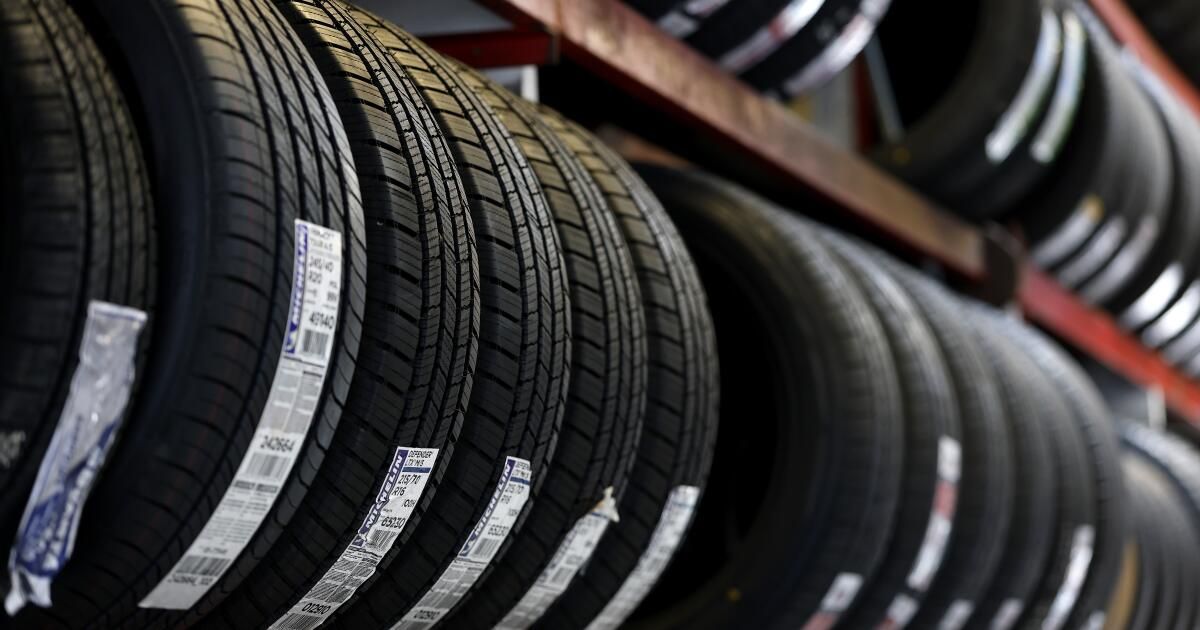
New car tires have low “rolling resistance,” which means there is less friction and resistance on the engine as it propels the car forward. That increases a car's total miles per gallon.
The public has until Tuesday to weigh in on a proposal that would require replacement tires sold in California to be as energy efficient as the average new care tire by 2031. California would be the first state with such a rule.
The effort comes as the Trump administration seeks to dismantle federal fuel economy standards and has blocked the state's ability to strengthen its greenhouse gas emissions rules for cars.
“At a time when the Trump administration is increasing harmful emissions and costs for drivers, this is a tool California has to reduce costs and clean up the air,” said Bill Magavern, policy director for the advocacy group Clean Air Coalition. “It does not require any approval from the federal government.”
The commission estimates that once the rule goes into full effect, drivers will save $153 over the life of their tires, after accounting for the higher cost of more efficient wheels, which add up to about $26 per set. By 2035, the rule would reduce annual gasoline demand by the equivalent of one to two months of a California refinery's annual production.
As for carbon dioxide emissions, they would be equivalent, annually, to taking 400,000 cars off the road, the commission said.
Many members of the public expressed their support at a public hearing Wednesday. But some said low rolling resistance tires are less safe and don't last as long.
In response to similar comments, the commission already included new grip standards in its proposal and produced a study that found that tire efficiency does not affect tire life. It also relaxed efficiency requirements for long-lasting tires.
People who race, collect cars, and buy ultra-high-performance tires for other reasons aren't happy either.
“As part of California car culture, enthusiasts who take vehicles to the track and enjoy a variety of higher grip and lower tread wear options would be disproportionately affected,” wrote commentator Tommy Wong. Trade and motorsports publications criticize the rule.
As for tire manufacturers and distributors, the industry is divided. Michelin, Discount Tire and electric vehicle tire maker Enso agree with the rule, but Goodyear, Yokohama and the California Tire Dealers Association oppose it, arguing that efficient tires would cost more than the agency's estimates.
Consumer Reports and the Consumer Federation of America said the agency's cost estimates were “well-founded” and that the rule was a “much-needed response to the affordability crisis.”
Ken Rider, an energy commission staff member, emphasized that people probably won't notice much difference if the rule is enacted because many cars on the roads already use these tires.
“There are a significant number of popular replacement tires that already meet [the requirements] that are safe, durable and competitively priced,” Rider said. “They are made through a variety of manufacturers, in a variety of vehicle shapes and sizes.”
A commission spokesperson said staff is considering further revisions to the proposal, which could lead to another round of public comment. Once the rule is final, it must be voted on by the commission.