One of the most magical and underrated natural wonders of the American West is about to unfold on the beaches of California.
Each year, in four-day periods from March to August, legions of small silvery fish called grunion ride the waves to the shore to perform mating rituals, beginning on the nights of the full and new moon.
But this is not just any spawn.
First, the females bury themselves halfway in the sand, leaving only their heads showing, and lay their eggs. The males then twist, turn and wrap around them. It's a strange and mysterious orgy that takes place in the dead of night. And everything is in public view.
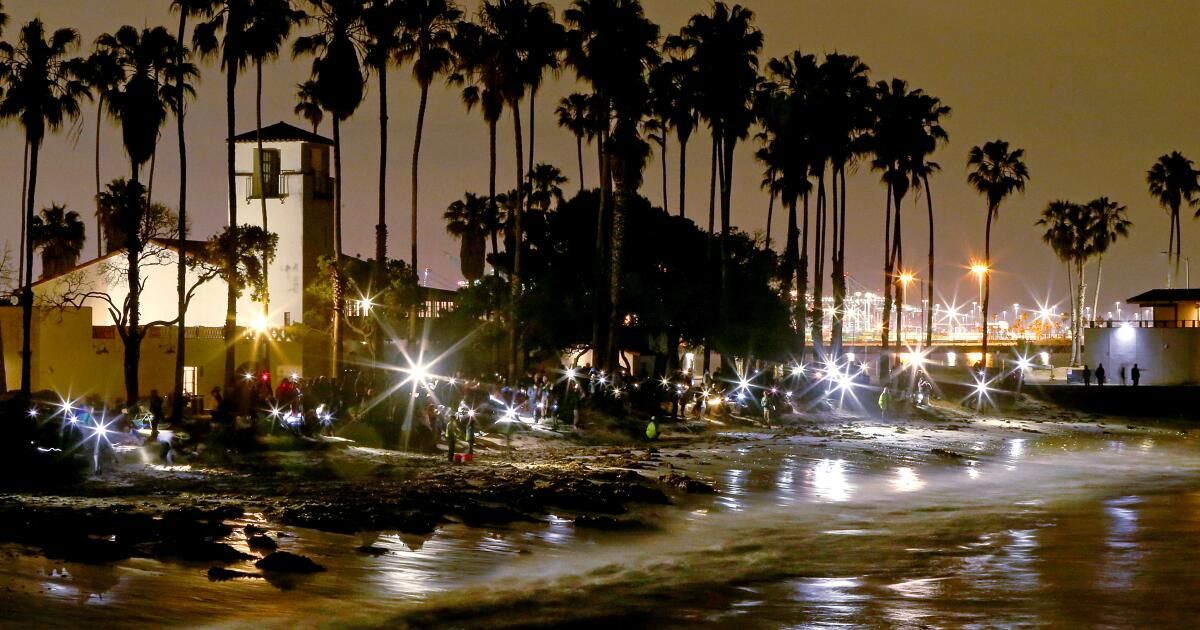
For some Southern California families, watching the grunion run is an annual summer tradition. There have already been several tours this year, with sightings reported from La Jolla to Ventura. Another is expected to begin Tuesday night.
When the grunions will be running
Grunion mate at Cabrillo Beach in San Pedro on June 5, 2023.
(Luis Sinco/Los Angeles Times)
This week's race is expected to run from Tuesday to Friday.
The fish remain on the sand for about two hours at night, when the high tide begins to go out, usually between 10 pm and 2 am. The second hour is when spawning picks up.
According to the California Department of Fish and Wildlife, the second and third nights of four-night tours tend to be the best to see grunion. The first night, Tuesday, is the least predictable.
The agency publishes a schedule of the days and times to expect the ritual, based on lunar cycles and the timing at San Pedro's Cabrillo Beach, a known grunion hotspot.
But everything varies.
“The further south you go, the grunions tend to show up a little bit earlier, and if you go further north, they tend to show up a little bit later,” said CDFW environmental scientist Malcolm Tunnell. “We don't fully understand this. They are a cryptic species.”
where to see them
Grunion is a native species and only lives off the coast of southern California and northern Mexico. Its usual distribution is from Santa Barbara to Baja California, although it has been moving north as climate change warms the oceans.
While you can expect to see grunion in Southern California, the exact beaches where they decide to spawn are a mystery, depending on the tides, sands, and conditions encountered by the scout fish that grunion send out before deciding where to mate.
“We typically say that if it's a surfing beach, they like the same surfing waves that people like,” said Karen Martin, a biology professor at Pepperdine University and a leading grunion expert. “But really, any beach that has a nice wide area where they can land is a potential beach.”
Martin runs a group where citizen scientists can report observations. He said this year the races have not been as abundant as in the past, but “there have been some good ones, even earlier this month.”
The CDFW recommends checking social media and calling local lifeguards to ask if grunions have been seen. Bait and tackle stores can also point you in the right direction.
What are the rules for fishing grunion?
Grunion face threats from coastal development, rising sea levels, changes in storm dynamics and hunting, Martin said.
Since the 1920s, populations have shown signs of intermittent decline. To protect grunion during their peak spawning period, CDFW prohibits fishing from April through June.
The season is now open with a limit of 30 per person; They can only be fished by hand and anyone over 16 must have a fishing license.
Flashlights should be used sparingly to avoid damaging them.
“Ideally you would just watch, but if you feel compelled to fish, maybe consider catch and release,” Martin said.
A fish that lives in such a limited geography, he said, needs our care.
“It's a really extraordinary fish.”