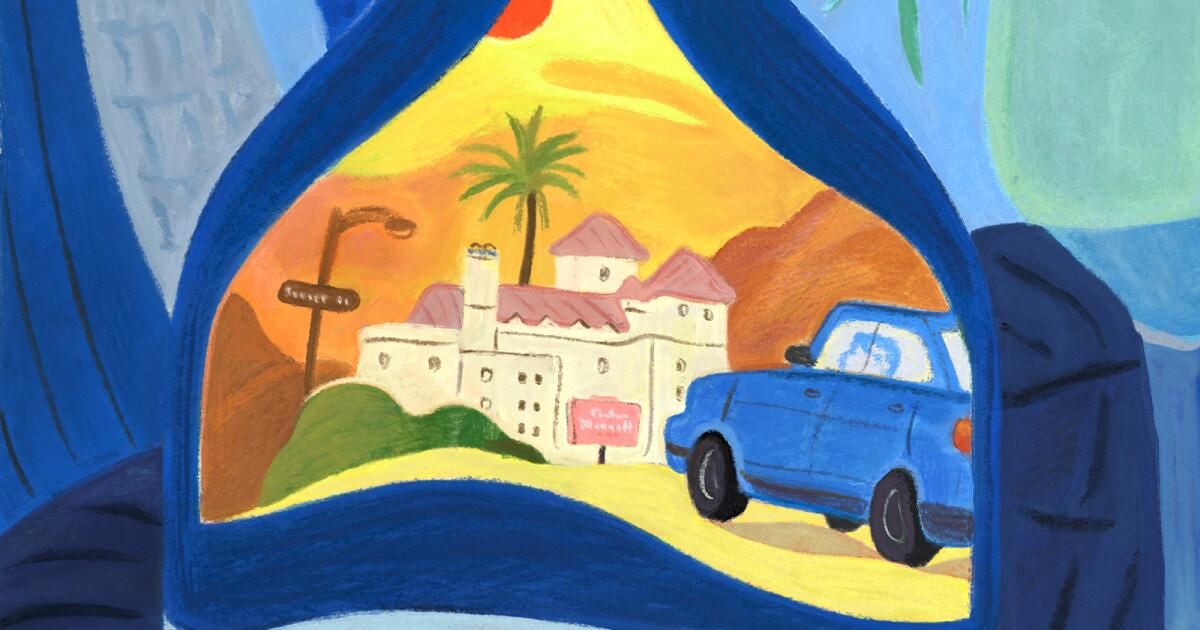
In 1994, weeks before I was born, my father was driving down Sunset Boulevard in a pale blue Jetta selling domestic and international wines at luxury restaurants and hotels. He was new in town, a salesman for American Wine & Spirits. Los Angeles had reached a fever pitch, still recovering from the Northridge earthquake. The OJ Simpson trial was about to begin.
Meanwhile, my father wandered from the Beverly Hills Hilton to Chateau Marmont, championing his best Chardonnays. He didn't have a cell phone, just a pager and good taste. He sold wine at Mezzaluna Trattoria, where Nicole Simpson had dined and Ron Goldman waited tables. He brought wine to the House of Blues, the red leather booths of Il Fornaio in Beverly Hills and Morton's Steakhouse.
In the 1990s, Los Angeles was experiencing what my father would call “the wine boom.” It still holds the title of one of the largest wine markets in the world. The largest is Vatican City, which, like Hollywood, is drunk on its own ancient melodramas.
The city was a favorable territory to convince men that they needed something they could not pronounce. The year 1994, the year of my birth, marked the long-awaited arrival of Bordeaux's collectible first-production wines of 1989, the best vintage since 1982. I never asked him which event he considers most important.
Los Angeles is a wine city. Sure, there's no shortage of cocktails: margaritas at dive bars, gin martini bars in Hollywood, and micheladas served at Dodger games. However, it is the wine that has stolen the heart of Sunset Boulevard.
Take it from famous enthusiasts like Francis Ford Coppola, who, according to my father, is a winemaker who is also a legendary filmmaker. In his classic film, “the godfather“, Michael Corleone watches a waiter uncork a 1938 table wine with tense anticipation. Coppola knows that each glass represents tradition, honor and family. All wine glasses are, really. The reasons we drink (to enjoy a moment for eternity, to enjoy the euphoria and pain of it all) are the same reasons we watch movies.
If you wanted to ruin your life on Sunset Boulevard, and quickly, my father might recommend a white Zinfandel. “The gateway drug to the 90s,” he affectionately calls it. Bubblegum pink, sweet, easy to swallow. His admirers would then find their way to Chardonnays and perhaps even cocaine, credit card debt and an appetite for infidelity.
This era of euphoria reached a crescendo, followed by an inevitable backlash. During the hangover, Zinfandels were considered poor quality and cheap. You can only be a star in Hollywood for so long.
Another good tip to follow at Chateau Marmont: don't be such a snob. Drink wine like Europeans. They drink nonchalantly, without pomp or circumstance. Also, bigger doesn't always mean better. Not all wines appreciate over time. In fact, my father often says that the best bottle of wine may be the screw cap that never arrives at your house.
At this time in his life, I imagine my father as a rolling stone and wine as his passport. His fluency with vintage wines took him to the dining rooms of Los Angeles and, later, to towns in France and Italy. Sometimes I wonder if my father was lonely like I am occasionally, like everyone else in Los Angeles. Ernest Hemingway's old quote is: “A bottle of wine is good company.”
Naturally, wine took up a lot of space in my childhood home. Bottles and corks filled any common living space. When I was 12, I used to design wine labels with colored pencils. I drew landscapes of vineyards and animals. I cut them out and glued them to empty bottles, lining them up along the mantelpiece at my father's eye level.
The Sunset Boulevard my father used to roam is not the one I inherited from him when I was 20 years old. Many of the restaurants have disappeared. Hollywood glamor has become outdated and kitsch. Iconic rock venues in Hollywood have since closed and their last glass of wine was served decades ago. There are no good parties anymore, my father might argue. Chateau Marmont, once synonymous with pleasure and late nights, today functions as a mausoleum of the golden age.
Hollywood and the wine industry were sometimes bedfellows. You may have guessed as much, but my dad has a concise view of the 2004 film “Sideways,” Alexander Payne's comedy about two men wandering through wine country. (It's a movie you could mention to my dad if you were, let's say, an idiot.) The film offers a few jokes. insults about merlot — one of the noble grapes, adds my dad. That year, Merlot sales plummeted, to the point that wineries ripped grapes from Napa vineyards. Naturally, this example of life imitating art distresses my dad.
Still, he is not easily offended. My father is intelligent, sentimental and talkative, characteristics that lend themselves well to selling wine. Proudly not a snob. According to him, every bottle of wine tells a romantic story. Wine is innately sentimental. Consider, for example, the vintage year of a bottle of wine. Then ask yourself: Where were you then? Was it the year of your first love? What have you lost since then? A bottle of wine is a time capsule from the past, my father maintains. It's a time machine in 24.5 fluid ounces. Enjoying the bottle is looking to the past, letting yourself be seduced by nostalgia in every sip.
According to my father, everyone asks the sommelier the wrong question. Here's one: will a white burgundy pair well with pan-seared monkfish? My father would say this is the best question: Do you enjoy wine? Do you like food? Do you like your company? If so, you're on your way to a beautiful evening. If not, no variation of the Grand Cru will save you. This is the closest my father comes to talking about his own personal doctrine. Life, like enjoying a bottle of wine, comes down to choosing good company to share it with.
Today, wine is less popular than ever. USA wine industrywhich has been facing a significant recession for years, lost $1 billion in 2025. I suppose that's partly due to its reputation for being a suffocating, out-of-touch concern for tedious people.
Wine bars in Los Angeles have adopted a new, arguably more offensive affection. They are great. Their menus are wines in contact with the skin, the labels are neon spots. The wine selection champions accessibility over tradition, an attempt to abandon the smugness of previous generations. In the process, she stumbled upon a completely new vanity. I think there is an inherent romance in the quest to understand something as elusive as wine. As generations begin to neglect wine, they ignore entire seasons, inheritances, patience: the reward of a harvest after a long winter.
When I feel nostalgic, I find myself in the wine section of a liquor store on Hillhurst Avenue, pointing out the wines harvested on Gehricke Road, where I grew up. Every once in a while, I feel a pang of sadness as I see my idyllic childhood reduced to a miserable wine label in the dead of night. However, once the bottle is opened, I know that everything that was once difficult will be incredibly sweet.