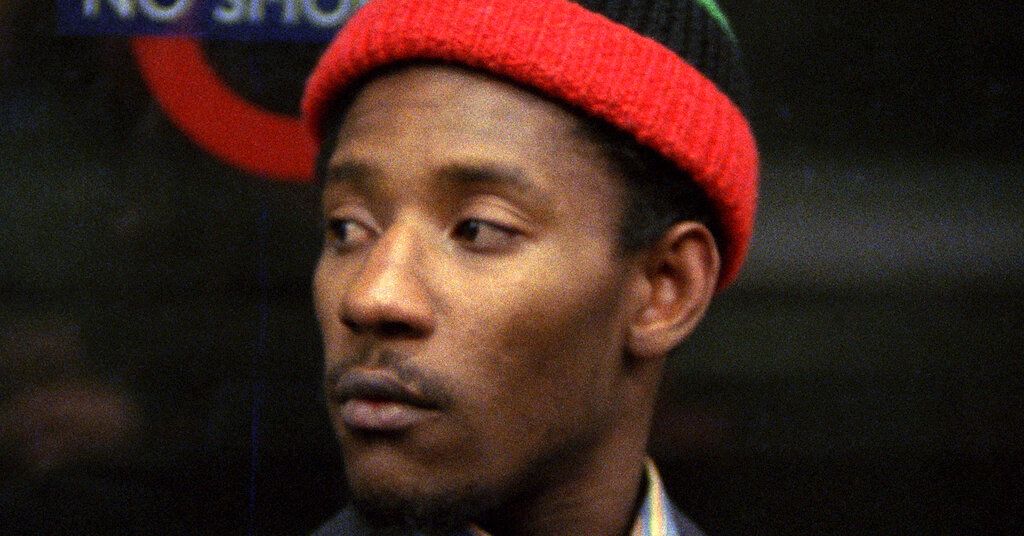
Early in the 1979 documentary “Dread Beat an Blood,” 27-year-old poet Linton Kwesi Johnson recites a verse outlining the challenges faced by Brother Buzza, a Jamaican-born character living in London: “De bredda say he's broke, he say he don't work / he say his wife is a breed, he say he don't even own a weed stick.”
Noting Johnson's Jamaican roots, a British journalist asks him if he plans to remain in Brixton, the south London neighborhood where the poet has lived since 1963. “England is as much my country as Jamaica,” Johnson responds in a gentle tone that belies the intensity of his words. “Most black people who come here dream of returning home. But we have a very important fight in this country right now, and I want to be a part of that fight.”
In the documentary, directed by Franco Rosso, Johnson performs and records verses from his poetry collection and album of the same title, with lyrics that vividly depict the racism and marginalization of black Caribbean immigrants in Britain. His recitation is backed by intricately layered, dub-infused reggae beats that established the subgenre he called “dub poetry,” a cousin of hip-hop that originated in collaboration with bassist Dennis Bovell and his stellar Dub Band. The works foreshadowed the violent clashes between Brixton's black migrants and the police in 1981 and after.
Johnson's work continues to connect with modern audiences. In 2002, he became the second living poet and the first black poet to have his work included in the Penguin Modern Classics series with the volume “My Revalueshanary Fren: Selected Poems.” And Johnson was asked to perform his “New Craas Massakah,” about the 13 young black men who died in the New Cross fire in 1981, for director Steve McQueen’s 2020 film series, “Small Axe.”
Over two conversations, in Brooklyn last September and by phone from Brixton this month, Johnson, 73, spoke about the documentary, his current work and what it's been like to witness younger generations discovering him. The interview was edited and condensed.
Having previously seen its original broadcasts on the BBC, have you had a chance to see the restored cut?
No, and I have no intention of seeing it either. What's really fantastic about all of this is that director Franco Rosso is getting some well-deserved attention. He didn't make too many films, but the two films for which he is known, “Babylon” and “Dread Beat an Blood,” are significant because they both offer snapshots of the black experience in Britain after World War II, the perspective of second-generation Caribbean immigrants in England. Franco deserves praise for taking the initiative to choose such themes for his films.
How did Franco Rosso get to know you and your work?
I was in the Black Panther movement, a young activist and one of the people picketing outside the criminal court when nine activists were on trial for rioting and incitement, following a demonstration against police brutality in Ladbroke Grove. Franco Rosso directed the original documentary about the “Mangrove Nine.” I released two poetry collections, “Voices of the Living and the Dead,” followed by “Dread Beat an Blood.” in 1975. I was part of the campaign to free George Lindo. [a Jamaican immigrant convicted of armed robbery based on a false confession obtained by police]. So Franco would have known me from those circles.
In “Dread Beat an Blood,” you explain that your poetic cadence is based on reggae bass lines. When writing, do you hear the bass line first or do the words dictate the musical flow?
I have always been interested in the language of music and music in language. When I write my verses, I try to highlight the musicality within the language and build everything around the bass lines. On my first three albums, “Dread Beat an Blood,” “Forces of Victory,” and “Bass Culture,” my late school friend Vivian Weathers played bass and on some tracks, it was Floyd Lawson. After that it was Dennis Bovell: Dennis was the producer, he did the mixing and we worked together on the arrangements of the songs. People think Dennis's bass lines are wonderful. [laughs]. They're my bass lines, but I couldn't make them sound as good as he did.
What motivated your decision to stop playing live with Dennis and the Dub Band?
I have a serious problem with my lower lumbar region. I can't stand for long without being in an uncomfortable position. When that music plays you can't stay still like a statue: at least you have to move your knees or shake your legs.
How did growing up in Chapelton, Jamaica influence your early life?
I grew up in the hills of Clarendon until I was 11, when I moved to England, and everyone there was involved in farming. We all had responsibilities, even if it was just feeding the chickens. It was the best moment of my life. That's where I absorbed elements of Jamaican popular culture that have stayed with me ever since. Folk songs, church songs, riddles and, at Christmas, Jonkonnu. [a traditional parade of costumed dancers accompanied by goatskin drums, shakers and bamboo fifes]. We had no radio, television or electricity, so we had to entertain ourselves.
You have said that your father was illiterate, your mother was semi-literate. Was there anyone around you who fostered your interest in poetry and writing?
No. My grandmother was illiterate and asked me to read the Bible to her. I came to like the language of the Old Testament, the Psalms in particular. Interest in poetry arose later. As a young Panther, I discovered African American literature. My original inspiration for becoming a poet came from WEB Du Bois’ book “The Souls of Black Folk,” the political poetry of Langston Hughes, Gwendolyn Brooks, and Amiri Baraka and the Last Poets. His speech was everyday African American speech, accompanied by percussion. I used to recite my poems with percussion in a group called Rasta Love, young Rasta people I went to school with.
Looking back at your work spanning the 1970s to the 1990s, how do the themes of political resistance and activism resonate in today's world?
It offers a historical perspective because I am from the past. [laughs]. People could understand something of the struggles we fought in England, how they corresponded to the anti-racist struggles being fought in the United States, and the sense of solidarity on different sides of the Atlantic. My journey through poetry and music was really a learning process through which I was able to record important moments, such as the New Cross fire or the Brixton riots.
When was the last time you sat down to write a poem?
Steve McQueen made a series of films called “Small Axe”; He asked me to write a poem for an article about the New Cross fire. That was in 2021 and it was very short, about eight lines. Before that I wrote “Reggae Fi Mama”, an elegy for my mother who was dying. Seeing my mother in Jamaica in 2019 and realizing it would be the last time I would see her alive was the inspiration for that piece. Some poets have to write a couple of lines every day but I only write when there is something that moves me to write.
What are you currently working on?
For the last 25 years I have had one ambition: to make an instrumental album with my own musical compositions and play the bass myself. I have completed that [an album titled “[Speechless]”]. Dennis Bovell helped me arrange the music and he mixed it. I might release it as a limited edition next year, or maybe it will be published posthumously. That was my big goal, so I don't have any artistic ambitions anymore. I've done enough, so my biggest ambition in life right now is to reach a state of complete satisfaction, to be at peace with myself.
How does it feel to see a new generation discovering your work?
It's great to have people who make you bigger in your old age. They better do it while you're alive because when you're dead, who cares?