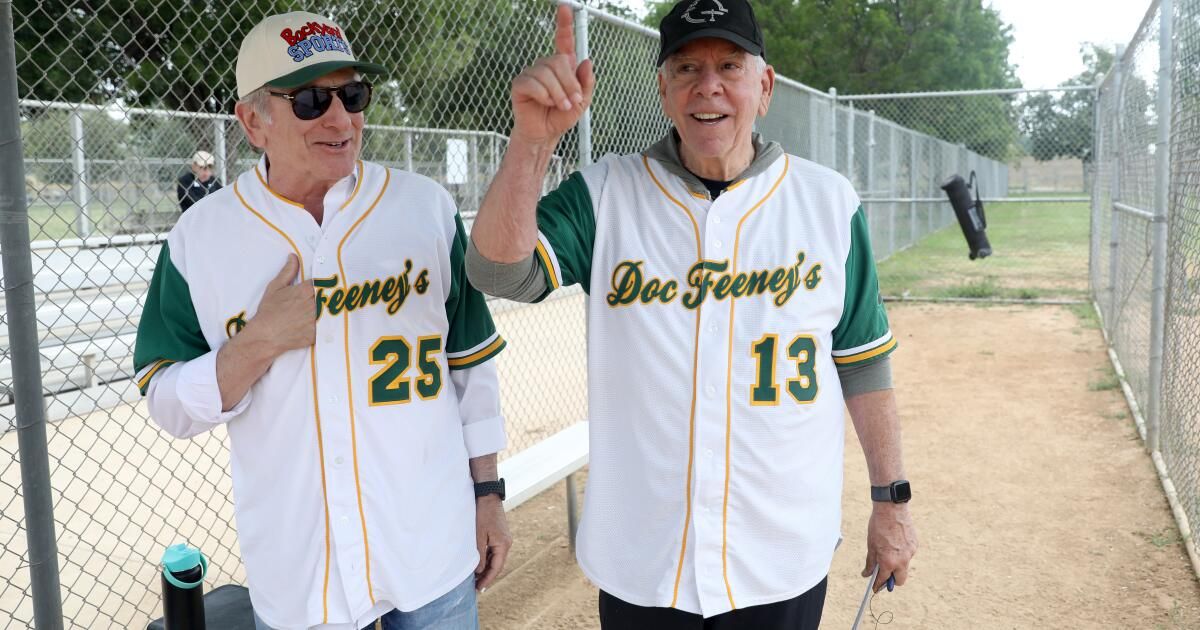
As Al Michel and Mike Sugerman tell it, their Los Angeles softball team's first performance was filled with “geeks,” “nerds,” and “dummies.”
So they took a name straight out of National Lampoon, a humor magazine that included “Doc Feeney's Scrapbook of Sports Oddities,” which featured outfielders catching 40 feet in the air and giving swimmers tips on proper drowning maneuvers.
“I'm thinking we're not a group of athletes, we're a group of geeks,” said Michel, the team's co-founder, current coach and catcher, reflecting on the loose group of UCLA law students, aspiring actors, accountants and other semi-athletic misfits. “Sports oddities? I thought, well, that's not going to work… Let's go with 'All Stars.'”
And so, in the spring of 1976, Doc Feeney's All Stars was born. Fifty years and thousands of careers later, six of the original players still take the diamond almost every Sunday, swinging for the fences. And if visitors come from out of town, the ranks of the veterans grow a little more.
On a recent wet Sunday afternoon, the score was 16-16 going into the final inning. A powerful home run in the bottom of the sixth by Aaron Krug (at 36, a young man by Doc Feeney's standards) had tied the game against the Six Pack at the Sepulveda Basin Sports Complex in Encino, one of the many fields in Los Angeles that the Feeneys have graced over the last half-century. The cohort of players, mostly in their 70s, in the dugout rejoiced, waving their caps and shouting.
This was no old Sunday showdown in the Los Angeles Municipal Softball League: The Feeneys' jerseys featured black patches embroidered with “JBK” for Jamie Bailey Krug, the first of the original founders to return to their base in the sky.
This game was a tribute dedicated to Krug, the patch a reminder that being a Feeney was never about sports anyway.
“Jamie taught me what a best friend is,” said second baseman Richie Greenberg, another Feeney parent. “I never knew that a best friend was someone you would never get tired of or never stop missing.”
Jeff Koppelman, 72, 48 years on the team, throws a pitch during a slowpitch softball game against Six Pack at the Sepulveda Basin Sports Complex in Encino.
(Gary Coronado / For The Times)
Jamie's son, Aaron, is one of a new generation of All Stars, some of whom grew up watching their fathers' games from strollers or in their mothers' arms.
“Every town in this country has a group of morons who get together every Sunday and who have done it all their lives, who love each other and each other's children, and who, for some miraculous reason, believe that this will continue with the next generation,” Greenberg said. “We are tied to this… It holds us.”
The Feeney Story, Told by the Founders
Feeney Ball's first season was a resounding success, despite all the strikeouts and blown catches in between. The championship game was a lawfare fight: Michel, then a lawyer in training, noticed that one of the opposing team's batters was using a baseball bat instead of the regulation softball bat with a smaller barrel. He kept this fact close to his chest until the other team went ahead in the seventh, final inning.
“The other team is celebrating, thinking they won the championship, high-fiving all over the place,” Michel said. “We call a timeout, point at the bat, and the umpire comes over and says, 'Oh yeah, that's illegal.'… It counts as one out and we win the game.”
“The only way to win like a Feeney,” Sugerman added.

Doc Feeney's All Stars pose for a team photo, circa the late 1970s.
(From Doc Feeney's All-Stars)
Another season, outfielder Craig Simon, knowing he was weak at the plate, intentionally struck out to avoid an impending double play, much to the dismay of the opposing team.
“Another Feeney classic,” Greenberg said.
No one expected the Feeneys to last half a century, but with each passing winter and spring, the team returned to the diamond, albeit with a rotating cast.
Krug, Michel and Greenberg were almost Sunday constants; Sugerman moved to San Francisco to become an award-winning correspondent on Bay Area radio, but always found a spot when he visited; Howard Lesner and Matt Kaplan became regulars in the 1980s; and other Feeneys faded into time, trapped as a memory of whatever decade they left behind.
At LA Municipal Softball, a grading system is in place to facilitate fair competition. The Feeneys ranged between C and B over the years, with a plus or minus depending on how much time had passed since the founding. About a decade ago, the team was defeated by a B-minus team in its first game after being upgraded, realizing that the senior's eyes could no longer keep up with the pace the B-minus bats were giving off.
“I couldn't even see it coming,” Michel said.

Doc Feeney All Stars players, from left, Jonny Ehrich, 36, Richie Greenberg, 72, Joel Gerson, 37, and Aaron Krug, 36, warm up before a slowpitch softball game. Greenberg has been a mainstay of the team for 49 years.
(Gary Coronado / For The Times)
Because the team has survived for so long, each Feeney has had his day: double plays, home runs and batting averages (think .450) that would make Shohei Ohtani look like a Triple-A backup. But that's not what brought the players back.
“I've had a great life and a nice life, but no sense of bond or family,” Kaplan said between innings as the dust on the plate lingered and tears flowed from who knows what. “This became my family… This gave me what I was missing.”
The legends surrounding the team can sometimes get confusing. On a recent day, outside the Apple Pan burger joint, one of Krug's favorites, Michel, Greenberg and Sugerman, all in their late 70s, argued over Feeney's story:
“Who was the one who was kicked off the team for being too competitive?”
“Did you marry the girl in this photo?”
“He never hit a home run in his life.”
“That guy was kind of an idiot.”
“Do you think so? I thought I was nice.”
But all these questions led to the same inevitable conclusion.
“Who cares, he was a Feeney.”

Doc Feeney's veteran All Stars, Richie Greenberg, from left, Todd Lesner and Jeff Koppelman, all 72, sit together as team rookie Matt Michel, 33, works the lineup. The trio has played on the team for almost 50 years.
(Gary Coronado / For The Times)
The new generation of All Stars
The weekend he died last May, Jamie Krug had planned to play on Sunday after attending his grandson's musical performance on Friday and going out to dinner with his wife, Simone, and friends on Saturday. Krug listened to the music and enjoyed a nice night, but never made it to Sunday's game.
The All Stars won, but on Monday they learned that Krug had gone to sleep and never woke up. Cardiac complications.
Family and friends remember Krug as many things: a reliable laugh, a godly father, an excellent second baseman, a competitive but selfless coach. At his funeral, his wife recalled, almost every speaker called him their “best friend.”
Although some of the wives didn't bother going to the games every Sunday, Michel said, many of the children saw the Feeney parents as true heroes. When she finally turned 14, Krug's daughter Ali broke Municipal League barriers when she became the first woman to appear as an All Star.
“My whole childhood was centered around baseball,” Ali said, remembering playing with his father. “He set up these scenarios that were like, two outs, bottom of the ninth, World Series, bases loaded; he'd hit a fly ball and I'd catch it.”

From left, Matt Michel, 33, Aaron Krug, 36, and Joel Gerson, 37, high-five after a Doc Feeney slow-pitch softball game. Michel's father, Al, and Krug's late father, Jamie, are original members of the team.
(Gary Coronado / For The Times)
Aaron, whose home run returned the Feeneys to the memorial game, also joined the team at age 14, playing alongside his father when he wasn't too busy with his own sports schedule.
“Playing with your dad,” he said. “It's hard not to get romantic about it.”
Michel's son, Matt, has tried to modernize the team with a scoring application that has proven more reliable than Michel's antiquated paper method.
“They used to pay me $20 to keep track,” Matt said. “I don't have to pretend anymore, though.”
The game plan in a modern Feeney game revolves around strategically placing seniors in the batting lineup to avoid having two quick strikeouts or slow runners on base. Although the Feeneys have become more competitive under young Michel, the original team's on-field rascal spirit still prevails.
“The combined age of every Feeney in the box could be 350 at any given time,” Lesner said before addressing the box.
Earn like a Feeney
Due to some sloppy defensive errors by the silver-haired infielder, the Feeneys allowed more runs in the top of the seventh. The Six Pack led, 18-16.
The Feeneys were in precarious waters when Greenberg came to the plate with two outs. By the memorial game, the Feeneys had reverted to their old batting order, so after Greenberg, the lineup would be composed entirely of Feeney seniors.
For the first time in the entire game, all the players glued their eyes to the plate, conversations and presentations stopped mid-sentence.
Greenberg did his best to ignore a nagging ankle injury that had plagued him for the past few weeks and grimaced in the hazy sunlight as the pitcher, probably 20 years or more his junior, stared at him.
The tone of the high bow increased.

Jeff Koppelman, 72, drives in a single during a slow-pitch softball game. He has been a member of Doc Feeney's All Stars for 48 years.
(Gary Coronado / For The Times)
Greenberg threw back his bat, looking like a young Ken Griffey Jr. He hit the ball hard, but it sent a bounce right toward a third baseman who was no older than 40. Greenberg only made it halfway to the base.
Out at first.
The Jamie Krug memorial game ended in a loss.
But instead of kicking up dust, breaking bats or attacking, the Feeneys gathered together in a green and yellow mass behind the dugout. They all high-fived each other, wondered about each other's families, and went to fuss over Ali's 1-year-old daughter, Krug's granddaughter, Eloise, who was wearing a T-shirt depicting 50 years of family and friendship. It says, “Littlest Feeney.”