Just north of Los Angeles, Evan Chambers The glassblowing studio emerges from a small warehouse district like a scene from “Alice in Wonderland.”
In this series, we highlight independent makers and artists, from glass blowers to fiber artists, creating original products in and around Los Angeles.
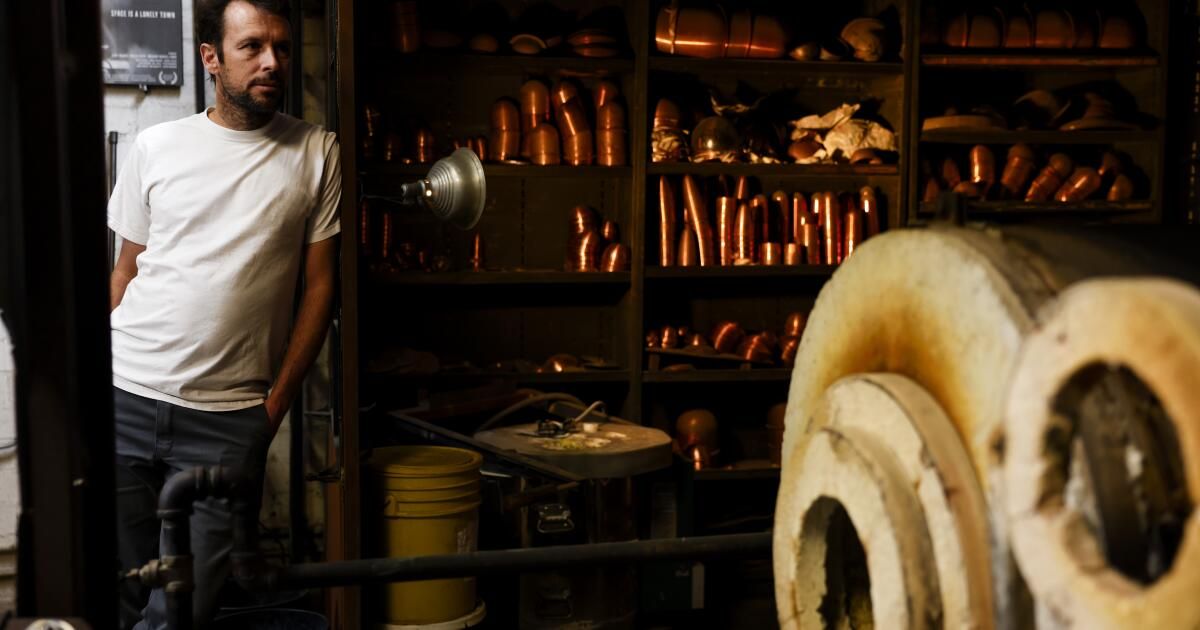
Beneath the skylight of a 10-foot industrial roof is a cold, foreboding blacksmith's forge, which, on an active day, would heat up to 2,500 degrees, surrounded by uncut conical metal jigs awaiting handling. On a nearby workbench, sea mine-shaped lamps sit atop metal molds of falcon legs next to caged bubble glass lanterns that look ready to burst from the internal pressure. Outside is a serene garden under a canopy of branches supported by iridescent copper bells, all handmade.
Sitting in a weathered wooden chair in the garden on a cool Tuesday afternoon, Chambers, 43, a professional glassmaker and goldsmith, reflected on his old-fashioned craftsmanship. He said his medium may have peaked during the Art Nouveau movement of the turn of the century, which saw an embrace of organic forms and a rejection of the mass-produced monotony of the industrial age.

Evan Chambers walks through his studio.
“Now all those artists and all that art are gone,” Chambers said, looking toward his studio, which houses dilapidated Louis Comfort Tiffany lamps. “I feel like I'm trying to recreate this time that I could never quite understand.”
There have been many other moments that Chambers couldn't fully understand: the moment his parents sold his childhood home, where he began to love art; the time his sister moved from Altadena, which she called the “perfect place,” to pursue glassblowing; and the time when, when his hometown was consumed by the Eaton Fire, he felt the authorities did little to help.
But if there's one thing Chambers does understand, it's that it lies somewhere deep in the dark steel “glory hole” of a forge.
“You see a piece of glass from 120 years ago, when there was real craftsmanship, and you think, 'You know, this is cool,'” Chambers said. “Being able to achieve it and then take it in your own creative direction, I like that challenge… It's like a game.”
Chambers, who grew up in working-class Altadena as the second child of a silversmith mother and a metalworker father, both with a master's degree in art and an aversion to television, spent much of his life immersed in Pasadena's robust arts and crafts scene in the early 2000s.

Evan Chambers in the garden of his studio.
“[In Pasadena,] There were artisan houses and ecological houses. … Seeing those houses and all the exterior lanterns with all this beautiful glass work and iridescent copper, I think that influenced my art,” Chambers said. “Altadena more informed the person I wanted to be.”
Unlike some of his artistic peers, who idealized studios and showcases in New York or Europe, Chambers never wanted to leave Altadena. “Altadena has always been a creative place, quite full of eccentrics and accepting of them,” he said. “When my sister went to college, I was sobbing and thinking, 'How could you move?'”
As defiant teenagers often do, Chambers abandoned the family profession and was admitted to Cal Poly San Luis Obispo as an agricultural business major. Admittedly, Chambers only spent three years before switching to English and starting working in an unconventional glassblowing studio.
“Going there was like the most beautiful place ever; very pastoral, it blew my mind,” Chambers said. “There are all these glassblowers there, and they're doing all this nature-inspired work, and then I ended up five years there.”

Evan Chambers holds up a template for his “snail boy” piece.
Many of Chambers' projects focus on the interaction between the natural and the practical. In a lamp in the studio, tentacles hold cylindrical copper needles with underwater-style mirrors to reveal a small light bulb inside. Glass vases with unnatural blue, green and gold metallic finishes are drowned in palm leaf motifs, ready to be bloomed.
Theodora Coleman, owner of the independent Gold Bug gallery in Pasadena, who has represented Chambers for nearly two decades, said she feels Chambers' metal work harkens back to epic journeys in literature, fitting appropriately into a world created by people like French writer Jules Verne. His glass work, he said, is considered preeminent by Tiffany historians, who do not often find artists who can authentically reproduce the brilliance of time-worn glass.
“There's some whimsy to it, but I think there's also something that can be incorporated into a more contemporary setting,” Coleman said.
Near the end of college, working in a glass studio without pay or financial support from his parents, Chambers used his craft skills to build a treehouse near his campus in which he lived for two years to avoid rising rent costs.
“I wanted to spend more time in nature and I wanted to be able to spend all the money I was making renting time in a glass studio,” Chambers said.
He would eventually meet his wife, Caitlin, then an English student at Cal Poly. Not long after, he was able to ditch the cold, insular treehouse for a beachside house his family owned in the area.

Evan Chambers' glass vases are displayed in his studio.
“I think he was about 24 and I'd never met anyone who talked about beauty like he did,” said Caitlin Chambers, now an English professor at ArtCenter College of Design in Pasadena. “I don't think it's typical for young men to say, 'This is beautiful.' I remember thinking, 'Wow, it's so nice to hear someone who is that kind of in tune with the world.'”
Around that time, Chambers dedicated himself fully to seeking mastery of an art form buried less than a century ago. As he recounted the odyssey, more than 20 years of practice could be traced through several stains and burn scars on his arms.
“Everything else falls away,” Chambers said. “All my anger fades away and I just focus on the thing.”
But that latent rage would eventually return, to the point that his art became secondary. Years after resettling in west Altadena with Caitlin and having two children, Edie, 9, and John, 5, tragedy struck the picturesque family home: the Eaton Fire.
The handling of the Eaton fire is the subject of an ongoing investigation. dowicked rrights investigation by the California Department of Justice. Victims of the fire in the historically black community of west Altadena have alleged discrimination by emergency services that resulted in 14,021 acres burned, 19 deaths and 9,000 buildings destroyed, one of them Chambers, over the course of the 25-day fire.
For the next year, Chambers barely worked. Coordinated with neighbors to help with fundraising projects; searched for art and jewelry for neighbors in vacant, charred lots, desperately trying to restore those pieces; and protested on the lawn of the fire department and sheriff's department, calling for a thorough autopsy of what went wrong in west Altadena during the fire.
“Accountability is very important to me,” Chambers said. “The people of western Altaden were literally burning their houses… It's not right.”

A close-up of an artwork by Evan Chambers.

Metal annexes that Chambers will use for future work.
This stubborn defiance is also present in Chambers' commitment to the “golden age” of decorative art. The turn-of-the-century molds in his studio, which use botanical motifs, blooming forms with metallic floral and winged accessories, look like desk ornaments worthy of an early 20th-century eccentric obsessed with Darwinism and industrialization.
“He [Art Nouveau] “The movement was a reaction against the Industrial Revolution and automation,” Caitlin said. “We could be in that kind of era, which, thanks to AI, is a resurgence of handmade. … He is part of that.”
On his website, Chambers' pieces range from $1,550 for the “opium-consuming baby” lamp to $12,500 for the “sterling opium lamp.” Its organic shapes, including a glowing cicada and a whale lamp, cost between $2,000 and $4,000.

Evan Chambers surrounded by lamps he created.
As Altadena began the arduous task of fire recovery, Chambers and his wife stumbled upon an opportunity reminiscent of the free treehouse he built in college: a 2,400-square-foot Craftsman-style home in Hollywood that was set to be demolished. The house was purchased for $1 from the developer, sectioned and transported on flatbed trucks to Altadena. It was cheaper than buying a new house, Chambers said.
“It was a time in Altadena where if someone needed something, it was very open,” Chambers said. “I never wanted to leave.”
As he sat under a shaft of natural light in his studio, with his creations staring back at him through a hundred radiant eyes and mirrors, Chambers sat hunched over. He said he didn't know how close he would come to fully understanding the era he was pursuing in his art, but behind him, decade-old soot on the edge of the dormant forge indicated that another era of craftsmanship might have gone unnoticed.