The wonderful novelist and food writer Laurie Colwin once warned against serving rapini on a first date. (Although one could argue for its healthy winnowing effect.)
In my own home I saw a dinner guest assiduously remove every piece of radicchio from his salad. Since then, I have tried not to serve bitter vegetables to guests unless I know they “get” them.
I have a particular love for chicories, the bitter lettuces, which include chicory (red, pink, green and speckled varieties), escarole, escarole and dandelion leaves, not to mention all the dark-leaved varieties of chicory that Italians consume, such as dente de leone, spada and the strange, crunchy, not-so-leafy many-lobed bulb called puntarelle.
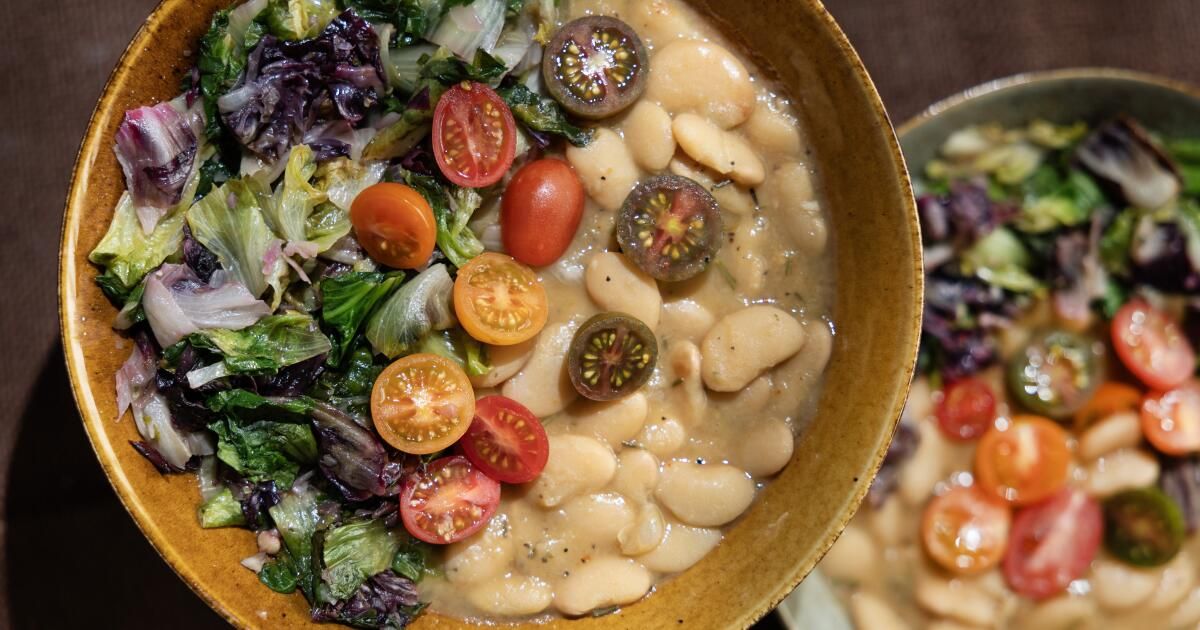
A quick sauté of vegetables before combining them with broad beans.
(Myung J. Chun / Los Angeles Times)
There are also bitter brassicas like rapini and its milder cousin, spigarelli; more kale; collards, turnips and mustard greens, which get their bitterness from glucosinolates, natural chemicals that evolved to defend plants against insects, herbivores and diseases, but they fail to deter us humans who have a taste for strong flavors.
The bitterness of chicories comes from the chemical compound lactucopicrin or intybin, which is their natural defense against disease and predators, and is also said to be a mild sedative and mild pain reliever. It's in the white “milk” you sometimes see when cutting lettuce and its bitter counterparts. When I was a child, my next-door neighbor, a woman from Sinaloa, Mexico, told me that she boiled lettuce leaves, cooled and strained the liquid, and then gave it to her babies to put them to sleep.
Of course, once they can make their preferences known, children often reject bitter vegetables. These strong leafy vegetables are clearly to the taste of adults, although not all adults like them. But many of us have come to appreciate, even desire, that bitterness in tolerable doses; how we like dark chocolate, black coffee, IPAs, quinine drinks, not to mention serious novels and movies with not-so-happy endings.
And how do I like my vegetables bitter?
Beans and vegetables! What is simmered for a long time and what is stir-fried quickly! Cranberry beans and dandelion greens. Cannellini beans and endive. Chickpeas and rapini. And on a hot summer day, there's fresh arugula with white beans and cherry tomatoes. Together in a bowl or plate, beans and greens have enough complexity and umami to please carnivores and vegetarians alike.
One of my favorite preparations is large, dried limes cooked to cloud-like softness with one or more bitter greens.
There's something delicious yet bold about the combination of big, smooth, creamy limes with the addictive, compelling bitterness of chicory. (Think gentle Jane Eyre and surly Mr. Rochester! Lively Lizzie Bennet with aloof Mr. Darcy!)
In short, a daring, dynamic and convincing mix.
Time 2 hours (or 1 hour if using pressure cooker) plus 6 hours for beans to soak
Yields Serves 8
After the bitterness, a little sweetness is in order. Something in keeping with the rustic, adult pleasure of the main course. Maybe a simple cake, like the one I ate years ago in the café at the Louvre… yes, that Louvre. I forget the savory dish I had for lunch, but I will never forget the only dessert on the menu that day: the anana tart.


1. Michelle Huneven's pineapple pie comes out of the oven in the LA Times Food test kitchen. 2. The finished pineapple cake. (Myung J. Chun / Los Angeles Times)
Pineapple? Was that what I thought it was?
Pineapple? Actually? In a cake? This was new to me. OK. I would try it.
The pie crust was barely there, just a buttery whisper beneath the fruit. The thinly sliced pineapple was caramelized in spots. Cooking had concentrated its sweetness and flavor so that this small portion had a brilliant explosion of flavor. Unforgettable.
It turned out to be easy to make and the perfect, sunny answer to those big, soft limes and deep, bitter greens.
Time 2 hours
Yields Serves 6 to 8 servings