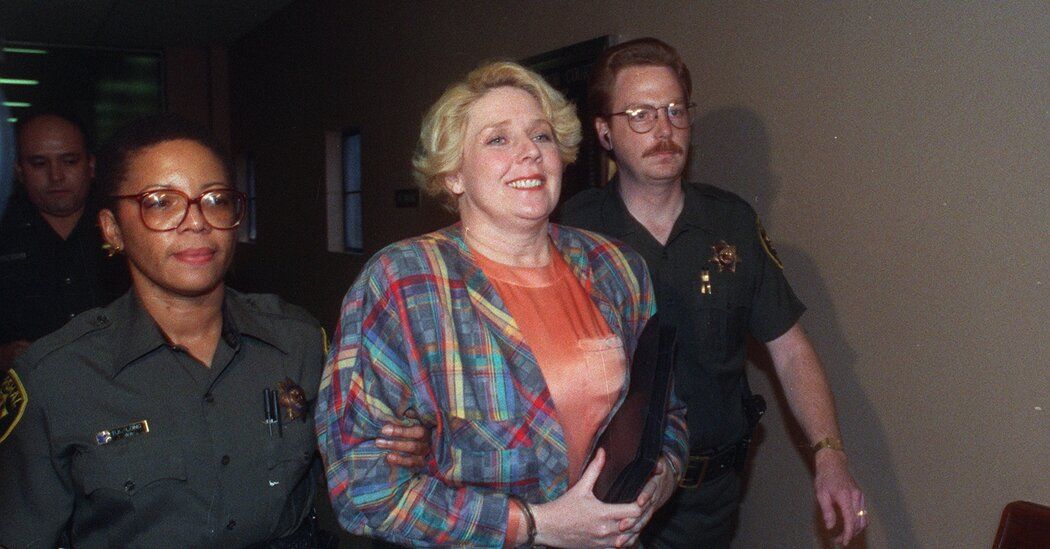
Betty Broderick, who shot and killed her ex-husband and his new, younger wife in 1989, a double murder that, with its overtones of marital betrayal, obsession and revenge, was the subject of headlines, TV movies, talk shows, a podcast and at least five books, died May 8 in San Bernardino County, California. He was 78 years old.
Her death, at a hospital to which she had been transferred last month from the California Institution for Women in Corona, in her 37th year of incarceration, was confirmed by the California Department of Corrections and Rehabilitation. No cause was provided.
On November 5, 1989, Ms. Broderick entered the home of her ex-husband, Daniel T. Broderick III, a prominent San Diego malpractice attorney, and Linda Kolkena Broderick, a former flight attendant who became his legal assistant and, while still married to Ms. Broderick, his mistress, and shot them in bed with a .38-caliber pistol.
Ms. Broderick, then about to turn 42, immediately surrendered to police and never denied firing the fatal shots at her ex-husband, 44, and his second wife, 28. But she denied committing murder, claiming in media interviews and in the courtroom that she had been the victim of years of psychological abuse.
His two trials — the first ending in a hung jury and the second with a conviction on two counts of second-degree murder in 1991 — turned on whether the shootings had been premeditated or were a spontaneous outburst after a long period of what Broderick described as mental torture.
Her anger at being wronged and her desire for revenge became a mirror in which many ex-wives who had also gone through hostile divorces glimpsed themselves.
Broderick spoke to magazines and newspapers before and after her trials, and appeared twice from prison on “The Oprah Winfrey Show,” venting angrily about her husband.
“He left with the fool at 40, driving a red Corvette. Haven't we heard this before?” he told the Los Angeles Times three weeks after the murders.
She claimed that Mr. Broderick, head of the San Diego County Bar Association, had used his wealth and legal connections to gain custody of her four children and deprive her of a fair financial settlement when they divorced in 1986.
“His was the way of hitting you from the white collar,” Broderick told the New York Times between his trials. “If he had hit me with a baseball bat, I could have shown people what he did and made him stop.”
In San Diego, where the couple was once socially prominent and lived in a five-bedroom house in the affluent community of La Jolla, there was much sympathy for her.
“She worked hard to help her husband finish medical school and law school,” one letter writer told the San Diego Tribune. “How did he reward her? He traded her for a younger model.”
In the years before the fatal shootings, Ms. Broderick's behavior had become increasingly volatile. When she first suspected her husband of cheating on her, she burned her clothes in the backyard.
He moved out in 1985. After that, she spray-painted the inside of his new house, rammed his front door with her car and left vulgar messages on his answering machine. He obtained a temporary restraining order and held her in a county psychiatric hospital for three days.
At her first trial, mental health specialists called by both the prosecution and defense testified that Ms. Broderick was narcissistic and histrionic. Melvin G. Goldzband, a psychiatrist who testified for the prosecution, refuted her claims of emotional abuse.
“She didn't want to be rejected,” she said, adding that she would have been angry even if her husband had agreed to an extravagant monthly support agreement.
“People prolong battles because it's the only form of relationship they have,” Dr. Goldzband said.
Ms. Broderick was sentenced in 1992 to the maximum possible sentence: 32 years to life in prison. He was denied parole twice.
Elizabeth Anne Bisceglia was born on November 7, 1947 in New York City, one of six children of Frank and Marita (Curtin) Bisceglia. His father owned a family plastering business founded by his father in 1908.
He grew up in Bronxville, New York, and attended Mount Saint Vincent College (now University), a Catholic institution in the Bronx.
She met Dan Broderick, the oldest of nine children in a Pittsburgh family, when he was about to enter Cornell medical school in Manhattan. They married in 1969. After completing medical school, Mr. Broderick decided to pursue a law degree at Harvard and enter the lucrative new field of medical malpractice law.
The young couple and their two children moved to San Diego, where Mr. Broderick's career flourished, two more children arrived and the couple was welcomed into elite social circles. They bought a ski condo in Colorado and dug a pool in the backyard.
But even before Mr. Broderick began an affair, Mrs. Broderick was unhappy in the role of socialite and mother, and her family's privilege seemed to bring her little pleasure.
“Mom was always a little weird,” her daughter Kimberly Broderick Piggins told The Los Angeles Times in 1990. “Mom got mad at Dad all the time. One time, Mom picked up the stereo and threw it at him. And she left it outside all the time. He would come up to my window and whisper, 'Kim, let me in.'”
In addition to Mrs. Piggins, Mrs. Broderick's survivors include two sons, Daniel and Rhett; another daughter, Kathy Broderick; and seven grandchildren.
Broderick and the murders have had a long hold on pulpy pop culture. A 1992 CBS television movie appeared in two parts, starring Meredith Baxter. The first installment, “A Woman Scorned: The Betty Broderick Story,” for which Baxter was nominated for an Emmy Award, was followed by “Her Final Fury: Betty Broderick, the Last Chapter.”
The story was adapted as the second season, broadcast in 2020 on USA Network, of the anthology series “Dirty John,” with Amanda Peet as the abandoned Mrs. Broderick and Christian Slater as her adulterous husband.
Los Angeles Times reporter Bella Stumbo wrote a book about the case, “To the Twelfth Never,” in 1993, a year after Bryna Taubman’s “Hell Hath No Fury” was published.
In 2020, the Los Angeles Times produced a podcast series, “It Was Simple: The Betty Broderick Murders,” which included interviews with defense and prosecution attorneys and the jury foreman.
The title was ironic; Nothing in Mrs. Broderick's story was as simple as it seemed. At his second trial, prosecutors played a tape of his son Danny, then 11, pleading with him to stop tearing the family apart with his destructive behavior.
“You want everything,” he said. “You want all the kids, all the money, to get rid of Linda, and that's not going to work, Mom. You've been mad too long already.”
Ms. Broderick responded: “No, I haven't.”