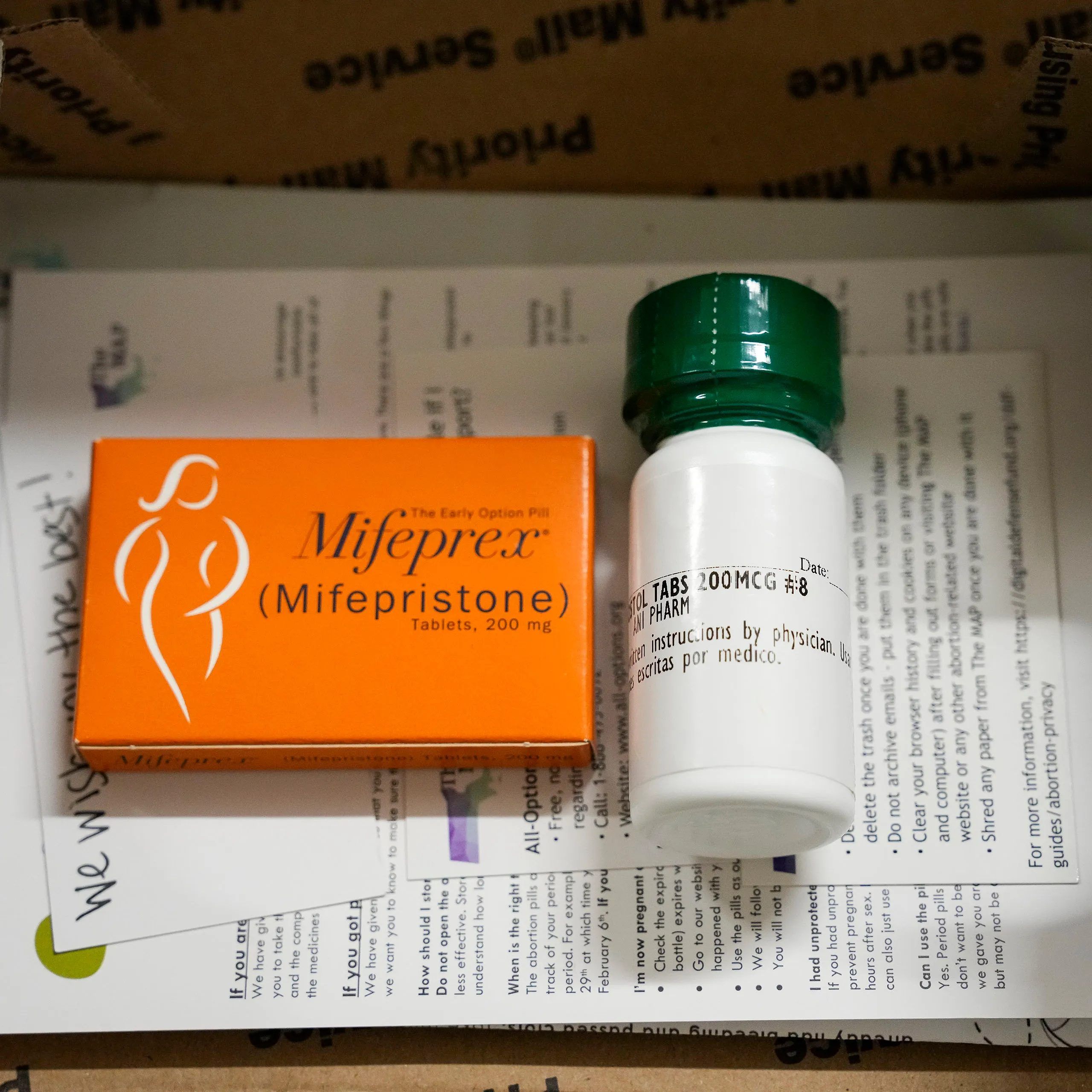
When Gov. Gavin Newsom, using his executive power, refused to extradite a doctor accused of prescribing and mailing abortion pills to a Louisiana woman, he said California would “never” allow “extremist politicians” to punish its doctors.
Newsom, who is considering running for president, has long championed reproductive rights, but state lawmakers in California's Democratic-controlled legislature know that future governors might not hold the same political beliefs.
Republican gubernatorial candidate Steve Hilton, a former Fox News host backed by President Donald Trump, has promised to honor such extradition requests from other states if elected, saying Louisiana “is trying to defend what its people voted for, and California is undermining that.” His opponent, Democrat Xavier Becerra, has said he would deny the requests.
The legislation advancing in Sacramento is the latest chapter in a tit-for-tat that has been going on between conservative and liberal states since 2022, when the U.S. Supreme Court overturned Roe v. Wadeending federal legal protections for abortion.
A bill by state Assemblywoman Rebecca Bauer-Kahan, which is being heard in committee, would take some decisions out of the governor's hands, requiring governors to deny extradition requests for health care providers who prescribe abortive drugs or administer gender-affirming care. It would also protect anyone in California who helps patients travel to California or another state to receive legal care. While opponents see “shield laws” as an incursion on the authority of other states, supporters of the bill see it as insurance, even as Becerra leads Hilton 52% to 31%, according to a May poll by the Institute of Governmental Studies at the University of California-Berkeley.
Newsom spokeswoman Marissa Saldivar said the governor does not comment on pending legislation. Hilton and Becerra did not return calls for comment.
“Protecting providers from prosecution should not depend on changing political winds or the decision of a single person,” said Alyssa Sherer, a nurse practitioner who spoke in support of the bill at a Senate committee hearing in June. Sherer is also the medical director of Hey Jane, a telehealth medication abortion provider.
Thirteen states have banned abortion entirely, and another 28 states prohibit abortion between six weeks and viability. At the same time, other states that allow abortion have enacted protective laws to protect doctors and nurses from liability when they prescribe across state lines.
People living in states with complete abortion bans are increasingly being prescribed abortion pills via telehealth, from 74,000 abortions in 2024 to 92,000 abortions in 2025, according to the Guttmacher Institute, citing figures from its Monthly Abortion Provision Study.
Critics of protective laws say states have a legitimate interest in enforcing their own statutes and that such laws represent an attempt by some states, such as California, to override the legal decisions of others.
“If California says, 'We're not going to respect any other state's laws. We're going to send abortion pills to your states. You can't have a law that says abortion is illegal,' I don't know, that doesn't seem like a viable situation,” said Greg Burt, vice president of the California Family Council who has spoken out against the protective laws at the state Capitol.
Twenty-one other states and Washington, D.C., have similar protection laws, but Arizona, California, Michigan, North Carolina and Pennsylvania rely on an executive order, which could be revoked by a successor, according to the Guttmacher Institute.
Amanda Barrow, a senior attorney at the UCLA Center for Reproductive Health, Law and Policy, said passing extradition protections would put California on firmer footing, because an executive order “could be overturned by a governor who is against abortion or against gender-affirming care.”
Hilton has said he would do just that if elected.
“Just like I wouldn't want to see Louisiana come in and undermine something we voted for here in California,” the Republican candidate told KQED in January.
During a gubernatorial debate in May, Becerra said he was strident about protecting reproductive rights as the state's attorney general. “Absolutely not,” Becerra said of allowing the extradition of California doctors.
This year, Hawaii added gender-affirming care to its existing protective laws. And Oregon expanded extradition protections, including prohibiting law enforcement from cooperating with federal or out-of-state investigations into care that is legal in the state.
But Republican lawmakers in conservative states have considered telehealth visits as a solution to circumvent their laws. And some have taken steps to restrict access to abortion pills.
The governors of Mississippi, Oklahoma and South Dakota signed bills this year criminalizing the sale, purchase or distribution of abortion-inducing drugs. Those states make it a crime to provide abortion medications to people seeking to terminate a pregnancy. The laws impose up to 10 years in prison and potentially tens of thousands of dollars in fines.
Mississippi amended the state's controlled substances code to add abortion pills as a criminal category. Although the state already bans abortion generally, the measure specifically addresses distribution, which could subject out-of-state providers to prosecution.
In January, Louisiana attempted to extradite a California doctor, Remy Coeytaux, accused of mailing abortion pills to a patient. Newsom denied the request. Likewise, New York Governor Kathy Hochul denied Louisiana's February 2025 extradition request for a doctor from her state.
Texas has taken a slightly different legal tact. Attorney General Ken Paxton, a Republican running for the U.S. Senate, obtained a default judgment of more than $100,000 against the New York doctor targeted by Louisiana, but a judge threw it out, citing New York's shield law. Neither Paxton nor Louisiana Attorney General Liz Murrill responded to requests for comment.
Fear of being charged with a crime for providing quality medical care is contributing to doctors leaving medicine, said Sacramento emergency room doctor Kamara Graham, vice president of the California chapter of the American College of Emergency Physicians, which supports the bill.
“It's really conflicting and difficult for us to weigh the concern of: Will I be extradited and charged and potentially separated from my family? Or will I do the right thing for my patient?” Graham said.
The availability of medications used in most abortions could soon change across the country. Under the leadership of Health and Human Services Secretary Robert F. Kennedy Jr., the Food and Drug Administration recently confirmed that it is conducting a safety review of mifepristone, one of two pill-form medications used in most abortions in the United States. The FDA maintains that the drug is safe and effective.
If the FDA were to decide that mifepristone is unsafe, such a decision would supersede state laws, even in states where abortion is legal. If mifepristone is restricted, many telehealth groups have said they would switch to using only the other medication, misoprostol.
“The elephant in the room is whether the Trump administration, particularly after the midterm elections, takes some kind of action to put national limits on abortion access,” said Mary Ziegler, a law professor at UC-Davis who has written several books on reproductive health law.
“Not everything is something that the legislature can resolve,” Ziegler said, “because there is some uncertainty about how the federal courts will react to all of this.”