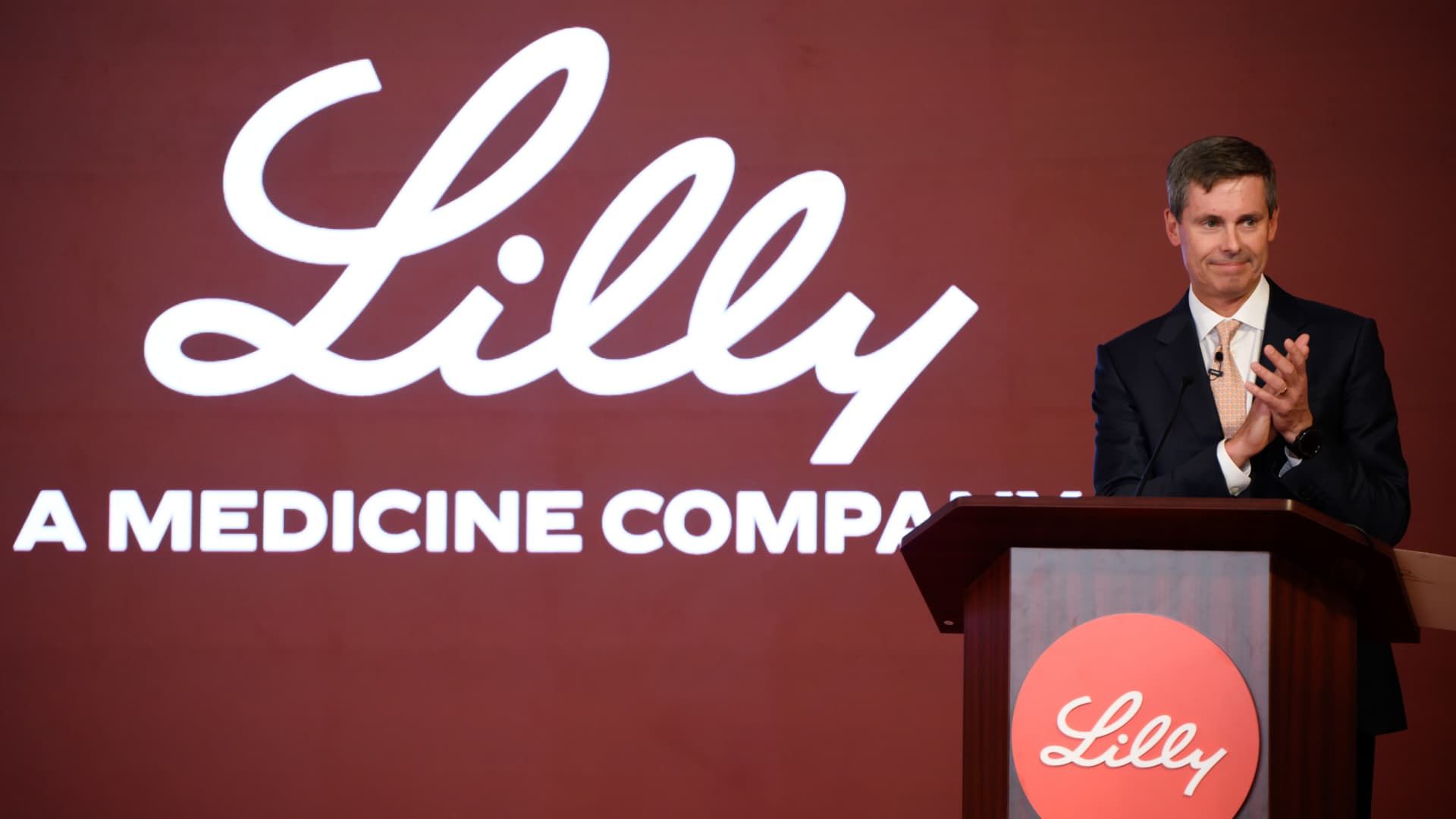
Obesity drug giant Eli Lilly reported a monster first quarter on Thursday, strengthening our conviction to hold the stock after a period of sluggishness. Revenue in the three months ended March rose 56% from a year earlier to $19.8 billion, beating the LSEG consensus of $17.6 billion. Adjusted earnings per share came to $8.55, more than doubling on a year-over-year basis and crushing the consensus of $6.66, according to LSEG. LLY 1Y mountain Eli Lilly stock performance over the past 12 months. Shares rose about 10% on Thursday. Shares entered the day down 21% for the year and about 23% from their late-November all-time closing high of $1,110. The stock's weakness was tied to a broader rotation away from the healthcare sector and broader questions about competitive dynamics in the burgeoning LPG-1 market. Simply put, Lilly knocked it out of the park. As if the huge top-line and bottom-line results weren't enough, the drugmaker raised its full-year guidance for revenue, operating profitability and earnings per share. “This is one of the biggest pharmaceutical stories,” Jim Cramer said Thursday. One of the main reasons Lilly's results are so impressive is that it does so despite lower drug prices in the United States, in part due to most-favored-nation agreements with the Trump administration in exchange for access to Medicare. Competition from Novo Nordisk, the maker of Ozempic for diabetes and Wegovy for weight loss, is another factor. Still, Eli Lilly CEO David Ricks has insisted that his company will be able to beat lower prices with higher volumes, and that's what's happening. In the first quarter, prices fell 7% in the US, but volumes rose 49% driven by its injectable GLP-1, Zepbound for obesity and Mounjaro for type 2 diabetes. (Both drugs share the active ingredient tirzepatide.) In reality, the dynamics were even more pronounced globally, with prices falling by 13% and volumes increasing by 65%. China was a big driver of weaker prices globally. Mounjaro drove the increase in volumes internationally, where it is marketed for both obesity and diabetes. Mounjaro's international strength has been a prominent theme recently, and that was again the case in the first quarter. For the full year, Lilly still expects prices to be a hurdle for low- to mid-teens on a percentage basis. So the fact that Lilly is adopting its guidance just one quarter into the year is a clear bullish sign anyway. All the billions of dollars Lilly has invested in expanding GLP-1 manufacturing capacity in recent years is paying off. Demand is strong, the LPG-1 market is growing and Lilly has the supply to meet the moment. Another big story Thursday had nothing to do with the reported numbers: the launch of the anti-obesity pill Foundayo, which won its long-awaited approval from the Food and Drug Administration on April 1 and became widely available about a week later. Foundayo used to be known by the name of its active ingredient, or forglipron. Investors wanted clarity on early prescription data that showed Foundayo had gotten off to a slow start compared to the launch of Novo's Wegovy pill in January. That revelation hurt stocks last week. During an interview with CNBC on Thursday morning, Ricks had reassuring things to say here, emphasizing that his long-term optimism has not dimmed. He admitted that Novo's pill had the advantage of leveraging the existing Wegovy brand. In contrast, the Foundayo brand is being built from the ground up and will take time to familiarize clinicians and consumers. Lilly hasn't started advertising on television yet, Ricks said, so most of the demand for the product comes organically. More than 20,000 people are taking the pill, he said. Also, a key statistic: about 80% of Foundayo prescriptions are for people who were not previously taking GLP-1. This supports the idea that pill convenience would expand the size of the obesity market, rather than cannibalizing injectables. The ramp will be developed in quarters, not days, Ricks argued. It's hard to disagree with him. Something to monitor in the future is the start of Medicare coverage for obesity medications with a $50 copay. The start of a pilot program was delayed due to the reluctance of private insurers to participate in their Part D prescription drug plans. In response, the Trump administration plans to extend a bridge program for one year until the end of 2027. Therefore, Lilly will be able to benefit from this bridge program. We just need to keep an eye on the long-term discussion to ensure Part D coverage is in place by 2028. Ricks said he believes the broader health benefits for patients will become evident over the next 18 months. “I would expect the government to work very hard to get buy-in into the Part D plan and normalize obesity care as a standard preventive treatment and something that should be used to treat comorbidities of obesity among the elderly population,” Ricks said on the results conference call. “We may have evidence to support that when we come out of the 27th.” Why We Own Them Eli Lilly's top drugs should enable growth above the industry average for many years to come. The portfolio is based on its GLP-1 franchise, which currently includes Mounjaro injectables for type 2 diabetes and Zepbound for obesity, as well as a new weight loss pill, Foundayo. This fast-growing class of drugs has the potential to treat other conditions. Competitors: Novo Nordisk, Biogen, Eisai, Merck, and Pfizer Portfolio Weight: 2.26% Most Recent Purchase: May 22, 2025 Started: October 8, 2021 Finally, Lilly executives remained optimistic about Lilly's portfolio of GLP-1 drugs, including retatrutide, which trials show produces even greater weight loss on average than Zepbound. The company plans to apply for regulatory approval in the US later this year. On the call, executives said retatrutide could be an especially useful product for patients with type 2 diabetes who need help with blood sugar control and weight loss. The current GLP-1s on the market have generally been less effective in generating weight loss in the diabetes population, so there is a need that retatrutide could fill. There are a lot of things to like about Lilly and we're glad Wall Street is taking notice on Thursday. For now, we reiterate our hold rating of 2. To account for the market's disdain for healthcare stocks, we are lowering our price target to $1,200 per share from $1,250. Guidance Here's an updated look at Lilly's full-year 2026 guidance: Revenue in the range of $82 billion to $85 billion, up from $80 billion to $83 billion previously. The new midpoint of $83.5 billion is ahead of the FactSet consensus of $82.1 billion. Yield margin, a measure of operating profitability defined by Lilly, in the range of 47% to 48.5%, up from 46% to 47.5%. Earnings per share in the range of $35.50 to $37, up from $33.50 to $35 previously. The revised midpoint of $36.25 beats the FactSet consensus of $34.52. (Jim Cramer's Charitable Trust is long LLY. See here for a full list of stocks.) As a subscriber to the CNBC Investing Club with Jim Cramer, you will receive a trade alert before Jim makes a trade. Jim waits 45 minutes after sending a trade alert before buying or selling a stock in his charitable fund's portfolio. If Jim has talked about a stock on CNBC TV, he waits 72 hours after issuing the trade alert before executing the trade. THE ABOVE INVESTMENT CLUB INFORMATION IS SUBJECT TO OUR TERMS AND CONDITIONS AND PRIVACY POLICY, TOGETHER WITH OUR DISCLAIMER. NO FIDUCIARY OBLIGATION OR DUTY EXISTS OR IS CREATED BY VIRTUE OF THE RECEIPT OF ANY INFORMATION PROVIDED IN RELATION TO THE INVESTMENT CLUB. NO SPECIFIC RESULTS OR BENEFITS ARE GUARANTEED.