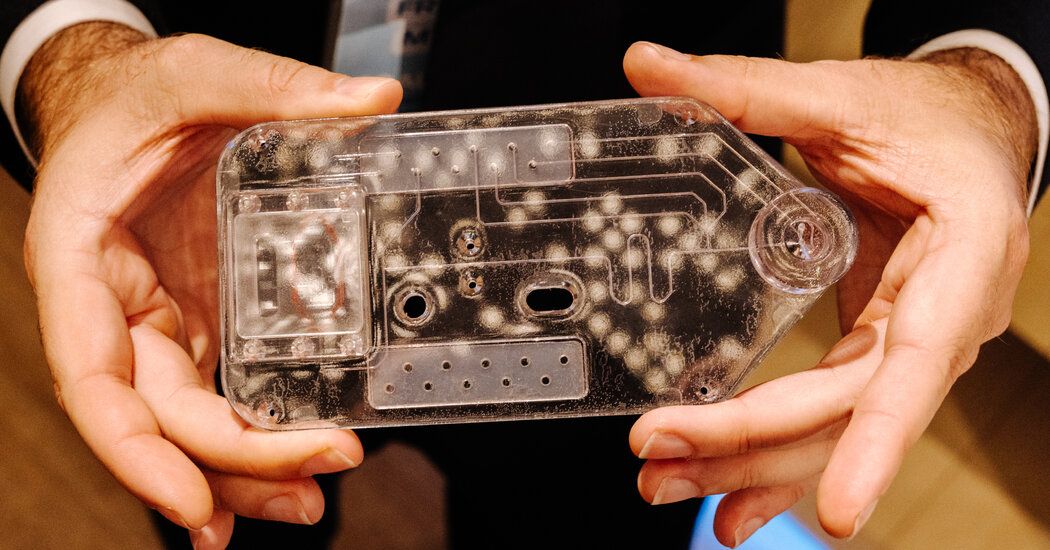
Linsey Marr, an environmental engineer, stood next to a pair of clear plastic boxes packed with tubes, nozzles and electronics, a strange-looking prototype that could one day protect daycare children from airborne pathogens.
A nozzle filled the box on the right with a faint silver mist. A pump drew some of that air into the box on the left, where a sampler caught floating particles and droplets. Soon, a digital display attached to the box turned red: “Detected! Dust mite allergen Der f 1.”
Der f 1, a protein secreted by dust mites, can trigger asthma attacks when inhaled. Dr. Marr's device had detected 843 picograms of Der f 1 per cubic meter. A single grain of salt weighs approximately 10 million times as much.
“Before this instrument, it would have taken us two days to determine how much was in the air,” Dr. Marr said. “Now we do it almost in real time.”
Dust mite allergens aren't the only threats Dr. Marr's team aims to fish out from the air. The technology, still evolving, can already detect influenza, coronavirus and E. coli.
“We have 10 different things that we can detect, and at the end of the program, there will be 25 different things,” he said.
Dr. Marr shouted above the noise on the fifth floor of a Washington office building, where more than 200 people milled about, giving their first look at a rapidly evolving frontier of science: technology designed to keep indoor air safe in daycares, schools, hospitals, anywhere people gather.
This science fair for adults was organized by the Advanced Research Projects Agency for Health (ARPA-H, for short), which is spending $150 million to create what it calls “an immune system for every building.”
At the beginning of the event, the person in charge of the program, Jessica Green, gave a short welcome speech. “We have the right to breathe healthy indoor air,” he said.
Lost lessons
Dr. Green was echoing the words of William and Mildred Wells, a husband-and-wife team who discovered the threat of airborne germs in the 1930s. They famously protected Philadelphia schoolchildren from a measles epidemic in 1940 by installing ultraviolet lamps that disinfected the air in classrooms.
“I believe that the supply of pure air for children (and adults) to breathe should be considered of equal importance with the supply of pure water and pure milk,” Mildred Wells later wrote.
But she and her husband failed to convince their colleagues, and the threat of airborne germs was underestimated for generations. When Covid arrived in 2020, the World Health Organization stated emphatically that it was not transmitted through the air, which turned out to be wrong.
Dr. Marr, who teaches at Virginia Tech, played a leading role in getting public health authorities to recognize that the SARS-CoV-2 coronavirus was, in fact, airborne. She and other researchers were frustrated by how difficult it could be to identify such pathogens.
“We would spend a day collecting samples on a filter, take them to the lab, and the next day it would take us several hours to calculate how much is there,” Dr. Marr said. “And by the time you have that number, it will be too late to do anything about it.”
As a stopgap measure during the pandemic, Dr. Marr and other experts recommended finding ways to prevent the coronavirus from building up indoors to dangerous levels. Some schools purchased air purifiers for classrooms, while others turned to DIY tricks made with box fans and filters.
As the pandemic subsided, attention shifted away from aerial threats. In America's schools, air purifiers came to be seen as noisy nuisances rather than life-saving technology.
“A lot of them were expelled, which is really sad,” said David Carel, co-director of the nonprofit Clean Air for Schools. “In fact, children were breathing much cleaner air three or four years ago.”
Covid never left; it only joined a growing group of airborne pathogens.
Measles, which is transmitted exclusively through the air, is resurfacing in undervaccinated areas of the United States. The flu spreads by several routes, but air travel appears to be one of the most important.
Beyond infectious germs, indoor air can also harbor other threats, such as dust mite proteins, mold spores, and pollen grains.
Engineers have continued to develop sophisticated systems to keep the air healthy. Luxury apartment buildings occasionally boast about the technology used to keep their tenants safe. But these systems are far from ubiquitous.
“One of the reasons I think healthy indoor air solutions have yet to scale in the broader market is because they are expensive,” Dr. Green said in an interview. “What we need are solutions that can be energy efficient but also healthy.”
Dr. Green, herself an expert in airborne microbes, started the program at ARPA-H to work toward those solutions: BREATHE, to build resilient environments for air and total health. The goal is for buildings to fight disease in the same way they fight fire.
When smoke activates smoke detectors, a building's control system can respond by spraying water with sprinklers or releasing fire extinguishing chemicals.
There is no need to wait for someone to inspect the signs and decide how to respond.
Four teams were awarded contracts to create these systems. They all face significant engineering challenges.
It is much more difficult to identify floating pathogens than it is to detect smoke. A very low concentration of germs or allergens can be dangerous. That means sensors have to sample large volumes of air, storing droplets and particles in liquid for analysis.
“These devices need to concentrate something like a pool of air into a tablespoon,” Dr. Green said. Each team is trying a different strategy.
SafeTraces, a California company, leads a group building an air sampler that is a low, wide, white metal box. Air flows through the box into a cartridge, where chemicals break down the cells and isolate the genes they contain.
The cartridge contains molecular hooks, each of which can snag a specific DNA or RNA sequence of a pathogen. If a hook catches any genetic material, it emits a flash of light.
The researchers hope their sensor will detect up to 100 pathogens. They are also creating software that can recognize when sensor signals mean occupants are at high risk of becoming infected.
Then the software could respond, perhaps by turning on ultraviolet lamps in the hospital's ventilation system. (In addition to measles viruses, ultraviolet light eliminates many airborne hazards.) Hospital staff may be prompted to use additional protection to avoid inhaling pathogens. And once sensors detect that the threat has disappeared, the hospital could return to business as usual.
Another team, led by Florida company Poppy, is designing a system that would work in schools. Signals from the team's air samplers would turn on the air filters in the classrooms. They ran until the air in the classrooms was safe again.
Dr. Marr's group has focused on daycares. They are creating software that can create models of a facility's rooms, predicting how air flows between them and the threat each room would pose if someone entered the building with an infection. The system could pump in fresh air from outside or turn on air purifiers to reduce the threat.
All teams are working to test their systems in the real world. SafeTraces plans to test a prototype at Walter Reed National Military Medical Center in 2028. Dr. Marr's group is preparing to test its system in childcare centers in California, Michigan and North Carolina.
The technology is intended to reduce respiratory illnesses by at least 25 percent in each setting. But the systems must also be affordable to purchase and operate. ARPA-H expects the systems to provide a 10 percent return on investment.
Giorgio Buonanno, an environmental engineer at the University of Cassino and Southern Lazio in Italy, who is not involved in the projects, said BREATHE's approach is fascinating but a bit fanciful.
“I'm skeptical about its plausibility in the real world,” he said. Dr. Buonanno favored simpler strategies, such as requiring buildings to exchange a certain volume of air every hour and using carbon dioxide sensors to track how much exhaled air accumulates in them.
“I don't think these things are mutually exclusive,” said Joshua Santarpia, an aerobiologist at the University of Nebraska Medical Center who is developing the air sampler for schools. But he said it would take an ambitious effort like BREATHE to raise indoor air safety to a higher level.
“We don't get the Internet just by sending a lot of mail,” Dr. Santarpia said.