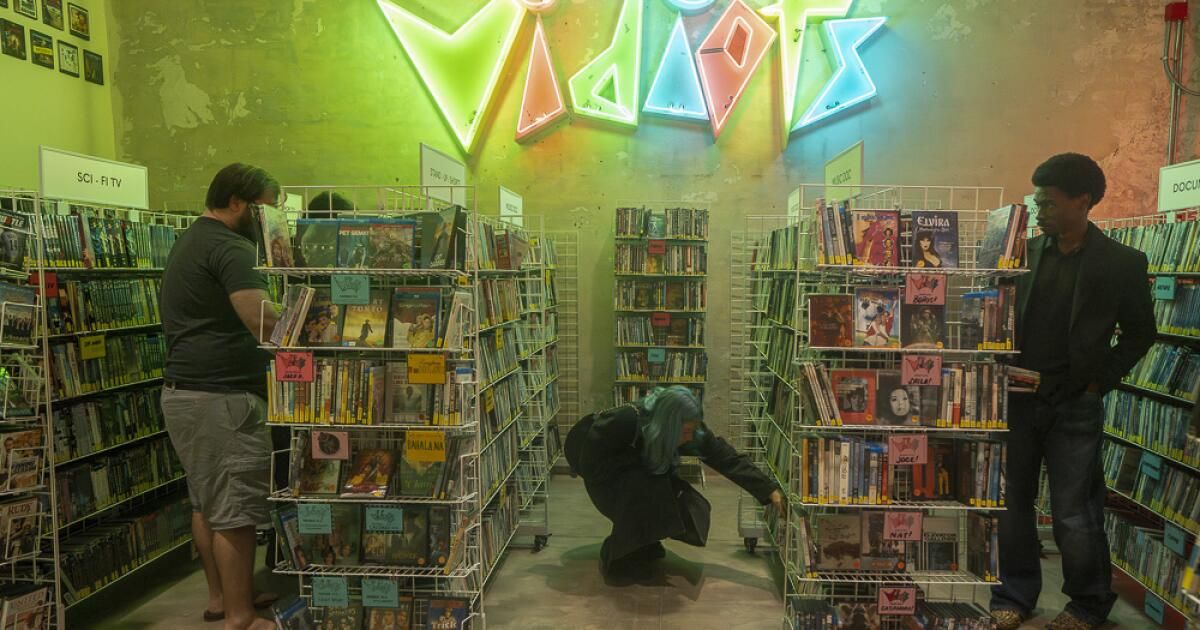
Before the lights went down for the movie, “The Lady from Shanghai” at Vidiots, Aidan Gannon and Jason Fine were busy perusing the aisles of endless DVDs. For these young movie buffs, downtown Eagle Rock isn't just a theater: it's a gateway to movie history.
Within minutes, the 24-year-olds found themselves in the middle of their “Star Wars” DVD and Blu-ray collection, reminiscing about the special features they enjoyed as kids.
But for them, collecting and watching DVDs is not just a childhood memory. They have rediscovered the medium as adults.
“I want something I can put on my shelf,” said Gannon, who recently collected 200 records. “I can go shopping in my closet, grab something and put it in, instead of spending an hour scrolling through Netflix to find something and then just watching the same TV show.”
Vesta McDade, 13, searches for DVDs at the Highland Park Video Library.
And Gannon is not the only one. Local video rental stores like Vidiots, Highland Park-based Vidéothèque and Westside's Cinefile video store in Sawtelle are reporting increased rentals, shopping and foot traffic. Even Barnes & Noble, one of the last major retailers selling movie discs, expects sales growth in that sector.
Before streaming platforms dominated home entertainment, consumers relied on places like Blockbuster, the now nearly defunct movie rental chain, and RedBox, the defunct movie vending machines, to watch newly released movies. So when Netflix and others launched streaming services, physical distribution eventually declined.
Like vinyl records that have made a resurgence among millennial customers, DVDs are enjoying a comeback among some Gen Z buyers, even though records no longer generate significant profits for studios.
DVD sales have been falling for years, falling more than 20% in 2023 and 2024 alone. However, the decline slowed substantially last year when sales of DVDs, Blu-rays and 4K Ultra HD declined just 9%, according to the trade association Digital Entertainment Group.
In turn, boutique Blu-ray companies, such as the Criterion Collection, are also on the rise. As a leading independent home video seller specializing in classic and contemporary films, Criterion confirmed to The Times that the company's sales are seeing “significant year-over-year increases.”
Peter Becker, president of Criterion, attributes this continued annual growth to young customers' enthusiasm for physical formats.
“At the dawn of streaming, it seemed like maybe this wasn't going to happen, but it definitely happened,” Becker said. “We're seeing a lot of evidence, including at Criterion Mobile Closet, that more and more young people are thinking about physical media in a different way. In a time when so much is available on-demand, it's becoming more and more important to us.”
Amy Jo Smith, president of Digital Entertainment Group, said physical media sales tend to peak when highly sought-after titles like “Wicked” and other franchise collections are released.
“This is clearest on 4K UHD Blu-ray, which offers a premium viewing experience in the home,” Smith said, adding that “American viewers spent 12 percent more purchasing 4K UHD titles in 2025 than in 2024.”
In January 2026, Vidiots said it had its biggest month ever, renting an average of 170 movies daily and 500 titles in just one day. Each disc rents for $3, including its most popular titles such as “Wild at Heart” by David Lynch and “The Heartbreak Kid” by Elaine May.
When it opened in 2023, Vidiots lent out around 22,000 discs. A year later, it doubled to around 50,000. The store's rental figures have continued to rise, reaching just over 1,000 films per week by 2025.

Nat Roberts retrieves DVDs from the shelves behind the Vidiots counter. Roberts has worked at the store for two years.
Robbie McCluskey, director of the video store, said the most recent numbers are “not even close to the mid-2010s,” adding that this moment feels like a “golden age” for physical media.
Over the weekend, Bianca Garcia and her friends Lauren and Emily VanDerwerken were on a mission to find “Raising Helen” and “Drop Dead Gorgeous” in the Vidiots collection, since they couldn't find the titles streaming. For them, owning and renting physical media means peace of mind.
“If something gets removed from an online platform, I'll still be able to see it because I have a physical copy,” Lauren, 31, said. “It's really valuable to be able to physically own things and not be at the mercy of the studios' financial decisions.”
García, 27, who began immersing himself in film during the pandemic, sees ownership of physical media as an act of “rebellion.”

Jay Spencer Restocks DVDs at Vidiots
“At this point, I'm forced to have six different subscriptions, which is crazy, and I still can't find what I want to watch,” Garcia said. “Why do I pay so much to have a movie given to me for a year and then taken away from me?”
“Vidiots is full of people who really love movies and don't just want my subscription money every month,” he said.
Cinefile, a video store founded in 1999, has a similar upward trend in its business. After COVID, there were approximately 300 paying members. Today, that number is around 500.
Cinefile employee Luis Samra has noticed both a rush of younger followers on the store's Instagram page and an influx of college students entering the store. He says that every Friday night (when they're open until midnight), he sees groups of Gen Z friends flock to the store looking for films by David Lynch, David Cronenberg and anything from A24, the production company best known for films like “Hereditary,” “Midsommar” and “Marty Supreme.”
“It's like an after-dinner hangout activity,” Samra said. “They like to look at each other and say, 'Have you seen this movie?' or 'Have you seen this director?' And maybe one in three of those people usually come and become a member.”
Before this increase in memberships, the video store depended on offering more specialty movies. But with renewed interest, Cinefile can spend more money to keep up with current releases, such as buying all of this year's Oscar-nominated movies for customers to rent. They have also been able to expand their sales section.
Barnes & Noble is one of the few retail chains that still dedicates in-store space to physical media items. According to Bill Castle, head of B&N's music and video division, DVD and Blu-ray sales have increased “mid-single digits” in the last year.

Víctor Gonzales, left, explores the interior of the Video Library on February 14. Gonzales said he has been coming to the store since it was located in South Pasadena more than 10 years ago and now lives nearby.
“We see that across all of our platforms, books, vinyl, everything, it's doing very well for us. People want to own things and build libraries,” Castle said, adding that the demographics of Barnes & Noble's media section continue to skew toward younger shoppers. “It's convenient. They can listen to them or watch them at any time. They don't have to worry about which streaming service offers them.”
Castle said he gets frustrated when big studios like Disney seem to prioritize streaming over physical releases.
“When Disney moved from its own distribution to Sony, we saw a drop in the number of titles and we often sold out of Disney titles. We see it decline at some studios,” Castle said. “We need products that sell interesting things for our buyers to browse. So without more content, it's a disadvantage.”
Recently, producer and chair of USC's Peter Stark Productions Program, Ed Saxon, was “surprised” when he received one of his old films, “Married to the Mob” (1988), as a new release from boutique Blu-ray provider Vinegar Syndrome.

Phoenix Topete and Dayana Gallardo visit the Video Library for a Valentine's Day date on February 14. Gallardo said she started coming to the store in the fall of 2023 and that she and her boyfriend enjoy browsing movies together. Maddie Bumb, seen in the background, has worked at the store for two and a half years and was previously a customer when it was located in South Pasadena.
“It's well thought out to this day, but it wasn't a huge hit. It's directed by a notable director, but that wouldn't have happened before this bump,” Saxon said, referring to the film's revival. “In an era where we're all online, it was comforting and comforting. It's a good testament to how much film culture means to people.”
He suggested that a precursor to this rise in popularity began in the 2010s, when audio streaming platforms were introduced and vinyl records began to regain popularity among millennials. He explained that for younger people like his students, collecting and renting DVDs is a way “to be able to slow down and get out of this hedonic routine of 'where will my next stimulus come from'.”
“Infinite choice is exhausting. People are just tired of it all. Claiming a part of the culture is somewhat subversive and counterattacks the control of the platform,” Saxon said. “Physical media does not compete with streaming. Rather, it corrects context and engagement.”
Saxon, who produced “The Silence of the Lambs,” is also well aware that physical media can be “good business for studios.”
He added: “'The Silence of the Lambs' is a perennial movie now. I understand how it's been everywhere, but that movie means enough to people to go buy it.”
“As a kind of mass market for old movies that have no new sources of income, beyond the new streaming platforms, [physical media] It's a nice bonus, and when you add it to an entire library of studio films, it adds up to real money.”