A couple married for 35 years walks slowly through a hospital after an appointment with a doctor to learn the results of recently performed tests. They are shocked by the news they have just received as their hands clasp and clasp tightly, realizing that a major battle is coming sooner rather than later.
In the Lifetime movie “Love, Again,” premiering Saturday at 8 p.m. on Lifetime, that unfortunate battle is early-onset Alzheimer's, and it's the diagnosis 60-year-old Judge Henry Stanford (Henry Czerny) receives after he's been masking greater forgetfulness and lying to his loving wife, Caroline (Valerie Bertinelli), about keeping up with her regular medical checkups.
As time passes in the film, written by Nancey Silvers and directed by David I. Strasser, Henry's health worsens and Caroline does her best to be her husband's sole caregiver, but experiences the weight of responsibility both physically and emotionally.
“Caroline is very vulnerable, but she's a lot like me, where you're strong and no matter what's going on that's scary or unpleasant in your life, you still have to go and do what you have to do,” says Bertinelli, who is also an executive producer on the project.
The subject of the film is not one that Silvers has had direct personal experience with, but when she was asked to explore the possibility of writing a film about the topic, fellow producer Linda L. Kent began sharing a story about a friend going through the experience of Alzheimer's disease with her spouse. However, Silvers stopped her before she shared too much, saying, “I don't want to know anything except the emotions of what happened, how you dealt with it, and what the hardest part was. I don't need the details because that's what I'll come up with on my own.”
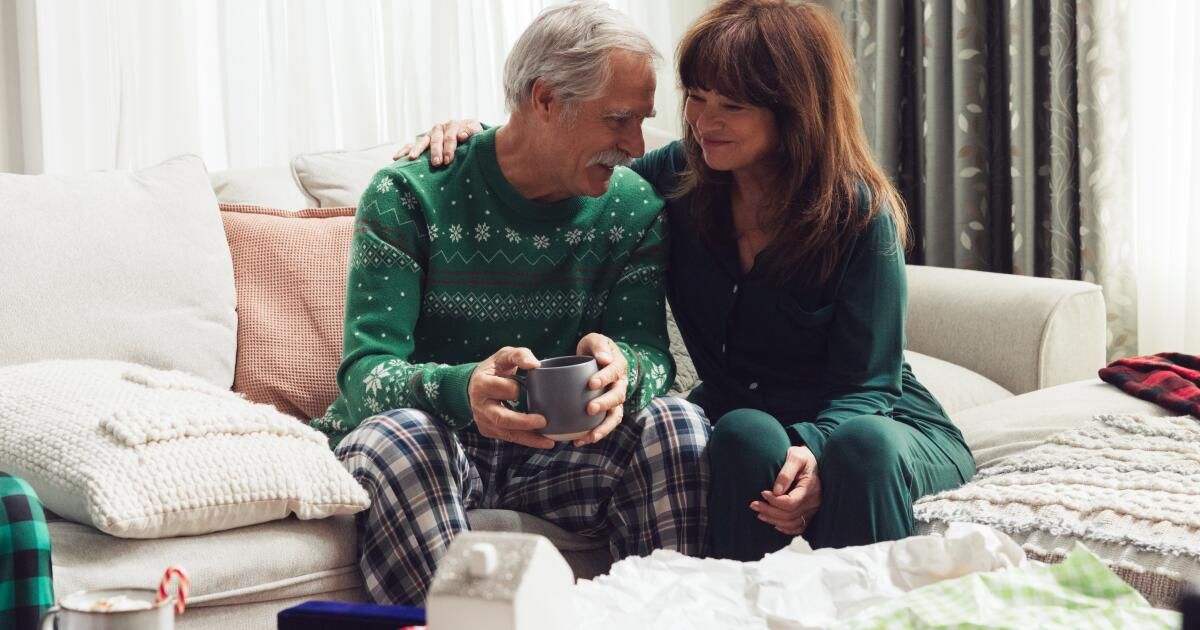
In the film, Caroline (Bertinelli) is the sole caregiver for her husband, Henry (Czerny).
(Marley Hutchinson / Lifetime)
The writer, daughter of beloved comedian Phil Silvers, had seen the 2014 film “Still Alice,” starring Julianne Moore and about early-onset familial Alzheimer's, but was surprised by what she learned once she started researching. “I assumed that we had made some progress and that things had moved forward [in finding a cure]but I was surprised that it's becoming more and more common,” he says. He then spoke to the Alzheimer's Foundation of America, which states on its website that there are nearly 15 million Americans living with Alzheimer's or caring for someone with the disease. Through the organization, Silvers received more education about promising medications and treatments that may not provide a cure yet, but that keep a diagnosed person healthier much longer. “I put [that information] “In the film there is hope on the horizon.”
Research aside, the emotional toll of caring for someone with Alzheimer's is something Bertinelli connects with because she has witnessed the slow death of people she loved, along with the difficult challenges caregivers face. “The role of caregiver is something that is never fully recognized,” she says. “The closest I've ever been to that was seeing my dad. [Andrew, who died in 2016] Going by the sunsets, which was a certain time of day that I just couldn't find it. “He was there, but he wasn't there, and that's the closest I got, and I understand how challenging it is for people.”
Although Caroline attempts to care for Henry on her own even as his health continues to decline (she forgets alarm codes, family members' names, and doesn't know where he is), she unexpectedly finds comfort in Dr. Leo Marford (Eric McCormack), who works as head of anesthesiology at the hospital where she volunteers in the gift shop. The fact that Leo is a widow who took care of his wife until she died of ALS (amyotrophic lateral sclerosis or Lou Gehrig's disease) gives them something to connect with, although their feelings gradually deepen over time. “As soon as she meets Leo, there's something there even though his light has dimmed and you also see it shine as they go,” Bertinelli says. “Caroline is going through confusing feelings because she absolutely adores and loves her husband.”
To create the two men with whom Caroline has different emotional connections in the film (one with whom she shares a life and the other with whom she finds a caring bond), Silvers didn't look for much inspiration. “Both men are my husband,” she says. “This story is the truth of how my husband and I went through this, even though we didn't. I just put him in those shoes and watched him lose and lose more every day in my head. It's hard, it's emotional, but that's what makes it real.”
As for Leo, who is slightly younger than Henry in the film, Silvers channeled her husband from the moment she met him.

Caroline (Valerie Bertinelli) finds comfort in Leo (Eric McCormack), whose wife died of ALS.
(Stephen Lew / Lifetime)
And although she is developing feelings for Leo, Caroline's attention remains focused on caring for Henry, which becomes more emotionally and physically exhausting, culminating in a moment where Henry does not recognize Caroline and, for the first time, becomes physically violent toward her. But Silvers toyed with where to set such a scene, thinking of situations where Caroline couldn't find Henry or he had wandered away from home. But he inevitably felt that those scenes had been played out before in film and television. “Me, [the bathtub] It was the most vulnerable place Henry could be,” he says. “He's naked with Caroline and he doesn't know who she is, and he yells at her and throws her away, then [remembers her and] He calls you back.”
Not wanting to play it safe in such a vital scene, even when Strasser suggested a double, Bertinelli's goal was for that moment to “feel as uncomfortably violent as it must have felt, and I know people go through this because you're also losing the person you love.”
And he adds: “You look directly into their eyes and they don't see you, and I wanted to capture all that fear and violence in that moment. It had to be scary.”
Strasser staged the scene carefully and was committed to making sure the actors, especially Bertinelli, were safe once Henry grabs Caroline tightly and then, when she lets go, falls back to the bathroom floor. “I told Val, 'We're not going to do this fall 10 times. We're going to do it once,'” Strasser says. “I put the camera [far back] because I want the audience to see that moment in this wide, layered shot where you see the openness and the vastness of the room and you see the impact of Caroline's fall.”
Ironically, it is that horrible moment that causes a change in Caroline and Leo, who Caroline summons to help with Henry after the domestic incident. “Leo handles that moment very carefully and I think that's where Caroline really falls in love with him,” Silvers says. Additionally, it helps that Leo's medical history allows him to handle himself emotionally and empathetically in tense situations because “he's also been through the same thing with his wife.”
Bertinelli has a simple hope about what people take away from the film when they watch it. “When heartbreaking things happen, find your community,” he says. “Love is always good, no matter where or who it comes from. I know that the older I get, the more I lean on my friends and demand that they lean on me.”
The actor, who has acted in television and film for more than five decades, says, “I'm absolutely proud of this. Things that come close to this are 'Hot in Cleveland' and 'One Day at a Time,' but for real emotional weight, I'm more proud of this.”
Bertinelli’s busy year began with her recently published memoir, “Getting Naked: The Quiet Work of Becoming Imperfectly Perfect,” and her website ValeriesPlace.com, where she is building a community by posting recipes, cooking videos and live chats on a wide variety of topics, including discussions after “Love, Again” aired on Saturday.
“I just turned 66 and it's scary to think that life starts to fall through your fingers as you get older,” he says. “I know that in recent years I've been looking at life through a completely different lens: 'What do I want to do with my third and final chapter? What do I want to accomplish? How much love can I show to the people I love so much?' Love again, again and again.