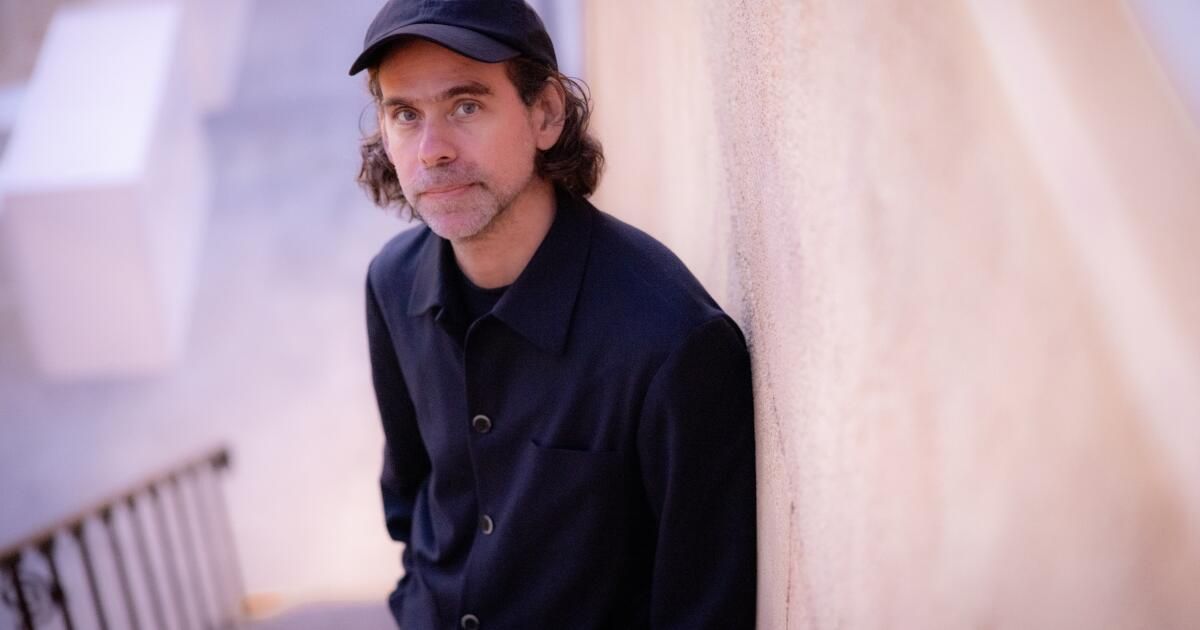
A few days before Sunday's Golden Globes ceremony, Bryce Dessner laughingly admitted that he had come to Los Angeles without a tuxedo, which is a problem considering he was nominated for an award.
“Film people think about how the actors are going to dress, of course, but the composer, who cares?” he said last week during a lunch in Beverly Hills. “I thought, 'Guys, do you have anything you can lend me?'”
You might consider buying a tux of your own: Although Dessner and Nick Cave inevitably lost the original song award at the Globes to the KPop hit “Golden” Demon Hunters, their theme song from director Clint Bentley’s “Train Dreams” made the short list for an Academy Award nomination, as did Dessner’s score for the film about a worker in northern Idaho in the early 20th century.
Adapted from a 2011 novella by Denis Johnson, “Train Dreams” follows Robert Grainier (played by Joel Edgerton) through 80 years of life in all its turmoil and routine; We see how he cuts logs in the forest, how he cultivates a romantic relationship and becomes a father, how one day he returns home to a nightmarish discovery from which he never fully recovers. A moving meditation on work, love, nature, and pain, the film doesn't contain much dialogue (critics have compared it to the films of Terrence Malick), which means that Dessner's soft, rolling folk chamber music is a near-equal companion to the images in the narrative.
“It's the water in the river that moves the movie forward,” Bentley said.
The title track features a haunting vocal performance by Cave, the veteran Australian post-punk singer-songwriter, who was so enthralled by Dessner's music that he was initially reluctant to participate.
“The last thing someone who has created a beautiful score wants is for a rock star to come in and sing over it,” said Cave, himself an experienced film composer. “It has happened to me many times.”
Best known as a member of the Grammy-winning indie-rock band The National, Dessner, 49, is one of a growing number of rock musicians finding a place in Hollywood. Last year’s original score Oscar winner was Daniel Blumberg of “The Brutalist,” who got his start in the band Yuck; Other songwriters on this year's shortlist include Radiohead's Jonny Greenwood (for “One Battle After Another”), Nine Inch Nails (“Tron: Ares”) and Daniel Lopatin, who records under the name Oneohtrix Point Never (“Marty Supreme”).
And Dessner isn't the only member of National to have established a successful career outside of the group: his twin brother Aaron is an in-demand pop producer who has collaborated with Taylor Swift, Ed Sheeran and Brandi Carlile, among others.
Still, “Train Dreams” feels like a breakthrough for Bryce Dessner: the point where his background in roots music, concerts, and film composition converge.
He came to the film early, having previously worked with Bentley on 2021's “Jockey” and 2023's “Sing Sing” (for which Bentley and his creative partner, Greg Kwedar, earned an Oscar nomination for adapted screenplay).
“They sent me the script and I composed a good amount of music” while Bentley was filming, Dessner said, “which tends to be a bad idea.” He recalled a similar experience about a decade ago in Alejandro G. Iñárritu's “The Revenant.” “I wrote about two hours of cello music and then Alejandro, who is the nicest person, said, 'So, I have to tell you that I don't think we need the cello.'”
Dessner, who lives in Paris with his wife and young son, was dressed all in black, as indeed he would be the following night during a live performance of “Train Dreams” at the Egyptian Theatre.
“But in this case it worked, I think because it's a different kind of movie, more like a cinematic poem,” he said of “Train Dreams.”
Some of Dessner's signals evoke the rhythms of a locomotive; others, he said, were inspired by the sheer splendor of the Pacific Northwest, a landscape he immersed himself in while recording much of the score at Flora Recording in Portland, Oregon, where National had previously worked.
“It has analog equipment, old ribbon microphones and a beat-up upright piano,” he said of the studio. “I wanted some dust in the sound.”
Nick Cave at London's Royal Festival Hall in October.
(Jonathan Brady/PA Images via Getty Images)
For the film's title song, Bentley said Cave was the only person he could imagine striking the right tone: a delicate mix of exhaustion and gratitude.
“Actually, I don't know if I would have continued if he had rejected us,” the director said.
In a phone call, Cave, who declared himself a big fan of Johnson's book, said he watched the movie “with a hand over my eyes just because I thought they might have done a terrible job.” He laughed. “But within a few minutes, I just relaxed. I was very moved.”
He said the lyrics to the song, which present a succession of stark images from Robert Grainier's world, came to him while he was sleeping after watching the film. “It was the gift of a fever dream,” he said.
As a father who lost two sons, did Cave identify with Edgerton's portrayal of a grieving father?
“Very much,” he said, adding that he had first read Johnson's book years ago, before his teenage son Arthur died in an accidental fall from a cliff near the family's home in Brighton, England. “Obviously, it was a book about grief, but it didn't affect me that way. Then I read it again – no, actually, I listened to Will Patton's audiobook, which is a work of art in itself – and suddenly it wasn't something I read from a distance anymore.” (Bentley's film employs Patton's voice-over narration.)
When asked if he had a favorite line from Cave's song, Dessner, who listens to “Train Dreams” in a sort of conversation with the singer's latest album, “Wild God,” chose the song's chorus, in which Cave sings, “I can't begin to tell you how it feels.”
“In a way, it's like the whole movie,” the composer said. “It's about what art can do.”
Dessner and his brother grew up in Cincinnati, where Bryce played flute and classical guitar when he was 12 or 13 years old.
“He was also very good at math,” Aaron recalled. “The combination of those things always seemed related to me.”
For the Dessners, music was “just what they did as suburban kids in a time when there was nothing to do,” Bryce said. “Either you take drugs or you play music.”
Bryce joined the National in New York after earning a master's degree from the Yale School of Music. (The other members of the band are singer Matt Berninger and a second set of brothers: bassist Scott Devendorf and drummer Bryan Devendorf.)

The National's Aaron Dessner, left, Matt Berninger and Bryce Dessner perform in Edinburgh, Scotland, in 2022.
(Roberto Ricciuti/Redferns via Getty Images)
“It was a bit of an accident that we ended up in a band that became popular,” Aaron said, but that's definitely what happened. In the mid-2000s, National's albums regularly topped critics' charts; In 2011, the band was headlining the Hollywood Bowl.
Bryce got seriously into film music after Iñárritu heard a piece he composed for Gustavo Dudamel and the LA Phil in 2014; The director called him the next day, Dessner recalled, and asked him to work on “The Revenant.”
These days, the members of National are “really enjoying a break,” Dessner said, after releasing two albums in 2023 and touring behind them in 2024. He's confident the band will get back together, but estimates it will be about a year before he and his bandmates are back up and running.
Until then, he is focusing on concert music: “I was just asked to write a concerto for the ondes martenot,” he said, referring to the first electronic instrument Greenwood used on Radiohead's famous experimental album “Kid A,” and he occasionally collaborates with his brother on Aaron's pop productions.
“Bryce is always going to do something interesting in any setting,” said Aaron, who recently asked him to orchestrate a song for Florence + the Machine.
And, of course, there's the long road to the Oscars with the quiet but powerful “Train Dreams.”
“I'm kind of excited to be a fly on the wall in a room with Spielberg and Scorsese and all these people,” he said before the Golden Globes.
As awards season begins, does Dessner harbor any hope of somehow triumphing over world-conquering “Golden”?
“I have to say yes,” he responded, laughing. “But not”.