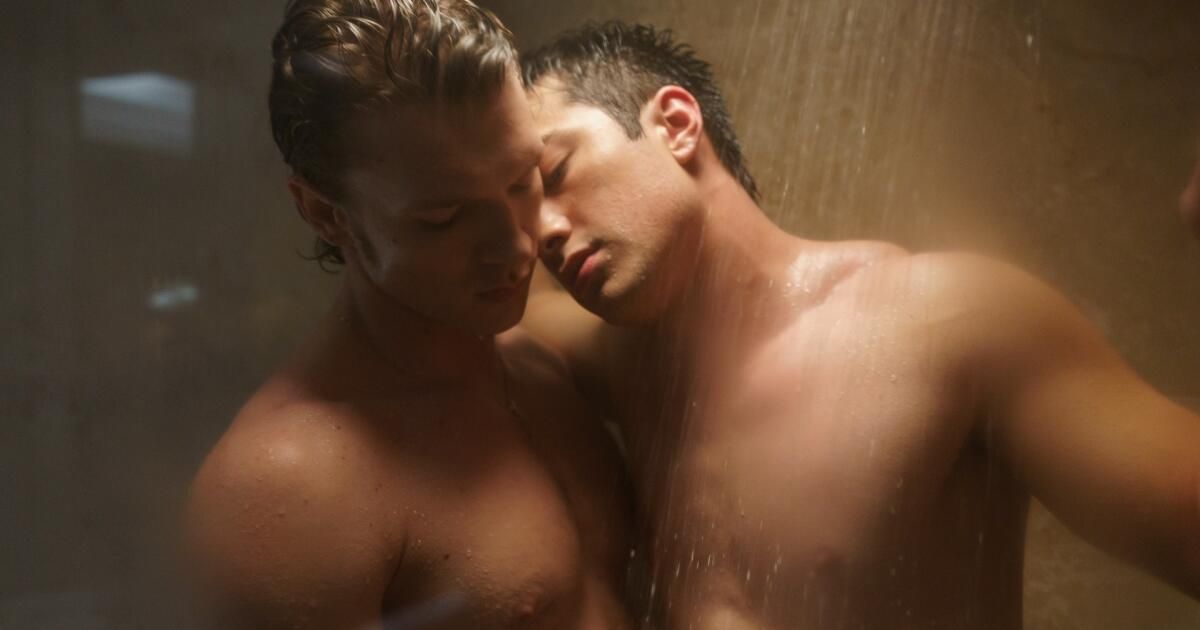
How did a gay hockey romance created by a little-known Canadian streamer become a global cultural phenomenon?
Turns out the answer was to lean toward a female and queer audience. Since last November's debut of “Heated Rivalry,” which chronicles the clandestine love story between two fierce hockey rivals, Bell Media's Crave drama series has emerged as an unlikely success story, defying a broader industry trend of media consolidation and waning commitments to diversity in Hollywood.
The mastermind behind the show's success is Jacob Tierney, who read author Rachel Reid's “Game Changers” series during the COVID-19 pandemic and then optioned all the books after reading a Washington Post story about the proliferation of romance novels. After writing a pilot on spec, he approached executives at Crave, where he had previously produced “Letterkenny,” “Shoresy” and “Canada's Drag Race,” about greenlighting a series. From the beginning, the gay writer and producer had a clear idea of how he wanted to adapt the “raunchy” story for television, starting with casting newcomers Hudson Williams and Connor Storrie as Shane Hollander and Ilya Rozanov, respectively.
“Jacob was very open to our comments, but his common [refrain] “He told us, 'We need to be true to the source material because the built-in fan base is going to expect certain things from us, and that includes the appearances of these actors and their ages,'” says Justin Stockman, vice president of programming and content development at Bell Media. “He said, 'We found them. These are the people in the book. And that's where we had to trust him.'
Brendan Brady, Tierney's producing partner through his Accent Aigu Entertainment brand, notes that the Canadian television model differs from the American one in that the producer retains ownership of the intellectual property while collecting a licensing fee from the broadcaster. To finance the series, Tierney and Brady reinvested their personal fees to cover approximately 10% of the budget, while another 30% came from tax credits. This included the Canada Media Fund, a resource derived from government and industry contributions that national broadcasters can allocate at their discretion. The rest of the financing usually comes from third parties.
But Tierney remembers that notes from potential financiers didn't align with his creative vision. Some wanted to delay the graphic depictions of gay sex and expand the world to include more characters. Someone even suggested introducing Rose Landry (Sophie Nélisse) early and putting her in a love triangle with Shane and Ilya, because they believed “this show won't work without a female entry point,” Tierney recalls. In the end, Bell Media opted not to use a co-financier and covered the remaining costs through its new distribution subsidiary, Sphere Abacus. But, Brady says, the budget was still “well under” 5 million Canadian dollars (approximately $3.6 million) per episode. “It's much less than that, it's almost nonsense,” adds Tierney.
Sean Cohan, an American executive who worked at A&E Network and Nielsen before being named president of Bell Media, does not believe “Heated Rivalry” could have been made in the United States. To begin with, “giving the green light” in the United States is a “slower” process; Tierney could have been stuck in development hell for years. The show also contains numerous Canadian references (rural countryside, loons, McGill University) that would not have made sense outside of the Great White North.
From left, stars Connor Storrie and Hudson Williams, creator Jacob Tierney and executive producer Brendan Brady on the set of “Heated Rivalry.”
(Sabrina Lantos)
For his part, Tierney doesn't believe “Heated Rivalry” would have been made any other time. Canadian network or transmitter. “There are a lot of ways to stick your fingers in and get sticky and mess things up, and these executives wanted the same show we wanted to do and they supported us 100%,” he says. Those executives were so confident in the show's success that they decided to move the premiere date from February to the end of November to take advantage of the holiday surge in viewership. The accelerated release schedule meant that Tierney delivered his version of the Season 1 finale a week and a half before it aired.
At the time of our interview, Tierney was already trying to reveal the story of season 2, which he and Brady say won't premiere until spring 2027. “As much as I appreciate how rabid and interested people are right now, the first season worked because I trusted my gut and I'm going to do it again,” Tierney says.
Like the audience, Bell Media executives are waiting with bated breath for the next chapter of “Heated Rivalry.” And since Accent Aigu has optioned all of the “Game Changer” novels (including Reid's upcoming “Unrivaled”), everything is on the table: more episodes or seasons, one-off specials, maybe even a spinoff. “We're open to anything that keeps the quality the way it was, but also gets our show back as quickly as possible,” Stockman says. (HBO Max will not participate financially and will remain simply a distributor.)
Tierney declines to reveal whether he will split “The Long Game” into one or two seasons, but admits he doesn't see himself doing more than six episodes per season. “I don't need to do 10. I'd always rather tighten my belt than relax,” says Tierney, who will have a co-writer for Season 2 but will still direct all episodes himself. “I'd rather say, 'Let's see how much story we can fit into these episodes.'”
“We want everyone to be left wanting,” adds Brady. “That's what everyone loves about this show. Less is more!”
“Heated Rivalry” may focus on Shane and Ilya, but there will “absolutely” be “detours” toward other canon characters. “Just as you can't tell the story without Scott Hunter, you can't really tell the story without Troy Barrett,” Tierney says, alluding to a character in Reid's books who has yet to appear in the TV series. And while there may be many more calls coming in about high-profile castings, he adds: “We need Canadian talent, and we love Canadian talent. It's not a burden, but it's also something we literally have to do to get our funding.”
For Cohan, “Heated Rivalry” is a valuable proof of concept as he attempts to convince more Canadian creators to return to their roots, no matter where in the world they live now. “It certainly helps to feel like we have a dramatic example, a fact – a pretty good one, too – to say: 'Yes, look, we Canadians, not just Bell, can do big, global, profitable businesses.' [shows]and we can do it by being authentic,'” Cohan says.