“H is for Hawk” is for birds. And they are such majestic creatures that they hold their own against the magnificent Claire Foy (“All of Us Strangers”).
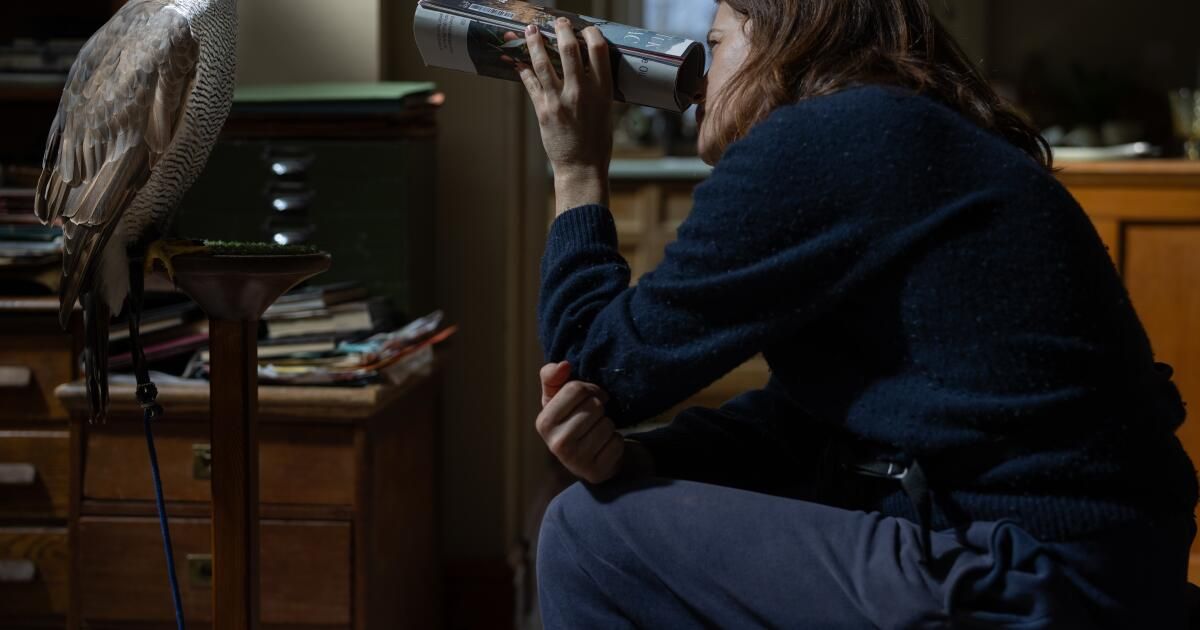
The film, directed by Philippa Lowthorpe and based on the memoirs of Helen Macdonald, centers on Foy's character Helen, devastated by the sudden loss of her father (played by Brendan Gleeson). In his grief, he turns to a childhood interest, falconry, and buys a goshawk. The wilder the bird, the tamer the name; Helen calls her Mabel.
Producer Dede Gardner and Lowthorpe had worked with Foy before (on “Women Talking” and “The Crown,” respectively) and agreed that she would be perfect as Helen. But Mabel was a completely different story.
Lowthorpe turned to Lloyd and Rose Buck, married bird specialists who had worked for decades on natural history documentaries with the likes of David Attenborough. Since they were conveniently located not far from their home in Bristol, England, the three got together to figure out how to make the film work.
It took five birds to play the character of Mabel at different points; the main two would have to be raised and trained by the couple long before filming began. Sisters Mabel 1 and Mabel 2 had most of the work. “They're from the same group, but they have a character like chalk and cheese,” Lloyd says. “Mabel 2 is much more timid and has more of a wild nature,” so she was used in the nervous bird scenes from the beginning. Mabel 1 was used to fly to and from Foy's glove, and during much of the action showing Helen cohabiting with Mabel in her home.
Jess, on loan from a friend in Scotland who had a falconry center, was used to people, so she appeared in Mabel's quieter moments. Juha, the only male and much smaller than the females, was seen only in high aerial shots. And Lottie starred in the hunting scenes, traveling up to 45 miles per hour through the woods to capture her prey.
Before filming began, Foy visited the Bucks for intensive falconry training for two weeks. “That was a pivotal moment for the whole project, because unless they had accepted Claire and she had accepted them, I don't think it could have worked,” Lloyd says. “But because she was so amazing, it works. She's interested, she's smart, but most of all she's just a lovely person, and that's what they see. You can't fool them, they're not stupid; they can see if someone is pretending to like them, but they really don't.”
Foy was delighted to work with the birds and the Bucks. “They are incredibly kind people,” he says. “They are so gentle and beautiful with their birds, and therefore they are also with other human beings. But they also included me. At the end of the first day I was with Lottie hunting, letting her loose from my arm. Learning with the birds was the last piece of the puzzle for Helen and the experience she was going to have, so it became a really profound experience.”
“Claire put her heart and soul into that training,” Lowthorpe says. “He has great physical and emotional instincts.”
Everything on the set revolved around the well-being of the falcons. Filming took place between October and January, to avoid the shedding season. Everyone on the crew wore dark, monotonous colors, because that's what the birds were used to. The microphones were hidden because the birds didn't like booms and most of the equipment was hidden upstairs; Even Lowthorpe hid behind a piece of furniture with his monitor. Lloyd or Rose would hood or remove Mabel from the scene and give the go-ahead before the crew could reappear to work between takes.
“I told Charlotte Bruus Christensen, our fantastic cinematographer, that we should shoot everything,” Lowthorpe recalls. “If you fix it, you could kill the taste of danger or surprise. Claire was so in tune in those scenes, she was able to react on the fly, and she was in character at all times during those very long takes. Like she was capturing the hawks, she was capturing Claire, allowing her to move wherever she wanted.”
“It wasn't like having another actor who had another agenda or actions or perspective that he wanted to convey in the scene,” Foy says. “I was with these animals on the trip.”
When Helen takes Mabel for her first walk around the house, she speaks kindly to her. “This is my kitchen,” he says. Mabel flaps her wings wildly. “It's not that bad.” The bird poops. “Oh, thank you very much.”
Mabel becomes Helen's salvation and addiction. “Feeling alive, chasing a goshawk while it hunts, is part of this extraordinary experience, which feels spiritual and meaningful,” explains Foy. “I think we try to avoid the ugliness of pain at all costs, as if it's something you're supposed to do alone in a closet and it's not witnessed. We're just very afraid of that expression. The journey with Mabel is the most vivid expression of that experience.”
Back home in London, Foy says he intends to visit the Mabels. “Every time you drive on a motorway in the UK you see birds of prey everywhere and now I can identify them,” he says. “I see them everywhere I go. There's an owl at the back of my house. Now I feel like I'm constantly looking up.”