With her nomination for “Sinners” cinematography, Autumn Durald Arkapaw becomes the first woman of color (and just the fourth) to be recognized in the category. Ryan Coogler's vampire film, set in the 1930s, received a record 16 nominations and advanced in every category for which it was eligible. Arkapaw previously collaborated with Coogler on 2022's “Black Panther: Wakanda Forever.”
Arkapaw spoke by phone Thursday morning from her Altadena home, fortunately spared from last year's fires, which she shares with her husband, Adam Arkapaw, also a cinematographer.
“It's good to understand what other people are doing because it's hard work and making movies is not easy,” Durald Arkapaw said of having two cinematographers under one roof. “But we also have a family, so usually when I work, he's taking care of our son and vice versa. So it's kind of a team effort. But there is an understanding. I wouldn't say we talk about it all the time because it gets exhausting. You have enough of that when you're at work.”
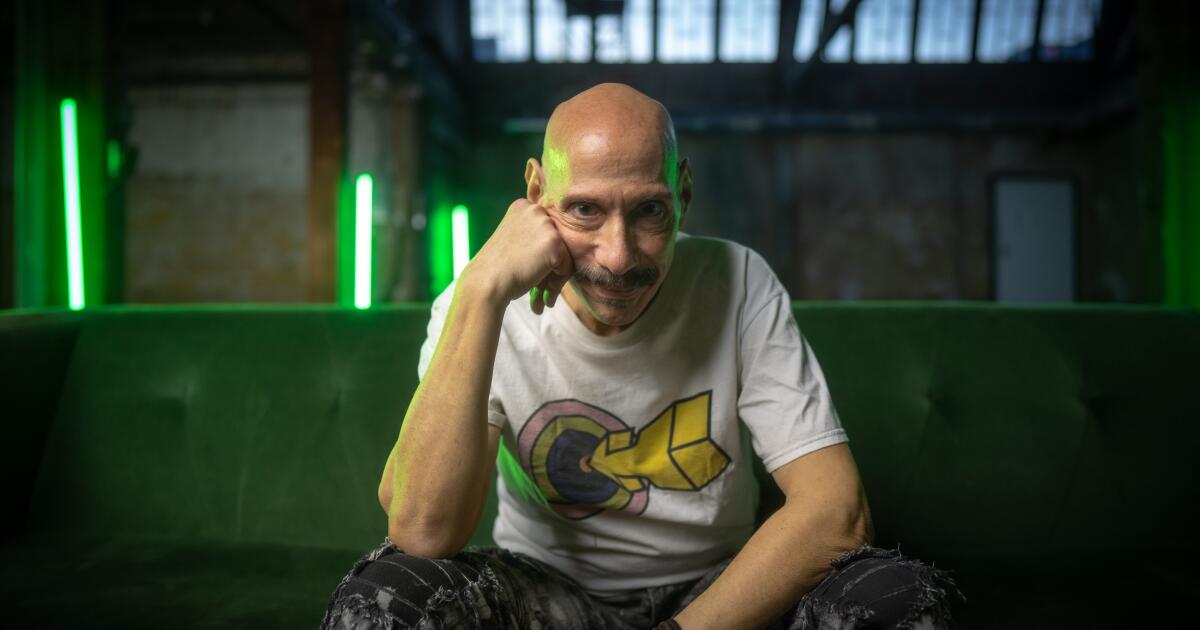
Autumn Durald Arkapaw, photographed in Los Angeles in November.
(Bexx Francois / For The Times)
To do? What do these historic firsts mean to you?
Autumn Durald Arkapaw: I'm trying to take a moment to take it in. I feel very honored every time I get to be alongside Ryan and make a movie with him, because what I think he does and says is unique. And we're always doing something for the first time and with a unique group of people. It's like all the department heads are women of color and these are women who inspire me every day. I think now to be part of that because [production designer] Hannah [Beachler] and [costume designer] Piety [E. Carter] I have also been able to do some work that has been recognized. Now, being part of that group, I feel very honored, especially for a film like this. That it is for this film means a lot to me.
W.What is it about this particular film that makes it even more special?
Arkapaw: I think for me and most of the team members, we have a lot of history and culture rooted in this history. My family is from New Orleans. My father was born there, my great-grandmother was born in Mississippi. So when I read the story, it felt very close to home. And I think that allows you to put yourself into it. And it has a lot of meaning and you want to make your ancestors proud. This movie has a lot of love on set and I think it really connected with a lot of people. And I think that's how really great movies are made. You put everything you can of yourself into it.
The film was a huge hit when it was released earlier this year. What do you think the audience was responding to?
Arkapaw: I'm an operator, so I love having my eyepiece in front of the camera and Ryan sits next to me. For many of the things we photographed, I was there in the moment. It was very heartfelt. And I always said, “If I don't feel it, then I don't feel like the audience can do it.” So I'm someone who shoots from the heart and wants to make sure that emotion comes across. The same thing happens to Ryan. There was a lot of that happening on set, where there were moments when you felt like you weren't really making a movie. Things were unfolding in front of you in a unique way. Sometimes it seemed like a real space. That matters. If you feel that way on set, it feels communicated until the audience sees it in this dark room. And then they no longer feel like they are watching a movie. And it's nice when that translates. It doesn't always happen. And with this film he did it, to an insane level.

Michael B. Jordan as Smoke and Stack in the movie “Sinners.”
(Images from Warner Bros.)
When did you and Ryan start talking about shooting 65 millimeters?maximum?
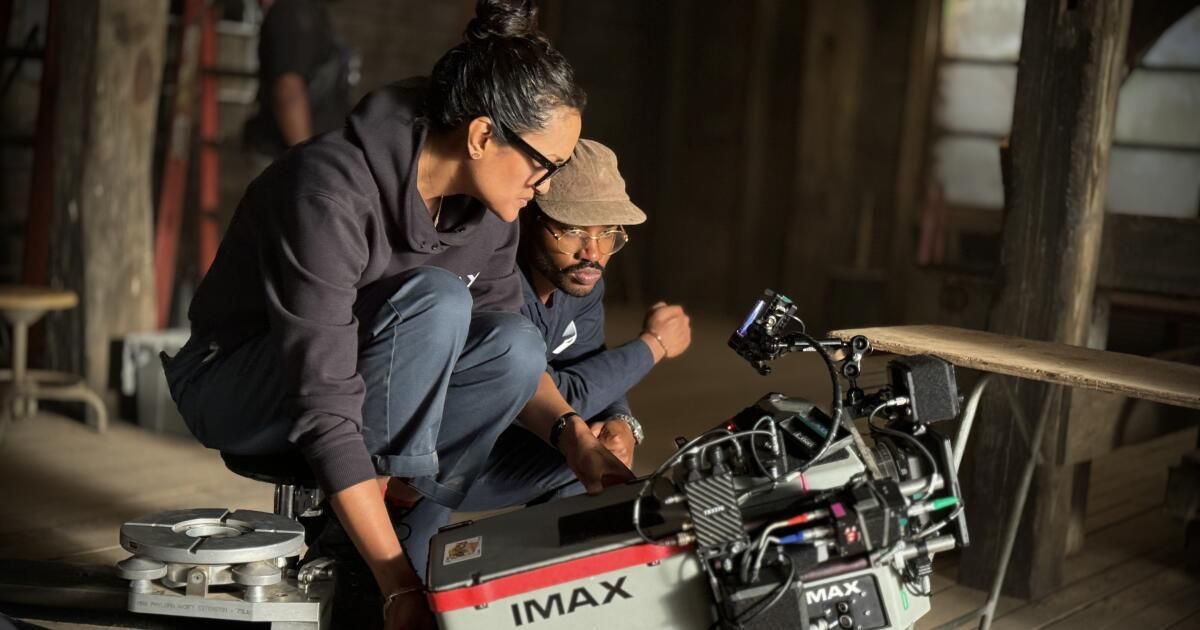
Arkapaw: I had imagined it with 16 millimeters. So I originally made some lenses with Panavision that I shot “The Last Showgirl” with before this. So I was trying them out hoping it would be something we could use. And then the studio called Ryan and said, “Have you thought about large format?” And he called me right after and said, “Let's talk about it.” And we bring together a lot of different formats and when you talk about large format in the film context, it means 65-[millimeter]. So we tried all these different formats. And obviously we fell in love with [Imax formats] 15 perforations and 5 perforations. And putting them together for the first time was unique. It was fun to do because we tested it and then we did an edit and we looked at it as a team and it all felt really good. So it's nice to do something historic like that and have it work and have the audience enjoy that big change of proportions.
From a workflow standpoint, what was it like having to adapt to these new technologies?
Arkapaw: I always feel like with Ryan, he always gives me a big challenge. He likes to think big and out of the ordinary. We did it in “Wakanda Forever.” We filmed a lot of our underwater scenes with real actors. And in this film, there were a lot of different sequences, moving the Imax camera around in the studio, treating it as if it weren't necessarily a large format film, but shooting it like we would if it were a smaller camera and staying true to how we like to move the camera. There are a lot of logistics involved. You have to have an amazing team. My team personally is fantastic and they did a great job. Blurring is not easy in a film like this.
So it was a challenge. But I think because everyone is so inspired by Ryan, he's a great leader on set and everyone really likes him, so they want to do a good job for him. I see that every time we make a movie, I have the same equipment that I use. It's like a family. And they respect it. So when you give us a challenge, we really want to make sure we do it right so it's a good experience for moviegoers. Because he always reminds us of that on set: “Great movie, great movie.” We are making a movie for theaters.
When the movie was about to be released, people really liked that explanatory video that Ryan did about the different formats. How did you feel about that video and that?, For something that seemed so technical and nerdy, it became very popular.
Arkapaw: I remember the moment he mentioned the subject, we were at the Playa Vista Imax headquarters and we had just done a screening to see the impressions. And he said, “I want to talk to you.” And then Zinzi and I [Coogler]our producer and our post-producer Tina Anderson, we went and talked for a second and Ryan said, “I want to make a video that explains all the formats so people can understand what we did and what it means and all that.” And his eyes lit up and I thought that was a great idea. Fast forward to when it came out and everyone accepted it because it was so thoughtful. It was really great.
If you watch it in Dolby, it's special, but if you watch it this way, it's even more special because the screen opens up. So I think putting that in the hands of the public is very thoughtful. And that's Ryan. He wants them to have this information because when he was a child and went to the movies, we all felt the same, when one night you walked to the movies or drove and waited an hour to see it and it was quite an experience. And I think that's why it went viral because people wanted to be a part of it.
Do you have a preferred format?
Arkapaw: My preferred format is the source format, because I am framing the film for Imax 1.43:1 and then also with the Ultra Panavision 2.76:1 format. So my best way to watch the film would be the 70mm Imax full frame print. And obviously, there are only about 40 theaters in the world that screen that. I don't think we had it in the '40s, maybe we only had 11, I think, in the whole world. But I was telling everyone that if you can get a ticket, go see it in 70-[millimeter] Imax projection, full-frame. It's so beautiful.