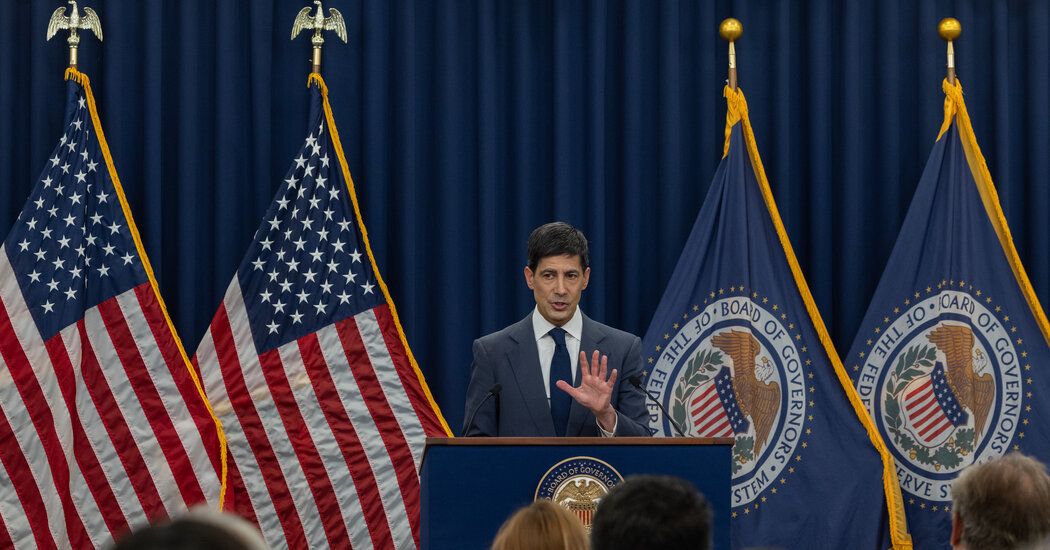
From the moment Kevin M. Warsh took the lectern for his first news conference as Federal Reserve chairman on Wednesday, he sounded less like the head of the central bank and more like a politician.
Fresh from chairing his initial policy meeting as head of the world's most powerful central bank, Warsh adopted the mannerisms and appearance of an elected official smoothing his way through a town hall forum.
He received questions with knowing smiles. It caused laughter. He gave long answers that were neither yes nor no. And he filled his answers with the kind of jargon that seemed more suited to a corporate boardroom than a Federal Reserve press conference.
He spoke of “first principles” and touted the brevity of Wednesday's Federal Reserve policy statement. He spoke of “alternative frameworks” and the “commitment” of the Federal Reserve.
“Change is not easy,” he said. “Change is full of risks.” He conveyed his hope that “we can put some points on the board.”
At one point, he said that AI was “perhaps shorthand for American ingenuity,” an idiom that would not have been out of place in a speech.
He even had a slogan prepared.
“We have a working group for that,” he said in response to a question about artificial intelligence, referring to groups he said he was creating to study topics including the Federal Reserve's communications and data sources.
Could the president offer his opinion on how much interest rates weigh on the economy? “We also have a working group on that.”
Still, it was notable that Warsh held a press conference.
He has promised “regime change” at the Federal Reserve, which will extend to the way the central bank communicates. He has suggested that his officials talk too much and has criticized the bank's tradition of indicating where it sees interest rates headed.
At his Senate confirmation hearing in April, Warsh did not commit to holding press conferences after every policy meeting, although he stopped short of advocating a reduction. Federal Reserve chairs have held scheduled press conferences after monetary policy meetings since 2011.
“The search for truth is more important than repetition,” Warsh said at his hearing. “If you have a press conference, you want to give some important news.”
Warsh, who was governor of the Federal Reserve from 2006 to 2011, provided some news on Wednesday. He said he was the Federal Reserve official who did not present a set of projections for the “dot plot,” which tracks what policymakers believe will happen to borrowing costs in the future. He promised that the Federal Reserve would focus on achieving “price stability.” Announced the formation of its working groups.
Many critics had feared that Warsh was President Trump's “sock puppet,” willing to do the president's bidding and lower interest rates at his request. That was not a conclusion on Wednesday.
Instead, it was Mr. Warsh's jocular jujitsu that was perhaps most surprising.
It was a marked departure from his immediate predecessor, Jerome H. Powell, who as chairman of the Federal Reserve was known for his frank communication. During one of his first news conferences, in 2018, Powell promised to provide a “plain English summary of how the economy is doing, what my colleagues and I at the Federal Reserve are trying to do, and why.”
Mr. Warsh seemed to enjoy obfuscation.
He declined to say what he thought should happen to interest rates, or how exactly the Fed would reduce inflation, which has remained well above the Fed's 2 percent target for five years. In response to a question about renovations at the Federal Reserve headquarters, which Trump has loudly attacked and which led to a criminal investigation of Powell, Warsh said little beyond the general need for the Fed to be “good stewards of taxpayer money.”
Responding to a question from a reporter about how patient he thought the Federal Reserve could be with regard to inflation, Warsh seemed to stifle a laugh. “Pretty much there,” he admitted. “Let me try to break that into pieces.”
“I'm glad you have the habit of asking you two questions, because my answer to your first question was very concise,” he replied after another question. “I have nothing more to say than the statement itself.”
“I don't want to prejudge the outcome,” he said over and over again.
His behavior seemed evasive to some Fed observers, although there were also concessions in which he seemed comfortable for a rookie.
“It was not a concise press conference,” said Christian Hoffmann, head of fixed income at Thornburg Investment Management. “I think he really likes communicating on his own terms.”
And Trump, for now, seemed to like what he saw.
Speaking to reporters after Warsh's press conference, Trump sounded lukewarm on the Federal Reserve's decision to keep interest rates steady. But he was more generous to his new Federal Reserve chairman.
“Now we have a very good guy there,” Trump said, “so I go by what he wants to do.”
Lydia De Pillis contributed reports.