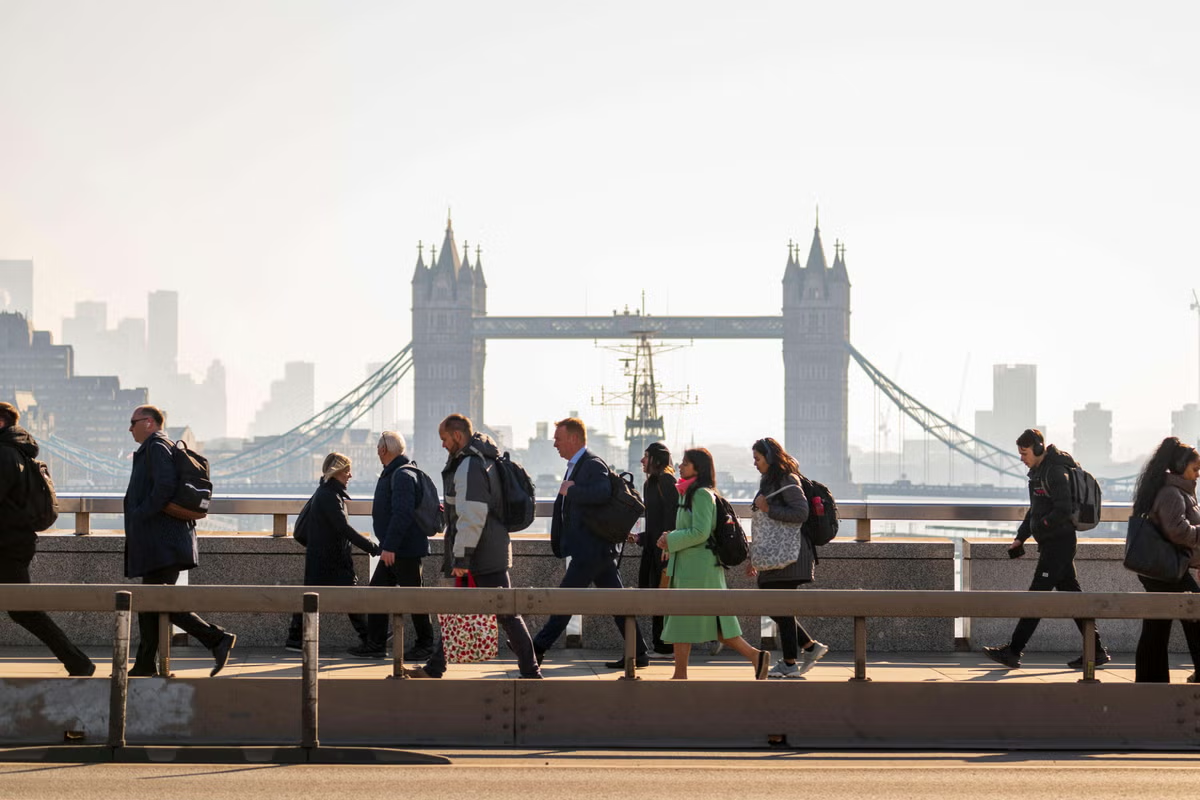
The British economy has contracted for the first time in eight months amid signs that the Iran war is beginning to take its toll on some sectors.
The Office for National Statistics (ONS) said gross domestic product (GDP) fell 0.1 percent in April, a sharp decline from growth of 0.3 percent in March and 0.4 percent in February.
The decline was driven by a 0.2 percent drop in services, which was partially offset by a 0.1 percent increase in construction and 0.4 percent growth in manufacturing.
In the three months to April, GDP grew by 0.7 per cent, according to the ONS.
The ONS said the services sector's strong performance was partly hit by a 4.3 per cent drop in arts, entertainment and recreation, while the sports industry saw a 9.1 per cent contraction in output as a number of sporting events in the Middle East were canceled due to the conflict.
It is the latest sign that the Iran war is putting pressure on some sectors, after recent official retail figures revealed sales fell at their fastest pace in almost a year, 1.3 percent, as rising petrol and diesel prices hit fuel sales.
Chancellor Rachel Reeves acknowledged that the war in the Middle East was affecting the economy.
She said: “Before the conflict in the Middle East, growth was higher than expected and inflation was falling. This is not a war we wanted or joined, but one that will have an impact at home.”
Mrs Reeves added: “The decisions I have made as Chancellor mean our economy is in a stronger position to cope with the costs of war, and we are getting on with the task of building a stronger and more secure economy.”
The figures will stoke fears that the Iran war will deal a blow to the British economy due to rising fuel and energy costs, as the Bank of England and leading forecasters such as the International Monetary Fund and the Organization for Economic Co-operation and Development have lowered GDP forecasts for this year.
The Bank will decide on interest rates on June 18, and many economists expect policymakers to vote to keep them at 3.75 percent until the impact on inflation and output becomes clearer.
Experts believe that after an unexpectedly strong start to the year, when GDP grew 0.6 percent in the first quarter, growth will progressively fade over the rest of 2026.
Stuart Clark, portfolio manager at Quilter, said: “Households and businesses alike have tightened their belts as costs rise and postponements of sporting events in the Middle East caused the services sector to contract.
“While the three-month growth has held up, the first quarter of the year looks like a false dawn, and with repeated resolutions between the United States and Iran failing to pass, conditions will remain difficult for longer.”
Pantheon Macroeconomics' Rob Wood forecasts growth will slow to 0.2 percent in the second quarter and 0.1 percent in the third quarter.
But the Item Club warned the UK could be left “flirting with recession”.
Matt Swannell, chief economist at the Item Club, said: “Rising prices on household essentials, combined with a deteriorating labor market, will reduce household purchasing power.
“Meanwhile, high input costs, tighter financial conditions and persistent geopolitical uncertainty will cause companies to put some investment decisions on hold.”