An airport VIP lounge, without security checks or boarding pass.
Credit card companies American Express and Chase They are increasingly fighting their luxury lounge wars outside the airport. From an air-conditioned retreat in the middle of the desert at Coachella to an exclusive meet-and-greet with athletes at the Paris Olympics, these companies are investing heavily in premium hospitality spaces to woo wealthy cardholders.
“It's very expensive, but I think what's happening is issuers are finding this is a premium differentiator,” said Donald Fandetti, managing director of consumer finance equity research at Wells Fargo. “It's about providing these services and experiences that make it worth it for the cardholder to pay those annual fees.”
The Platinum cards from American Express and Sapphire Reserve from Chase, the leading premium cards on the market, increased their annual fees last year. The Amex Platinum now has a fee of $895 per year, and the Sapphire Reserve has a fee of $795.
The benefits associated with these cards, such as dining credits, hotel upgrades, and digital partnerships, help offset the cost. Everything is an effort to attract and retain those who spend the most. Amex and Chase have competed for years to be the card of choice for America's elite.
Increasingly, access makes the difference.
“Credit cards [with] higher rates, it will send a certain signal. But what we really need to make sure is that we understand the psychology of exclusivity,” said Dan Bennett, head of behavioral sciences at Ogilvy Consulting. “It's easy to say, 'I'm very resourceful.' It's harder to say, 'I have enough social capital to earn a place in spaces.'”
Beyond the airport
Some of the events that American Express Platinum cardholders had lounge access to in 2025 include the US Open tennis tournament; Stagecoach Music Festival in California; and multiple Formula 1 races around the world.
Meanwhile, Chase Sapphire Reserve customer lounges were present at Chicago's Lollapalooza music festival; Miami Art Week; Sundance Film Festival; and the PGA Tour.
While some lounges and brand activations are open to all customers or even all event attendees, many of these spaces are reserved exclusively for premium cardholders.
“We see this customer as very engaged,” said Laura Picciano, CEO of Chase Sapphire. “Once you get their business, there's a lot of loyalty there. So, they're an important segment that we need to continue to nurture.”
Sundance Film Festival 2026.
Courtesy: Chase Bank
While temporary credit card rooms are popping up at festivals and sporting events, they have also become popular and permanent inside stadiums and arenas.
American Express has partnerships with more than 20 locations around the world. Eight of them currently have venues, including Hard Rock Stadium in Miami and the O2 Stadium in London, and a new location will open this year at the Barclays Center in New York City.
Bess Spaeth, executive vice president of global brand management and experiences at American Express, said factors such as footprint, ability to provide food and beverage and display capabilities are considerations when deciding which venues get lounges.
“It's a real puzzle that we try to look at all the pieces and think about it holistically in terms of how we can best serve our members in those spaces,” Spaeth said.
The Chase Lounge at Madison Square Garden.
Courtesy: Chase Bank
Chase has built lounges at Madison Square Garden and the Chicago Theater that are open to all its customers, although Madison Square Garden has an exclusive space for Sapphire Reserve cardholders.
“Salons are really interesting because economists would consider them more of a network good,” said Chenzi Xu, an assistant professor of economics at the University of California, Berkeley. “These lounges become particularly valuable when there is a set of them that can be accessed in a variety of different locations…perhaps not just at an airport, but at another exclusive event.”
Attract high spenders
Chase and American Express are courting wealthy customers who are not only willing to pay rising annual fees but also rack up higher balances on their cards.
Those with a credit score of 720 or higher, which is typically required to be approved for a Sapphire Reserve or Platinum card, spend more than twice the average of those with a score between 660 and 719, according to data from the Federal Reserve Bank of Philadelphia.
American Express said earlier this year that it shifted marketing money from fee-free cards to its more premium offerings as it seeks to attract wealthier cardholders.
American Express credit card fees totaled nearly $10 billion in 2025, up about 18% from 2024. Chase does not break out credit card fee revenue.
“Chase is working very hard to compete with [American Express]”Xu said. “They're just making the benefits of having these cards better and better for the consumer. “That competition is good for the consumer, but it's competition that only happens at the high end, and at the low end you don't see as much entry or as much competition.”
That upper echelon is key for credit companies. A 2025 Mastercard report found that wealthy consumers, defined as households with an income of $200,000 or more and at least $250,000 in investable assets, spend 4.3 times more than the general population on discretionary purchases.
According to data from JD Power, cardholders with an annual fee of more than $500 spent an average of $3,200 per month from May 2025 to June 2026, about 17% more than the previous 12-month period.
Meanwhile, those with cards that have a fee of less than $500 spent an average of $1,144 per month, up about 6% from the previous year.
It's yet another sign of what economists commonly call a “K-shaped economy,” in which higher-income people accelerate freely, while lower-income consumers retreat in some areas. It's also placing even greater importance on high spenders during a period of economic uncertainty.
“The attraction of the premium segment for these card issuers is that there are consumers who spend a lot,” Fandetti said. “This business requires a lot of scale. So you need to have a very large revenue base to fund all these lounges, rewards and benefits.”
Building on brands
The lounges are just one way credit card companies leverage their sponsorships at these locations.
Chase's head of dining and lifestyle, Paul Needham, said it also offers things like gift bags, premium viewing areas, special access to merchandise and money on food through its partnerships.
Chase and American Express also often offer discounts or statement credits for purchases at their respective sponsored locations, as well as certain events like music festivals.
“I think when you take a broader view of sports and entertainment venues, what we're really trying to do is elevate these moments for our customers, but also reach our customers in places and contexts where we know they're so passionate and excited to be there,” Needham said.
Chase Sapphire Reserve cardholders have access to hosted dinners at FIFA World Cup venues in New Jersey and California. Meanwhile, Marriott Bonvoy partnered with American Express in April to recreate the iconic New York City restaurant Rao's inside one of its hotels for a cardholder dinner. Marriott has long partnered with American Express and Chase for its co-branded credit cards.
This category of cards, which also includes co-branded offers from Delta Airlines and hiltonIt accounted for about a quarter of American Express cardholder spending in 2025, according to an Amex report.
Ogilvy Consulting's Bennett said one of the key considerations for credit card companies to be in some of these physical spaces is whether they can play an authentic role in the event at hand. He said American Express at Coachella is a good example because it provides a space to cool off in the desert heat.
“You can't just set these types of corporate strengths exactly the same in every location. That's not going to be enough. What's going to be enough is to really understand the customer needs in each of these locations,” Bennett said.
Spaeth says parts of American Express' strategy have leaned toward fandoms, from collaborations with music artists like Harry Styles and Olivia Rodrigo to the NFL and Formula 1.
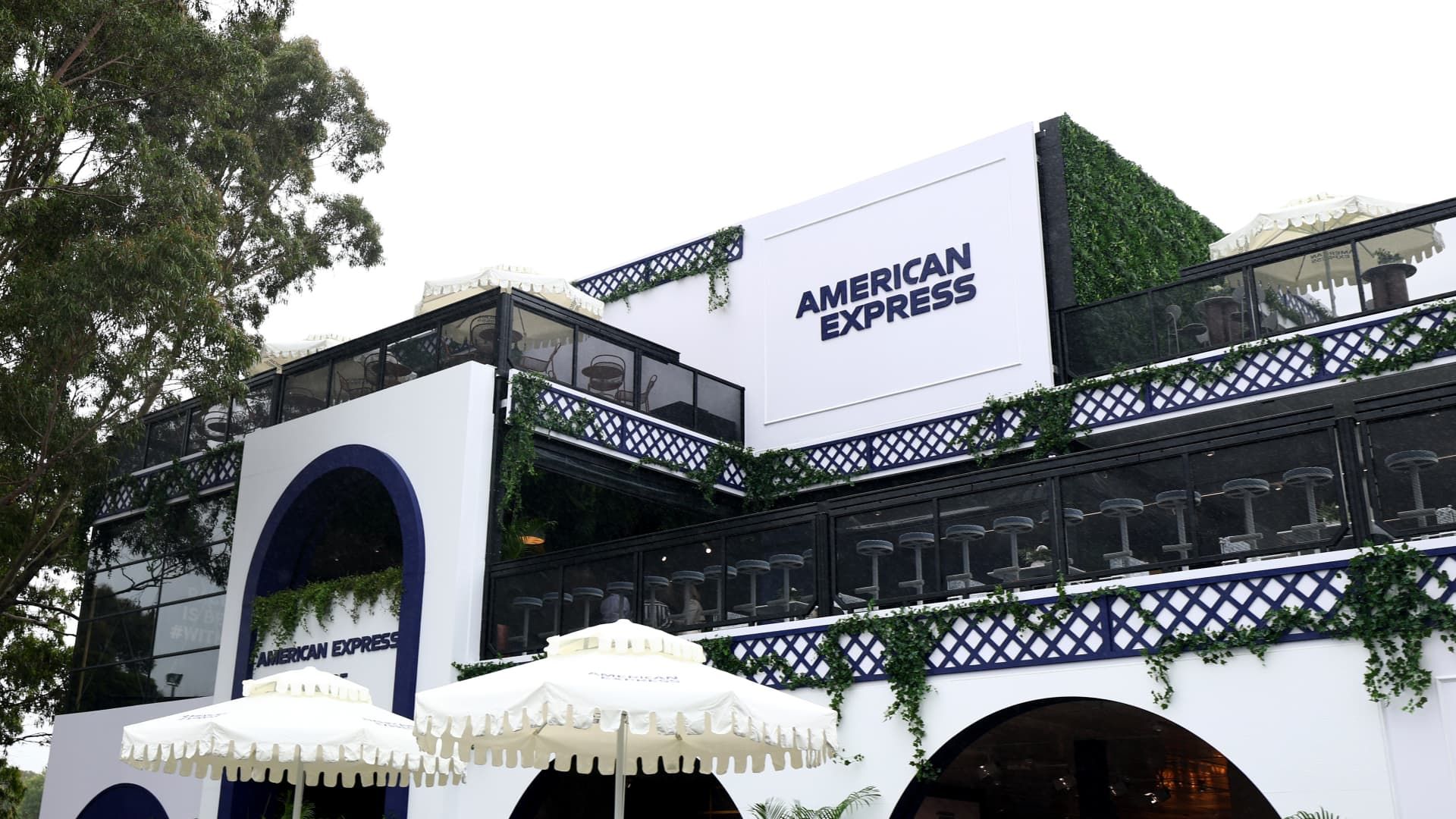
A general view of the American Express Lounge during the 2026 Qatar Airways Formula 1 Australian Grand Prix preview day at the Albert Park Grand Prix Circuit on March 2, 2026 in Melbourne, Australia.
Josh Chadwick | fake images
American Express' partnership with Formula 1 began in 2023 and marked its first new sports sponsorship in more than a decade. A year later, it expanded the deal further and began rolling out new fan benefits such as trackside lounges.
“Our hope is that you will engage in these moments, deepen the emotional connection you have with American Express and that it will really push the American Express card to the top of your wallet,” Spaeth said.