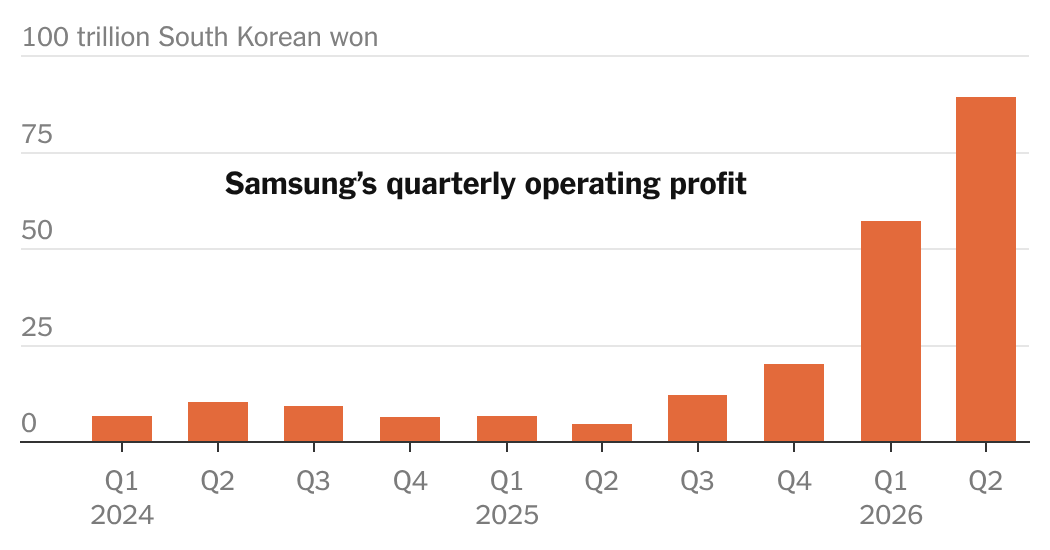
Samsung Electronics said its latest quarterly operating profit was nearly 20 times higher than last year, driven by seemingly insatiable demand for memory chips used in data centers for artificial intelligence.
The preliminary April-June results, announced by the South Korean tech giant on Tuesday, underscore how the staggering investments companies are making to build computing infrastructure for AI continue to drive memory chip makers' profits to record levels.
Samsung said it generated an operating profit of 89.4 trillion South Korean won, or about $58 billion, in the second quarter. That was well above the 4.7 trillion won it earned in the same quarter last year, and more than it earned in 2024 and 2025 combined. The company's revenue also more than doubled in the quarter, to about $112 billion.
Despite the strong results, Samsung shares fell 7 percent in Seoul after the announcement, a sign of how high investor expectations have become. Still, Samsung stock has more than doubled this year, fueled by AI mania.
The Kospi, South Korea's benchmark stock index, recently set a series of records, outperforming major markets around the world. It has more than doubled over the past year, and Goldman Sachs analysts estimate that nearly 90 percent of those gains have been generated by Samsung and SK Hynix, another memory chip maker. Both Samsung and SK Hynix reached trillion-dollar market valuations this year. “The stock market has never been more concentrated,” the analysts wrote.
The mania has attracted many individual investors, generating increasingly harrowing volatility in recent months. Although Goldman strategists warned of a “bumpy road given the volatility inherent in the memory sector,” they forecast a 20 percent gain for Kospi in the second half of the year, driven by “exceptionally strong” earnings growth.
The Kospi fell 5 percent on Tuesday, dragged down by Samsung.
High-bandwidth memory chips are a critical component for feeding the data needed to train AI systems and run large language models, but increased spending on data centers has depleted much of the global supply of these semiconductors. This has allowed Samsung, SK Hynix and other memory makers to raise prices and maintain large profit margins.
On Monday, SK Hynix began a share sale in the United States potentially worth $28 billion, which would make it the second-largest share issue on record, following SpaceX's successful $86 billion public offering last month.
Sanjeev Rana, head of Korea research at CLSA, an Asia-based investment group, said he expects the supply of high-bandwidth memory chips to remain limited until 2028, when new semiconductor factories currently under construction come online and ramp up production.
High-performance memory chips are essential for reducing the energy costs of running data centers and improving their capabilities.
South Korea produces about 60 percent of the world's memory chips. However, many are concerned that profits will flow primarily to a handful of companies, such as Samsung, with few spillover effects to the broader economy.
Earlier this year, Samsung avoided a strike by agreeing to pay employees in its semiconductor division, including assembly line operators, an annual bonus of up to $400,000 next year if certain profit targets are met.