The FTSE 100 fell slightly on Friday as US President Donald Trump said he was now making a “final” decision on whether to strike a peace deal with Iran.
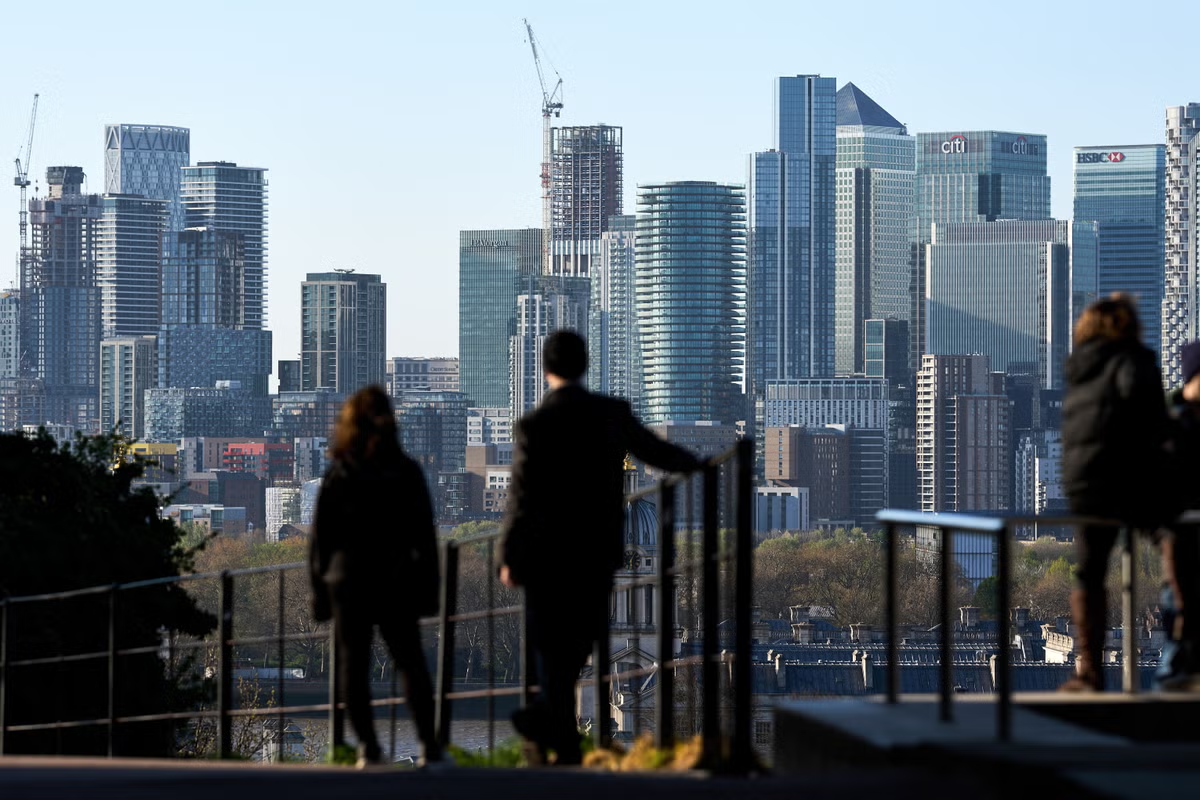
The FTSE 100 closed down 16.68 points, or 0.2%, at 10,409.28.
The FTSE 250 finished up 100.85 points, or 0.4%, at 23,425.77, while the Aim All-Share rose 7.62 points, or 0.9%, to 821.25.
For the week, the FTSE 100 fell 0.3%, the FTSE 250 strengthened 2.1% and the Aim-All Share rose 3.3%.
In a lengthy social media post, Trump said Friday, “I will meet now, in the Situation Room, to make a final determination,” and emphasized that Iran must agree to never have nuclear weapons and open the Hormuz sea lanes.
In the post, Trump said Iran will “complete immediate removal” of mines in the strait and that the U.S. naval blockade of Iranian ports “will now be lifted,” allowing tankers and other oil tankers to begin moving.
However, it was unclear whether Iran had agreed to this or whether the US blockade had actually been lifted before Trump made his decision.
US Vice President JD Vance had previously said Washington and Tehran are close to reaching an agreement to extend their ceasefire in the Middle East war, although potential progress still depends on Trump's approval.
According to the news, Brent crude for delivery in July fell to $91.62 per barrel on Friday, compared to $94.57 at the close of the London Stock Exchange on Thursday.
In European stock markets on Friday, the CAC 40 in Paris closed down 0.1% and the Dax 40 in Frankfurt closed up 0.1%.
In New York, the Dow Jones Industrial Average rose 0.7%, the S&P 500 rose 0.3% and the Nasdaq Composite strengthened 0.2%.
On Wall Street, Dell stole the show with a 31% rise as first-quarter earnings beat expectations and raised revenue guidance by $30 billion for the 2027 financial year to $165 billion to $169 billion.
Dell is “beating expectations” and raising its outlook “materially,” JPMorgan analysts said.
The pound was trading at $1.3479 on Friday afternoon, down from $1.3435 on Thursday.
Against the euro, sterling strengthened to 1.1543 euros from 1.1530 euros on Thursday.
The Bank of England governor has said allowing inflation to remain above target levels for a period is “appropriate” in the face of uncertainty and weakness in the economy.
Andrew Bailey told an audience in Reykjavik, Iceland, that reacting too soon to concerns about inflation “can lead to undesirable volatility.”
He said: “Given the backdrop of weakness in the real economy and uncertainty around the scale and duration of the shock, temporarily tolerating above-target inflation to provide some support to the real economy is an appropriate way to address the balance.
“But that tolerance would be weakened if signs of side effects start to emerge.”
The 10-year US Treasury yield fell to 4.43% on Friday from 4.46% on Thursday.
The 30-year US Treasury yield fell from 4.99% to 4.97%.
The euro traded higher against the dollar, trading at $1.1680 on Friday versus $1.1653 on Thursday.
Against the yen, the dollar was trading at 159.15 yen, down from 159.23 yen.
Gold was trading at $4,584.74 an ounce on Friday, down from $4,479.57 on Thursday.
The rise in the price of the yellow metal boosted Endeavor Mining, with an increase of 4.2%, and Fresnillo, with an increase of 1.4%.
On the FTSE 250, Ocado soared 7.1% after announcing a deal to develop supermarket Asda's online business across the UK.
Leeds-based Asda is one of the UK's largest grocery retailers, with total 2025 sales of more than £21bn and operations in 1,100 stores across the country.
Asda's online grocery business processes more than 700,000 ecommerce orders weekly.
Based on comparable deals, Bank of America estimates fees in the range of 0.7% to 1.0% of sales, implying annual revenue of around £21 million to £30 million once the launch is complete by the 2028 financial year.
“We view the deal as a positive development for Ocado,” BofA said, adding that the contract should be “highly profitable.”
RBC Capital Markets believes the deal is a “small drawback” for Asda rivals Tesco and J Sainsbury.
It said: “We expect this to be a significant enhancement to Asda's ecommerce capabilities and should allow it to better compete in a rapidly growing part of the grocery market.
“As such, we see this as a small potential downside for the likes of Tesco and Sainsbury's, although we note that both players have had strong ecommerce offerings for some time now, which are likely to be more profitable than this deal for Asda.
“Still, it is another step in Asda's recovery.”
Tesco shares fell 2.2%, while J Sainsbury's fell 2.3%.
Other retailers were hit when Deutsche Bank Research downgraded Wickes, Dunelm, Currys and B&M European Value Retail, causing the four to fall 2.2%, 2.3%, 1.0% and 2.4% respectively.
Although the retail sector has devalued since March, as consensus expectations have declined due to inflation concerns, “we still see downside risks for low-income, high-spending consumers,” analysts at Deutsche Bank said.
The biggest risers on the FTSE 100 were Endeavor Mining, up 184.0p to 4,594.0p, Autotrader, up 14.3p to 441.5p, Airtel Africa, up 8.2p to 352.6p, Convatec, up 3.9p to 202.2p and DCC, up 115.0p to 4,594.0p. 6,005.0p.
The biggest fallers on the FTSE 100 were SSE, down 74.0p to 2,331.0p, Diageo, down 46.5p to 1,535.5p, Imperial Brands, down 73.0p to 2,696.0p, British American Tobacco, down 116.0p to 4,591.0 pence, and Coca-Cola Europacific Partners, which fell 170.0p to 6,670.0p.
Monday's global economic calendar includes a slew of manufacturing PMI reports, eurozone unemployment figures and German retail sales data.
Next week's local corporate calendar includes a trading update from British American Tobacco, owner of Dunhill and Lucky Strike, on Tuesday, and full-year results from water company Pennon, also on Tuesday.
– Contributed by Alliance News