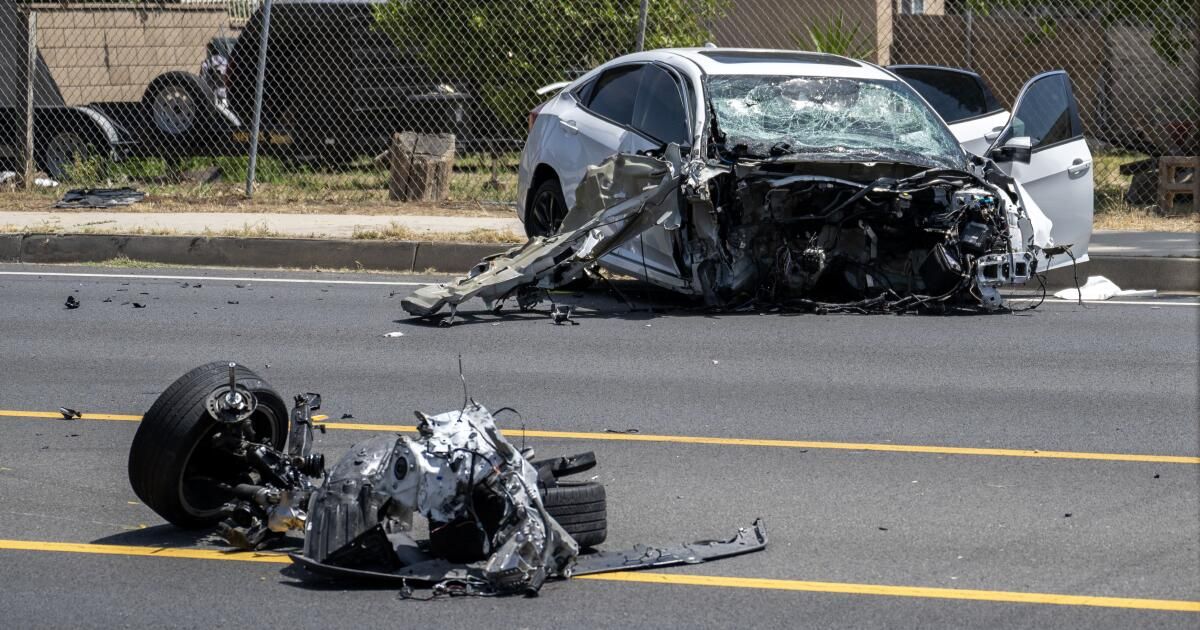
After experiencing the loss of three friends in car accidents, Assemblywoman Tina McKinnor decided she needed to take action.
She immersed herself in the movement to improve driving safety, and now the Hawthorne Democrat is drafting controversial legislation that could revolutionize the way auto insurance rates are set for many California drivers.
The McKinnor Consumer Driving Data Protection Act would allow insurers to track speed, braking and other driving habits to establish a motorist's safety record, a key component in setting individual premiums, as long as the motorist agrees to it.
While that tracking has Big Brother overtones, the bill promises lower rates for drivers who may not have the best driving record but can demonstrate that they are now using less fuel and have stopped weaving in and out of traffic.
Currently, a driver's safety record is determined by the Department of Motor Vehicles' point system, which considers the driver's traffic violations and accidents.
That system would remain in place for those who don't want insurers tracking them and looking over their shoulders every time they get behind the wheel.
The use of telematics calling, while common in other states, has raised concerns among consumer and privacy groups because of the data collected by insurers and the technology companies that provide the systems. Critics also doubt that the systems do much to reduce crashes.
“This bill forces Californians to choose between their privacy and affordable auto insurance,” said Carmen Balber, executive director of the Los Angeles advocacy group Consumer Watchdog.
But insurers and safety advocates argue it is a more accurate way to determine drivers' likelihood of getting into a crash and a method to encourage better driving.
“To me, this is a way to incentivize people to slow down,” McKinnor said. “If 10 people choose to participate and slow down, and if we can save 10 lives, that will make me very happy.”
Data can be collected through smartphone apps, transponders and other technologies, and apps can detect whether a driver is on their phone and distracted, a leading cause of accidents along with speeding.
It is expected that California insurers will likely collect the data for six months and use it to quote premiums for the next six-month period. The systems provide real-time information about driving and could be challenged by drivers.
A study last year by the Maryland Insurance Administration found that in 2023, 31.2% of the state's drivers who signed up for telematics insurance saw a decrease in rates, 23.6% saw an increase, and 45.2% of rates remained unchanged due to telematics rating factors.
With advances in technology, insurers have been accelerating investments in telematics, data and artificial intelligence, including to better predict driver risk and set rates, according to insurance rating agency AM Best.
The effort comes as insurers have been hit with more expensive accident claims due to parts inflation; more expensive, complex and heavier vehicles; and increased speeds on highways leading to more serious crashes, although deaths decreased last year statewide and nationally, according to government statistics.
“I don't see it so much as a source of revenue as much as saving money, because if there are fewer claims and fewer accidents, that changes the payment structure,” said Allison Adey, a lobbyist for the Personal Insurance Federation of California, an industry trade group in favor of the legislation.
On average, insurance rates written by California's largest auto insurers have increased more than 30% since 2022, according to S&P Capital IQ.
Although California is often at the forefront of technological advances, it is the only state in the country that prohibits the use of telematics in personal auto insurance rate setting, even though the systems were introduced more than two decades ago. It is also voluntary in all other states.
This is due, at least in part, to Proposition 103, which passed in 1988 in an era of skyrocketing auto premiums. It strictly regulates how rates are set and provides for extensive public oversight. The measure cannot be changed without a two-thirds vote of the Legislature, and any amendment must further its purposes.
The law requires that rates be set primarily based on an individual's driving history, as well as years of driving experience and miles driven annually. Rates must be reviewed and approved by the insurance department, which takes months.
Passage of McKinnor's bill would open California's large personal auto insurance market (with more than 27 million licensed drivers) to the growing telematics industry, which makes tracking devices and other technologies that insurers employ and provides the software to process all that data.
The global market is expected to surpass $92 billion in revenue this year and reach $270 billion by 2033, according to research and consulting firm Grand View Research.
The bill passed through two state Senate committee hearings, helped by testimony from McKinnor and witnesses who lost loved ones in accidents and offered accounts they had seen of unsafe driving.
But the bill's future is not assured, due to opposition not only from consumer and privacy groups but also from the state Department of Insurance.
The department, in a June 20 letter to the Senate Insurance Committee, said the bill shifts responsibility for regulatory compliance from insurers to telematics service providers, does not give the agency sufficient oversight over providers and places a heavy regulatory burden on the department.
A series of amendments adopted by the Senate Committee on Privacy, Digital Technologies and Consumer Protection sought to address some of those concerns. McKinnor is in talks with the department about other changes he seeks.
“They gave me like 15 or 20 pages of amendments. I think we'll get it done. We're working on those amendments with them because otherwise I don't think the bill will pass,” said McKinnor, who has received donations from the insurance industry but said they haven't influenced his telematics advocacy.
Michael Soller, spokesman for Insurance Commissioner Ricardo Lara, declined to comment on the talks.
Concern over data collected by telematics companies and other companies has been fueled by breaches, illegal sales, and the growing ability to “re-identify” the source of data even when it has been anonymized.
This year alone, General Motors agreed to pay $12.75 million for violations of the California Consumer Privacy Act after selling the driving data of California drivers who signed up for the company's OnStar navigation and roadside assistance service to data brokers without proper notice or consent.
Consumer Watchdog, founded by attorney Harvey Rosenfield, author of Proposition 103, has been among the legislation's most notable opponents.
Although the bill prohibits the sale of the collected data, the group maintains that the legislation includes loopholes that will allow its disclosure. Consumer Watchdog also cites the secrecy surrounding telematics companies' proprietary algorithms.
“It destroys Proposition 103's good driver protections and replaces your actual driving record with a black box score based on extensive data collection,” Balber said.
Ryan McMahon, senior vice president of Cambridge Mobile Telematics, the nation's largest automotive telematics company, said the bill has strong data protections, allows only driving habits to determine a driving safety score, and is misunderstood by critics who generally oppose telematics.
“There are a number of high-level things that people are opposed to in principle that are not represented in the language,” he said, noting that the bill gives state regulators access to algorithms.
Another issue raised by Consumer Watchdog is that the bill could result in drivers with poor driving records paying less for insurance than excellent drivers who don't want to be tracked; and those drivers would, in essence, pay discounts for tracking. The group alleges that is a violation of Proposition 103.
Adey said he believes it would be possible to eliminate the fact that good drivers pay for tailgating discounts by creating separate “risk pools” that don't mix the two populations. Balber disagrees.
There is also the question of whether telematics really reduces accidents and deaths. Supporters of the bill have cited two studies that received funding from the insurance industry and show a reduction in unsafe driving habits, including one in the peer-reviewed medical journal JAMA, which also received funding from two government agencies.
McMahon also cites a study that found a 20% reduction in accidents in commercial fleets using telematics. However, a limitation of consumer programs is that they are voluntary.
“Overall, there are benefits to using telematics,” said Chris Draghi, director of AM Best. “However, there is something that can also influence this: [is] “the group of people who opt into these programs may also be those who are already ‘safer’ drivers.”
One of the most compelling witnesses in favor of the bill has been Damian Kevitt, who founded Streets Are For Everyone, a group co-sponsoring the legislation. He acknowledges that he has received sponsorship from the insurance industry in the past.
Kevitt lost his right leg in a 2013 hit-and-run collision in Griffith Park while riding his bicycle after the car accelerated and dragged him down a freeway on-ramp.
He is unsure of the cause of the collision, but is convinced the legislation will make the streets safer.
“We know that texting while driving causes traffic collisions, so having something that is an incentive instead of a penalty to incentivize you to drive safer is a no-brainer,” he said.