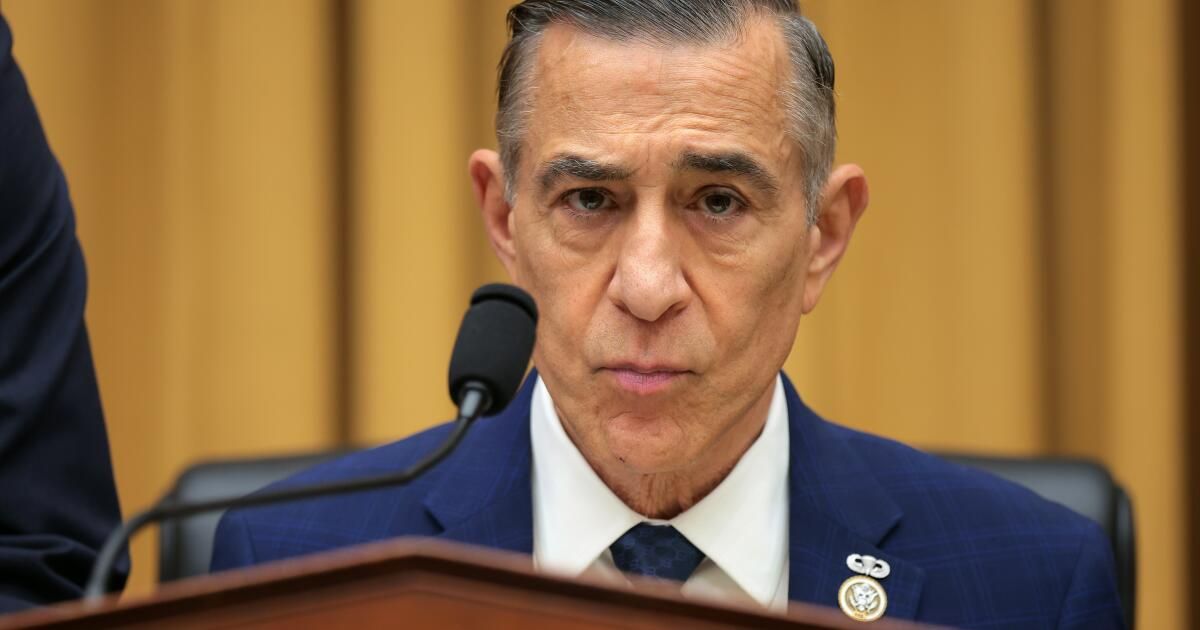
Veteran Republican Rep. Darrell Issa announced Friday that he will not run for re-election in his newly drawn congressional district in San Diego and Riverside counties.
“This decision has been on my mind for a while and I did not make it lightly,” Issa said in a statement, arguing that he would have won the 2026 race based on his campaign's polls and President Trump's support, among others. “But after a quarter century in Congress, and before that, a quarter century in business, the time is right for a new chapter and new challenges.”
Issa called congressional service “the honor of a lifetime” and highlighted his work for constituents like retired Navy fighter pilot Royce Williams, 100, who received a Congressional Medal of Honor during Trump's State of the Union address. “…every day, my teams in Washington and California have worked to deliver for our constituents,” Issa said.
Issa, one of the richest members of Congress, began telling people earlier this week that he was retiring from Congress, the sources said.
He had an enormous impact on state and national politics, according to experts and political strategists, including funding the successful impeachment of Gov. Gray Davis in 2003, which brought Arnold Schwarzenegger to office, and his work as head of the powerful House Oversight and Government Reform Committee during high-profile investigations of the Obama administration.
“Darrell Issa was a constant and consequential presence in the Republican Party in California without ever being its most prominent leader,” said Thad Kousser, a political science professor at UC San Diego. “He's probably the person most responsible for the impeachment of Gray Davis going forward, but then he was shut out of the race when Arnold Schwarzenegger came in. He became one of Barack Obama's most prominent players. But that never elevated him to state prominence or state office in his own state.”
National and state Republicans praised Issa.
“We are grateful for Congressman Darrell Issa's decades of dedicated service to the people of California and our nation,” said National Republican Congressional Committee spokesman Christian Martinez. “Throughout his career, he has embodied the spirit of public service, defended our military, and fought tirelessly for a stronger America.”
Kevin Spillane, a San Diego-area Republican political strategist, said Issa substantially raised his national profile during the investigation into the 2012 attack on the U.S. diplomatic mission in Benghazi, which resulted in the deaths of Ambassador Christopher Stevens and three other Americans.
“He's been a national figure practically since he's been in Congress,” Spillane said. “He was one of the most vocal people on Benghazi. He's been a national foil to Obama and Hillary Clinton. He was a major figure at the state level in terms of funding the recall that allowed Arnold Schwarzenegger to get elected. He's been a major figure in San Diego County politics for more than two decades. He's an important member of Congress.
“It's a loss for California Republicans in terms of our congressional delegation,” Spillane said. “It's a loss for national Republicans in terms of losing a significant figure in the Republican caucus.”
Issa's move was prompted by the redrawing of his congressional district under Proposition 50, a redistricting plan that voters approved in November to counter President Trump's efforts to pressure GOP-led states to redraw their congressional lines to favor Republicans.
“Unfortunately, Rep. Issa is a victim of his own inaction,” said Paul Mitchell, the Democratic strategist who drew the new congressional districts approved in November that made Issa's reelection prospects shaky. “Privately, every Republican incumbent in California knew it was a mistake, and yet the veterans with all the presidencies and power didn't speak up.”
Issa wasn't the only Republican member of California's congressional delegation whose reelection plans changed Friday because of Proposition 50.
Rep. Kevin Kiley (R-Roseville) made a surprise announcement Friday night that he would run for re-election as an independent candidate.
The redistricting approved by voters last year fractured Kiley's huge district in Northern California into six pieces. Earlier this week he announced he would run in the district that includes his hometown and other Sacramento-area suburbs but has a nine-point lead in Democratic voter registration.
Kiley described his decision to run as a candidate without party preference as a way to “fight back and protect our democracy” from “partisan games.”
“It's no secret that I've been frustrated, sometimes disgusted, by the hyperpartisanship in Congress. Over the past year it has led to the longest government shutdown in American history, a massive rise in health care costs, and, of course, a futile redistricting war,” Kiley wrote on the social media site X.
Shortly after Issa announced his retirement Friday night, Democrats were quick to celebrate the party's prospects of winning the seat and adding to their ranks in California's congressional delegation.
“After more than two decades of disastrous representation, Darrell Issa is once again running for the exits — and out,” said Anna Elsasser, spokeswoman for the Democratic Congressional Campaign Committee. “Issa's abandoning his voters now is the clearest sign yet that Republicans know he can't win with his record of skyrocketing prices, destroying health care, and looking out for himself and rich special interests above all else.”
Issa endorsed San Diego County Supervisor Jim Desmond to replace him. His supervisory district includes more than a quarter of the new district.
Desmond had been running in a neighboring congressional district that spans Orange and San Diego counties and is currently represented by Rep. Mike Levin (D-San Juan Capistrano). Although Levin's district has been considered competitive, Proposition 50 made it safer for Democrats. Desmond withdrew from that race and filed to run in Issa's district on Thursday, according to San Diego County voter registration.
Issa, 72, has represented several San Diego-area districts in Congress for 23 years. Issa's district, once solidly Republican, had trended more moderate in recent years.
Registered Democratic voters outnumber Republicans by more than four percentage points in Issa's new district, which spans San Diego and Riverside counties and was reshaped to include liberal communities such as Palm Springs, according to the nonpartisan California Target Book. Issa's current congressional district had a 12 percentage point Republican advantage in voter registration in 2024.
As soon as the new districts were approved, speculation began to arise about Issa's re-election plans. Some of his supporters in Texas urged him to move there to run in a GOP-friendly Dallas-area district, but he said in December that he declined and would instead seek re-election in California.
“I believe that the people of San Diego County, who have elected me so many times, in fact, regardless of their registration, will vote for me,” Issa told Fox's San Diego affiliate in December. “This is my house and I am going to fight for it.”
Several Democrats had already announced plans to challenge Issa, including San Diego City Councilwoman Marni Lynn von Wilpert and repeat candidate Ammar Campa-Najar.
Issa, a high school dropout and Army veteran, made his fortune by purchasing a struggling electronics business in 1980 and transforming it into the Viper car alarm system, with Issa's voice warning would-be thieves to “stay away.”
Times staff writer Nicole Nixon iin Sacramento contributed to this report.