MEXICO CITY — Hugo Chávez called the United States “the empire” and President George W. Bush “the devil.” By denouncing capitalism as “the road to hell,” he promoted an alternative economic model that nationalized key industries and redistributed wealth.
During his 14-year presidency in Venezuela, Chávez warned of a CIA plot to kill him and steal his country's vast oil reserves, declaring: “Homeland, socialism or death!”
Now, after the United States attacked Venezuela and imprisoned Chávez's successor, Nicolás Maduro, the future of the leftist movement forged by Chávez (known as chavismo) may be at stake.
Venezuela's interim leader Delcy Rodríguez insists that her country “will not be a colony” of any imperial force, but appears willing to tolerate President Trump's demands that the United States gain “full access” to Venezuela's oil.
Rodríguez, Maduro's vice president, has called for reforms in Venezuela's energy sector to attract foreign investment and has freed dozens of dissidents once considered enemies of the Chavista revolution.
“Venezuela is entering a new political era, which allows for understanding despite political and ideological differences and diversity,” Rodríguez said last week. On Thursday he met in Caracas, the capital, with CIA Director John Ratcliffe, whose agency helped plan Maduro's kidnapping.
“It's quite interesting to see how a hardline Chavista like Delcy has done a 180 degree turn just a week after assuming the presidency,” said Imdat Oner, a former Turkish diplomat in Caracas.
Some analysts now wonder whether the days are numbered for Chavismo, which allowed Chávez to concentrate power under a banner that extolled nationalism, populism and what he described as “21st century socialism.”
“I think he is in intensive care and I don't think he will come out of the operating room,” said Enrique Krauze, a Mexican historian who wrote a biography of Chávez. The movement has been undermined by the American attack, Krauze said, and discredited by authoritarianism, widespread corruption among leaders and an economic crisis caused by falling oil prices and American sanctions that led a quarter of the population to flee.
The ideas of Chavez, a charismatic figure who inspired a generation of Latin American leftists, have been hopelessly tarnished, Krauze said.
“We Venezuelans are exhausted after 26 years of Chavismo,” Venezuelan journalist Boris Muñoz wrote in the newspaper. Time magazine. “Understandably, many are willing to accept American guardianship as the price to pay.”
Other political analysts say Chavismo remains strong, even if aspects of its identity have changed since its namesake died of cancer 13 years ago.
Chavismo is not a passing fad. It is a lifestyle and a principled conviction.
—Wilson Barrios
“What's left of Chavismo? Everything,” said Javier Corrales, a political science professor at Amherst College. Except for the removal of Maduro and his wife, Cilia Flores, who now face drug trafficking charges in the United States, “not a single person has been displaced,” Corrales said. “The inner circle, the military generals, the collectives“The governors, the mayors, they are all there.”
He noted that Chávez, despite his fierce anti-American rhetoric, maintained extensive oil trade with the United States. The current agreement with the Americans, he said, “does not depart from anything that Chavismo once represented.”
In Caracas, where faded and scattered portraits of Chavez still adorn the walls, there is a sense that little of substance has changed since American bombs woke residents in the predawn hours of Jan. 3. For the many Venezuelans who despised Maduro and his government, that is disappointing. For those who support the government, it is a relief.
On a sunny morning last week, about 2,000 Chavistas demonstrated on a downtown street.
“It won't be easy to erase socialism overnight with a few bombs and the kidnapping of a president,” said Wilson Barrios, 37, who works in the Ministry of Education.
“Chavismo is not a passing fad,” he stated. “It is a lifestyle and a principled conviction.”
Leader of the pink tide
Chávez, a former army officer inspired by Marxist and revolutionary thinkers such as Simón Bolívar and Fidel Castro, was one of the most consequential political figures in recent Latin American history.
His election in 1998 helped unleash Latin America's “pink tide,” in which leftist leaders rose to power from Argentina to Brazil to Ecuador.
His populist rhetoric and mixed-race background appealed to the masses in a nation long governed by an elite minority of mostly white, pro-business politicians with close ties to the United States and foreign oil giants.
At a rally in Caracas in 2024, a supporter holds a statue of the late President Hugo Chávez as his successor, Nicolás Maduro, delivers a speech to formalize his re-election bid.
(Getty Images)
Buoyed by record oil prices that inflated state coffers, Chávez launched social programs that reduced poverty rates. His government built housing for the poor and provided free and subsidized basic foodstuffs to those in need. He opened hospitals and schools and drastically reduced infant mortality.
An outspoken critic of American intervention in Latin America and what he considered rampant materialism in the “imperialist” United States, Chávez forged alliances with Washington's adversaries such as China, Cuba and Iran.
In a speech to the UN General Assembly in 2006, a day after Bush gave a speech on the Iraq War, Chavez declared: “The devil was here yesterday… this place still smells of sulfur!”
Disgruntled Venezuelan elites attempted to overthrow Chávez (mostly during a brief coup in 2002), but he continued to win elections.
The tide began to turn after his death in 2013 and the rise of Maduro, a former union leader who lacked the charisma of his mentor. Then came a dramatic drop in oil prices, inevitable in an industry prone to boom-and-bust cycles.
As incomes sank, the economy collapsed amid soaring inflation. The lines to buy bread and medicine lasted for hours. Malnutrition and infant mortality increased. Millions fled the country.
Support for Maduro plummeted and the opposition handily defeated his party's candidates in 2015. parliamentary elections. Sanctions on Venezuela's oil industry during Trump's first term made things worse for Maduro.
From the beginning, Maduro had been deepening the authoritarianism that had begun under Chávez, a model that, according to Corrales, was “based on the idea that the revolution will never give up power.”
Maduro claimed he won a disputed election in 2018, although the United States and other countries refused to recognize the results. In 2024, Maduro again declared victory, although voting records collected by the opposition showed that he lost by a wide margin.
Maduro clamped down on dissent, imprisoning hundreds of activists, ordering government forces to shoot protesters and sparking another exodus of migrants.
These days, the pink tide is far in the rearview mirror, with conservatives winning recent elections in Ecuador, Argentina and Chile.
John Polga-Hecimovich, a Latin American expert at the U.S. Naval Academy, said emigration from Venezuela to neighboring countries in recent years has influenced many people's views on leftist politics in general and Chavismo in particular.
Across the region, it is now common for right-wing candidates to accuse their left-wing opponents of being like Chávez and wanting to turn their country into “another Venezuela.”
True believers or pragmatists?
Rodríguez has deep revolutionary roots. His father was a Marxist guerrilla who was killed after kidnapping an American businessman in 1976. Rodríguez, one of Chávez's early disciples, whom he still refers to as “comandante,” said building a socialist state was “personal revenge” for his father's death.
But in recent years, as he rose through the ranks of Maduro's government, Rodríguez showed a pragmatic side.
To help correct the economy, he made agreements with business elites and pushed for a reform that allows Venezuelans to use the dollar instead of the bolivar. He helped change laws to make the energy industry more attractive to foreign capital.
Their efforts caught the attention of White House officials last year as they weighed a possible operation to overthrow Maduro.
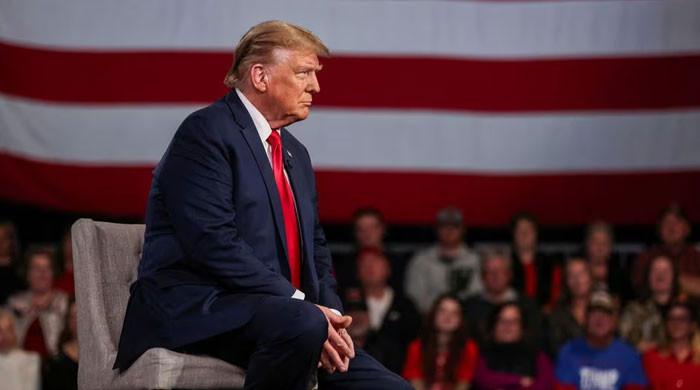
Now Rodríguez must walk a fine line and continue to show his revolutionary bona fides to hardline Chavistas while placating Trump, who has warned that he will “pay a very high price” if he does not comply with the United States' demands.
He denounced the “terrible military aggression” carried out by US forces, but also had what he called a “long and courteous telephone conversation” with Trump, saying that with “mutual respect” they discussed a bilateral agenda for the benefit of both nations. He, in turn, called her “a great person.”

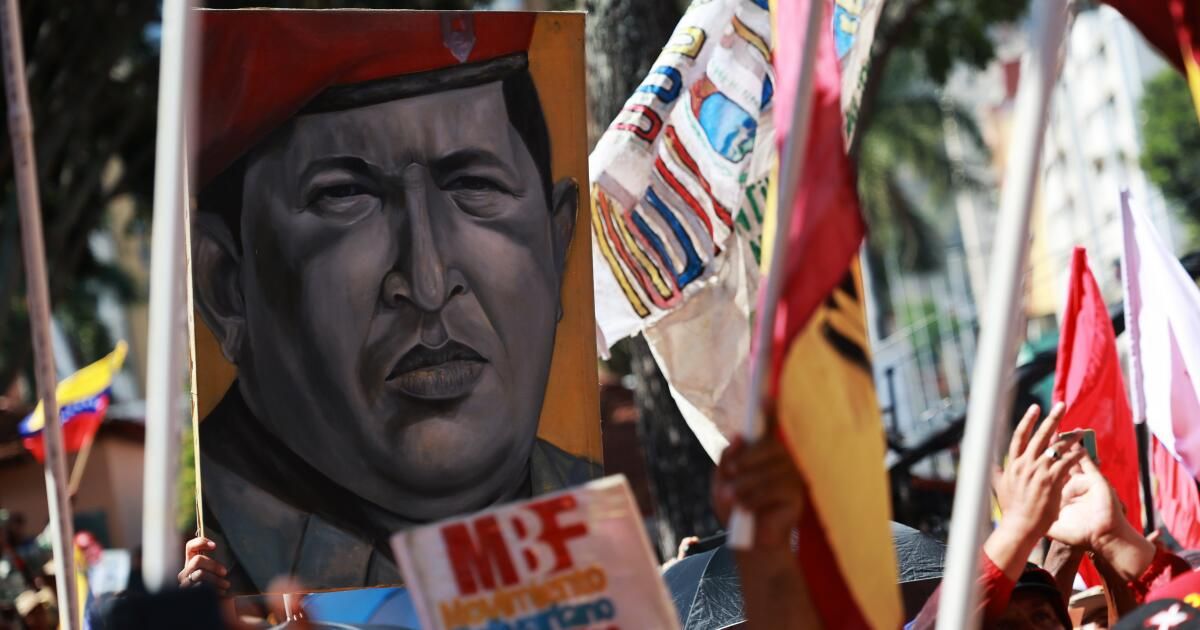
A government supporter holds paintings of the late President Hugo Chavez during a campaign rally on November 18, 2021 in Caracas.
(Manaure Quintero/Getty Images)
Oner, the former diplomat, said that her closeness to Washington does not mean that Rodríguez has abandoned her revolutionary ideology. He believes she and other leaders have sacrificed some key principles of Chavismo to save it.
“They are doing this for the survival of the regime,” Oner said. “They have to be flexible to stay in power, or they will lose everything.”
Still, there is little doubt, Oner said, that Chavez would be disappointed.
“He would feel deeply betrayed by Delcy's actions.”
Linthicum and McDonnell reported from Mexico City and James from California. Special correspondent Mery Mogollón contributed from Caracas, Venezuela.