- Trump claims Iran was about to strike first, contradicting Rubio.
- Conservatives criticize US involvement in the Iran war.
- White House in damage control for conflicting war reasons.
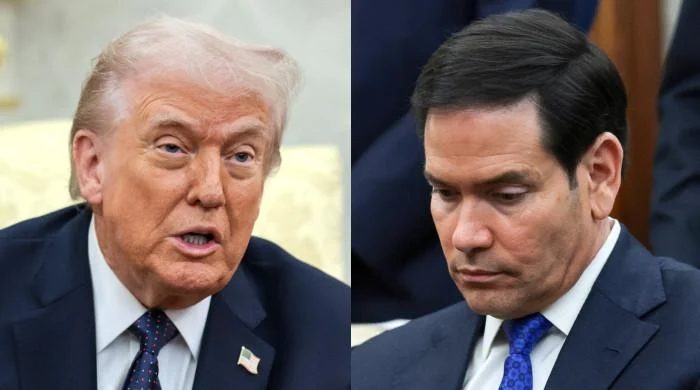
WASHINGTON: President Donald Trump said Tuesday that he ordered U.S. forces to join Israel's attack on Iran because he believed Iran was about to strike first, contradicting a justification offered a day earlier by his secretary of state for how the war began.
Secretary of State Marco Rubio told reporters on Monday that the United States launched the attack out of fear that Iran would retaliate in response to planned Israeli action against Tehran.
“We knew there was going to be an Israeli action; we knew that would precipitate an attack on American forces, and we knew that if we didn't preemptively pursue them before they launched those attacks, we would suffer greater casualties,” Rubio said.
Trump rejected suggestions that Israel pushed the United States into the conflict, as his administration gave different accounts and faced criticism from some supporters and Democrats who accused him of launching a “war of choice.”
“I could have forced (Israel's) hand,” Trump told reporters in the Oval Office while meeting with German Chancellor Friedrich Merz. “We were negotiating with these lunatics and in my opinion they were going to attack first. If we didn't, they would attack first. I felt that strongly.”
Iran has said the US attack was unprovoked.
Several prominent conservative commentators stepped up their criticism of the Iran attacks, arguing that Rubio's comments indicated that Israel, not the Trump administration, was calling the shots.
“So he flat out tells us that we are in a war with Iran because Israel forced us,” conservative podcaster Matt Walsh wrote about Rubio to his 4 million followers on X. “This is basically the worst thing he could have said.”
Megyn Kelly, a conservative podcast host, told her audience that she had doubts about Trump's decision to attack Iran.
“Our government's job is not to take care of Iran or Israel. It is to take care of us. And this clearly strikes me as Israel's war,” Kelly said in remarks broadcast before Rubio's comments.
The criticism from Trump's right flank comes as his Republican Party struggles to maintain control of the US Congress in November's midterm elections.
Damage control
The debate over the run-up to the war has forced the White House to do damage control.
On Tuesday, Trump took questions from reporters in a public setting for the first time since the air war between the United States and Israel began three days earlier. He previously discussed the attacks in two videos, one-on-one interviews with select journalists and brief comments Monday at the White House.
The president said he believed Iran was about to launch attacks, without presenting evidence to support his view, after U.S. negotiations with Iran last Thursday in Geneva. Iran described those talks as positive and more are planned in the coming days.
“It's something that had to be done,” said Trump, who did not present detailed arguments for war against Iran before it began.
Rubio, pressed Tuesday for his earlier comment during a visit to the Capitol, told reporters: “The bottom line is this: The president determined that we were not going to be the first to be attacked. It's that simple, guys.”
Two senior Trump administration officials held a conference call Tuesday with reporters to describe the events leading up to the military operations, particularly the Geneva talks with Iranian officials held by U.S. envoys Steve Witkoff and Jared Kushner and mediated by Oman.
The two officials said Witkoff and Kushner repeatedly pressured Iran to abandon uranium enrichment. Instead, Iran presented a plan that would allow the Iranians to enrich uranium at higher percentages at the Tehran Research Reactor in northern Iran, they said.
U.S. envoys felt the Iranians were employing delaying tactics, according to the officials.
“They were not willing to give up the basic elements of what they needed to preserve in order to get to a (nuclear) bomb,” one official said.
Iran denies seeking a nuclear weapon.
Envoys briefed Trump and told him that it might have been possible to reach a nuclear deal similar to the one former President Barack Obama's team and world powers negotiated with Iran in 2015, but that it would take months.
Trump ordered US forces into action the next day and the strikes began on Saturday.