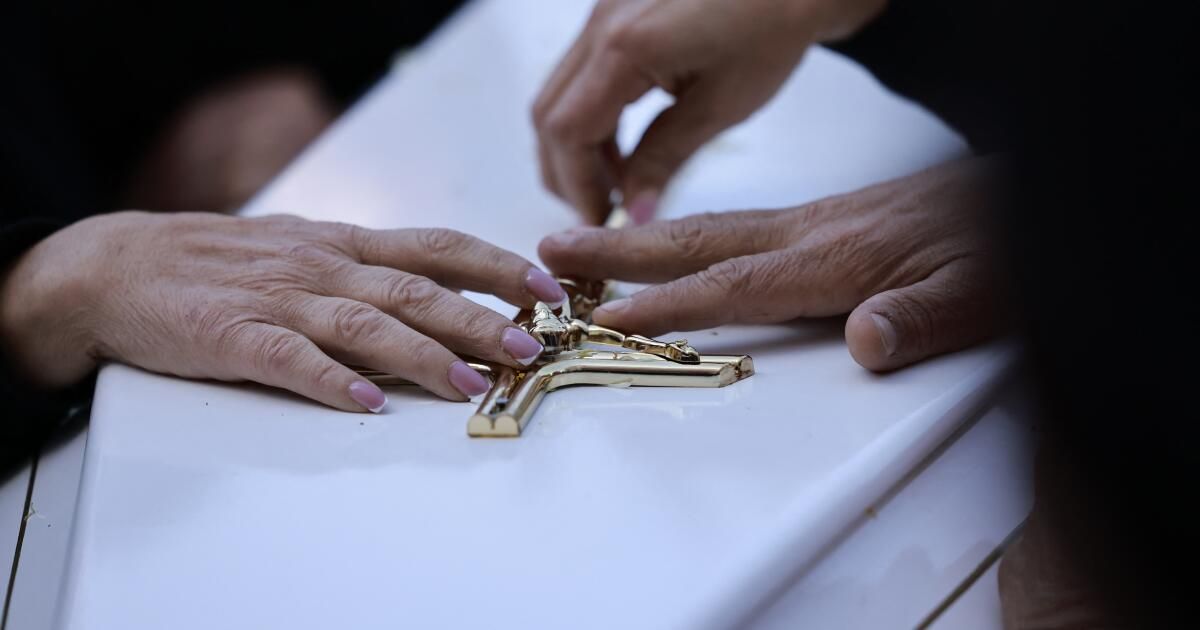
QLAYAA, Lebanon — The bells rang, their peals obscuring the drone of the Israeli drone overhead as Father Pierre al-Rahi's coffin arrived at the parish where he had served.
Just a few days earlier, Al-Rahi had been at the same cemetery where crowds gathered Wednesday for his funeral. He had announced that the people of Qlayaa would ignore Israel's evacuation orders for southern Lebanon and remain.
“It gave us strength to stay rooted here. I kept repeating, 'We will stay,'” said Eveline Farah, a 67-year-old resident.
And he had kept his word, Farah added. So when a shell from an Israeli tank hit a house in the village on Monday, Al-Rahi and others rushed to help the elderly couple who lived there.
A Lebanese soldier stands next to a poster of the village priest, Father Pierre al-Rahi, during his funeral in the Lebanese Christian border village of Qlayaa on March 11, 2026.
(Rabih Daher / AFP/Getty Images)
That's when the second projectile fell, wounding Al-Rahi and five other people. He bled to death that same day, bringing home to Qlayaa, one of the few Christian-majority areas in southern Lebanon, the latest conflict between Israel and the Islamic militants of Hezbollah. It is a war that no one here wants.
“No one in Qlayaa is fighting. There is no Hezbollah here. They want to fight, let them. It has nothing to do with us,” said Najla Farah, 39, a distant relative of Eveline Farah.
As the funeral procession approached the cemetery, a group of women threw rose petals and rice. Others ran towards the coffin, dancing, clapping, hooting; all through tears.
“Get up, Father Pierre. Get up!” an elderly woman shouted as she stood in the path of the pallbearers, her screams causing her voice to become hoarse as she partially collapsed in a doctor's arms.
“You're not one to be left alone!” she said. “No one can carry you!”
More than a week after hostilities escalated between Hezbollah and Iran-backed Israel, the war that many Lebanese hoped to avoid is escalating, causing devastation in communities that in the past had managed to stay out of it.
Lebanese government health authorities said Wednesday that 634 people have been killed in the country since March 2, including 47 women and 91 children, when Hezbollah launched rockets into Israel and spurred an all-out Israeli campaign. Some 816,000 people have been displaced.
Despite the severity of those numbers, before Al-Rahi's death, many here in Qlayaa had settled into a routine born of a long familiarity with the conflict.
After all, the approximately 4,000 people living here had withstood the 2024 conflagration between Hezbollah and Israel. Although most of the cities and towns around it are under de facto Hezbollah control, Qlayaa – like other Christian, Sunni Muslim and Druze communities that dot the bucolic hills of southern Lebanon – had adopted a resolutely neutral position. Those communities prevented Hezbollah fighters from taking up positions in their areas and that is why Israel did not attack them.

An Israeli airstrike hits Dahiyeh, in the southern suburbs of Beirut, on March 11, 2026.
(Hassan Ammar / Associated Press)
That pace continued after a ceasefire came into effect in late 2024, with Hezbollah disarming in the south and the Lebanese army taking control of the area. Meanwhile, Israeli troops still occupied parts of the south, and the Israeli army carried out almost daily attacks that it said were aimed at stopping Hezbollah's efforts to regroup.
In Qlayaa, less than three miles from Lebanon's border with Israel, the sounds of artillery, airstrikes and drones had mixed with the background noise.
Even after Hezbollah launched what it said was a campaign to avenge the assassination of Iranian Supreme Leader Ali Khamenei on February 28, and although Israel issued unprecedented evacuation orders for all of southern Lebanon soon after, “things seemed normal,” Najla Farah said.
“We even had a wedding on Sunday. It seemed less intense than the last war, until what happened with Father Pierre,” he said.
On Wednesday, Pope Leo XIV paid tribute to Al-Rahi in his weekly address. He noted that the word “rahi” means “shepherd” in Arabic, and that Al-Rahi was a “true shepherd” who had rushed to help injured parishioners “without hesitation.”
“May the blood he shed be a seed of peace for beloved Lebanon,” Leo said. “I am close to all the Lebanese people in this moment of grave trial.”
However, the comfort those words gave to the parishioners of Qlayaa was tempered by the confusion felt by Al-Rahi's murder.
Israeli army Arabic spokesman Avichay Adraee said Israeli troops had deployed a drone to “kill a Hezbollah terrorist cell in a Christian village in southern Lebanon,” but gave no further details about the location.
Residents said the house, near the outskirts of Qlayaa, was owned by a retired schoolteacher and his wife, who were in the kitchen at the time of the attack. The Lebanese army said the attacks involved two Merkava tank shells and that there was no Hezbollah presence in the area.
“Why hit the first time? Well, why hit again?” said Father Antonius Eid-Farah, vicar of St. George Parish and Al-Rahi's assistant.
Eid-Farah (no relation to Eveline and Najla Farah) echoed what seemed a common sentiment in the city: that Al-Rai's death had only galvanized the people's determination to stay.
The city's Christians have confidence in their church, he said. And furthermore, if they left Qlayaa, where would they go?
“To the streets?” asked. “How can they support their families?”
However, there was also a sense of frustration among many here, underscoring the growing anger not only against Hezbollah but also against the Lebanese government for its failure to weaken the group and stop its ability to wage war. When the head of the Lebanese army arrived at the funeral, some attendees interrupted and refused to allow the ceremony to continue until he left.
“Now he's coming? Why is he here instead of protecting us from projectiles and missiles?” said Chawline Maroun, a 23-year-old student whose home in the nearby village of Kfar Kila was destroyed in the fighting. He has since moved with his family to Qlayaa.
When, he asked, would the Lebanese military actually fight? “When the war ends?” she said.
Maroun said Qlayaa was not only vulnerable to Israeli attacks, but had also been hit by what appeared to be Hezbollah rockets that had misfired or missed their targets.
“We, the Lebanese who do not want this war, are being attacked by both sides,” he said.
With Israel pushing further into Lebanon, fears are growing that Qlayaa will suffer the same fate as Alma al-Shaab, a Christian village on the border whose remaining residents were evacuated after a villager was killed this week.
Plans for a buffer zone would see Qlayaa fall under Israeli control, a repeat of its past, when the village was controlled by the South Lebanon Army, a Christian-led militia armed and financed by Israel during the 18-year Israeli occupation.
Some would welcome that proposal.