- The EU welcomed Lebanon's ceasefire announcement.
- Differences remain over nuclear program: Iranian official.
- Lebanon-Israel to begin ceasefire at 5 pm EST: Trump
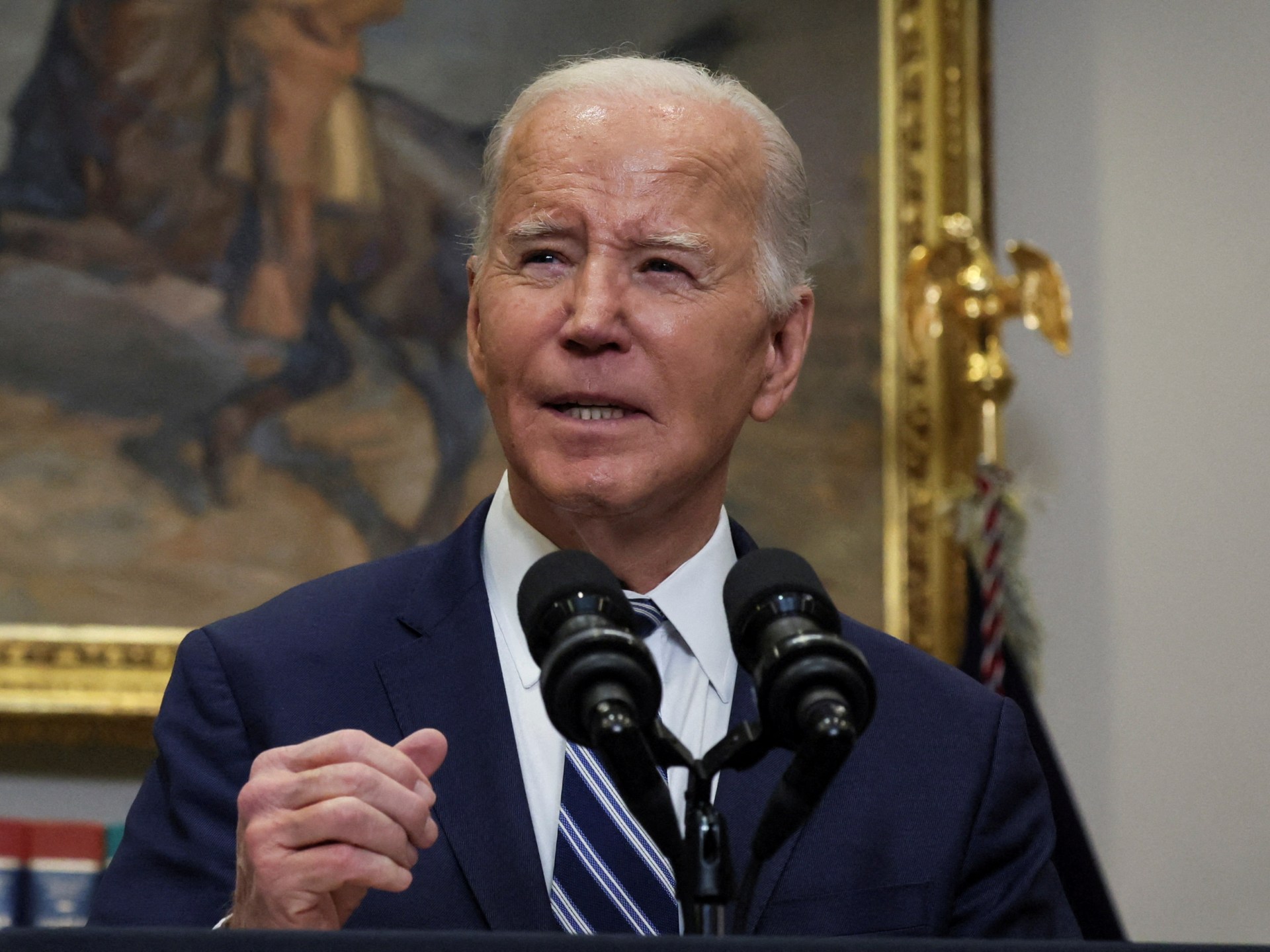
US President Donald Trump announced on Thursday that Lebanon and Israel had agreed to a 10-day ceasefire, as optimism grew that the Iran war could be coming to an end.
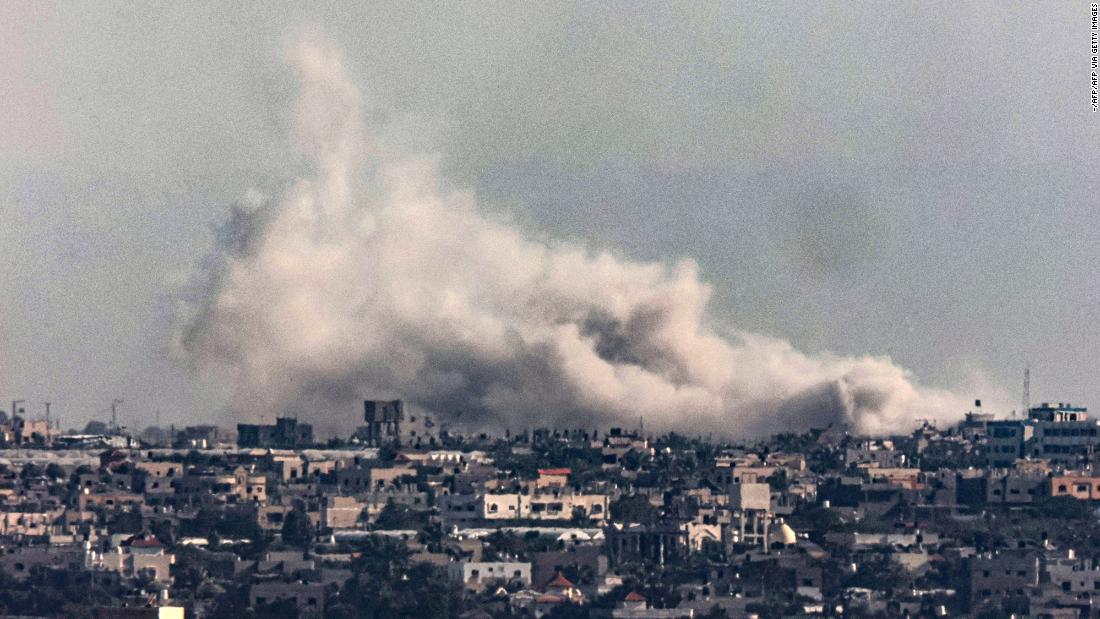
Trump said in a social media post that the ceasefire would begin at 5:00 p.m. ET (21:00 GMT), aimed at stopping a conflict between Israel and the Iran-aligned Lebanese group Hezbollah that was reignited by the US-Israel war against Iran.
He said he had had “excellent talks” with Israeli Prime Minister Benjamin Netanyahu and Lebanese President Joseph Aoun.
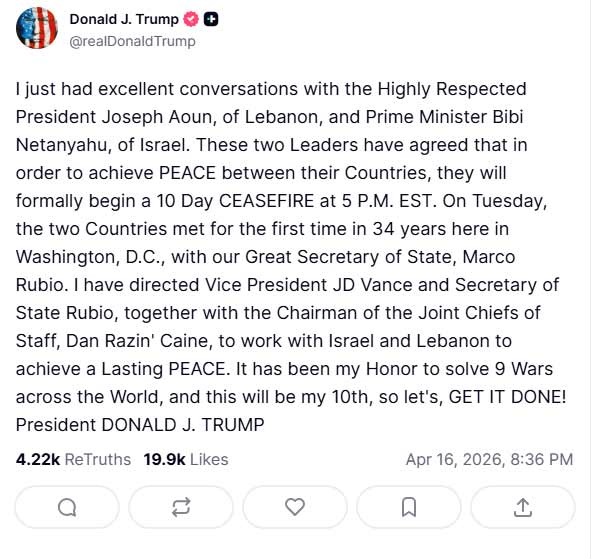
“These two leaders agreed that to achieve peace between their countries, they will formally begin a 10-day ceasefire at 5 p.m. EST,” he said. “Both sides want to see peace and I think that will happen quickly.”
Trump said he had ordered US Vice President JD Vance, Secretary of State Marco Rubio and Chairman of the Joint Chiefs of Staff Dan Caine to work with the two countries to achieve lasting peace.
The war with Iran spread to Lebanon on March 2, when Hezbollah opened fire in support of Tehran, prompting an Israeli offensive in Lebanon 15 months after the last major conflict.
European Commission President Ursula von der Leyen welcomed the ceasefire announcement, saying on X: “This is a relief, as this conflict has already claimed too many lives.”
Progress on the 'thorny issue' between the United States and Iran
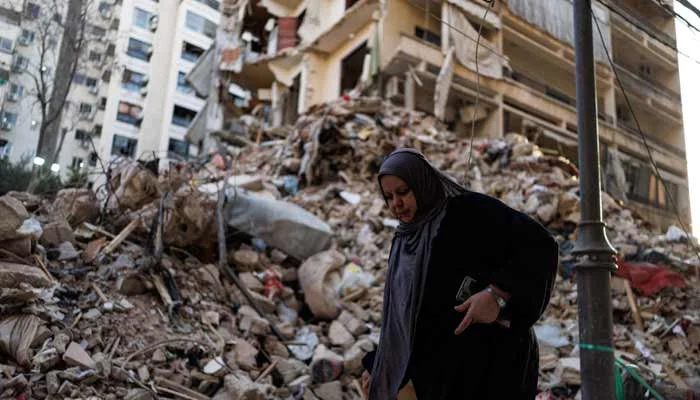
Thousands of people have been killed, mainly in Iran and Lebanon, since US-Israeli attacks on Iran began on February 28, triggering Iranian airstrikes on Iran's Gulf neighbors and reigniting the conflict between Israel and Hezbollah.
Rising energy costs have rattled investors and policymakers around the world since Iran effectively closed the Strait of Hormuz, through which a fifth of the world's oil and gas supply flows.
The closure of the strait has caused the worst oil price shock in history and forced the International Monetary Fund (IMF) to lower its outlook for the global economy, warning that a prolonged conflict could push the world to the brink of recession.
But hopes for a deal between Iran and the United States have been growing, with a two-week ceasefire in effect.
A security source said a Pakistani mediator had made progress on “difficult issues”, although Tehran said the fate of its nuclear program had not been resolved. Trump has said the deal would open the Strait of Hormuz.
Chief of Defense Forces (CDF) and Chief of Army Staff (COAS) Field Marshal Asim Munir, a major figure in the mediation efforts, arrived in Tehran on Wednesday to try to prevent a resumption of the conflict after talks in Islamabad ended without a deal.
A senior Iranian official said Reuters The trip on Thursday raised hopes for a second round of talks and an extension of a two-week ceasefire, but said fundamental differences remain over their nuclear program.
'Locked and loaded'
US Defense Secretary Pete Hegseth said troops were prepared to restart combat operations if a deal with Iran was not reached.
“We are reloading with more power than ever and better intelligence,” Hegseth said at a Pentagon briefing. “We are stuck and burdened with their critical dual-use infrastructure, with their remaining power generation, and with their energy industry. We would rather not have to.”
But a security source said Reuters a deal was nearing and that the United States wants a breakthrough before the ceasefire expires next week. Washington is offering to lift sanctions and unfreeze Iranian assets worth billions of dollars, he said.
Iran will open the strait only if a permanent ceasefire is reached and there are guarantees from the United Nations that the United States and Israel will not attack again in the future, he said.
Another government source said talks would be held “soon” in Islamabad, although no date has been set.
Stock markets have rallied strongly in recent days on expectations of a quick resolution to the clashes, with global stocks surpassing their previous all-time highs in trading on Thursday. However, oil prices rose, demonstrating continued uncertainty over the prospects for a ceasefire and the opening of the strait.
Iran's nuclear ambitions were a sticking point in last weekend's talks. The United States proposed a 20-year suspension of all nuclear activity by Iran, an apparent concession to long-standing demands for a permanent ban. Tehran suggested a suspension of three to five years, according to people familiar with the proposals.
Washington has pushed for the removal of all highly enriched uranium (HEU) from Iran. Tehran has demanded that international sanctions against it be lifted.
Two Iranian sources said there were signs a compromise was emerging over HEU stockpiles, and that Tehran was considering sending some, but not all, out of the country, something it had previously ruled out.