The indictment is notable for its details as it exposes a web of corruption at the highest levels of the Mexican government.
At the center, according to the US Department of Justice, is Sinaloa Governor Rubén Rocha Moya, accused of allowing his state's eponymous cartel to operate with impunity after its leaders guaranteed his election by sending armed men to intimidate rival candidates, steal ballots and threaten voters at the polls.
Rocha Moya, who maintained he had done nothing wrong when he took leave as governor this month to address the charges, is allegedly allied with “Los Chapitos,” a faction of the cartel led by four sons of the infamous Joaquín “El Chapo” Guzmán.
While prosecutors in the Southern District of New York described damning evidence, the indictment was equally notable for everything that was not mentioned. One name in particular was conspicuously absent: Ismael “El Mayo” Zambada, El Chapo's longtime associate and reputed to be the Sinaloa cartel's most powerful godfather.
The charges against Rocha Moya and nine other current and former Sinaloan officials have roiled Mexican politics and intensified scrutiny of the cases of Zambada and dos Chapitos who are already in US custody.
Beyond a ledger of monthly bribe payments to senior Sinaloa officials that prosecutors said was “recovered from Mexico” during the investigation, the allegation appeared to rely on evidence that had to have been obtained through extraordinary surveillance, or from people intimately familiar with Los Chapitos.
Many cartel leaders, feeling pressure from U.S. authorities, have turned on each other in recent years, and the latest case has left questions about whether there will be more betrayals to come. Two of El Chapo's sons remain at large, although there is talk that they could reach an agreement to avoid being killed or captured.
Sinaloa Governor Rubén Rocha Moya (left) attends an event in Mexico City on April 17. Rocha Moya was accused this month by US authorities of being corrupt by the Sinaloa cartel. He has denied the accusations.
(Luis Barrón/Eyepix Group/Sipa USA via AP)
Some suspect that the chain of events that led to the recent charges began nearly two years ago, when a private plane arrived at a small New Mexico airport with three people on board.
One of them was Zambada, a septuagenarian capo with so many judges, generals and politicians in his pocket that he was able to avoid spending a single night in jail in a criminal career that dated back to the 1970s. The others on board were the pilot and Joaquín Guzmán López, El Chapo's 39-year-old son and Zambada's godson.
According to Zambada's version of what happened, told through a statement issued by his lawyer, he was ambushed and kidnapped by Guzmán López, who lured him to a villa on the outskirts of Sinaloa's capital, Culiacán, where he hoped to mediate a dispute between Rocha Moya and another Sinaloan politician.
Rocha Moya claims that her name was used as bait. The governor has denied knowledge of the plot and has an alibi that he was traveling to Los Angeles that day. Zambada only described seeing the other politician, who he said was shot to death at the scene.
Zambada said Guzmán López forced him onto the plane and then handed him over to FBI and Department of Homeland Security agents waiting on the tarmac in New Mexico.
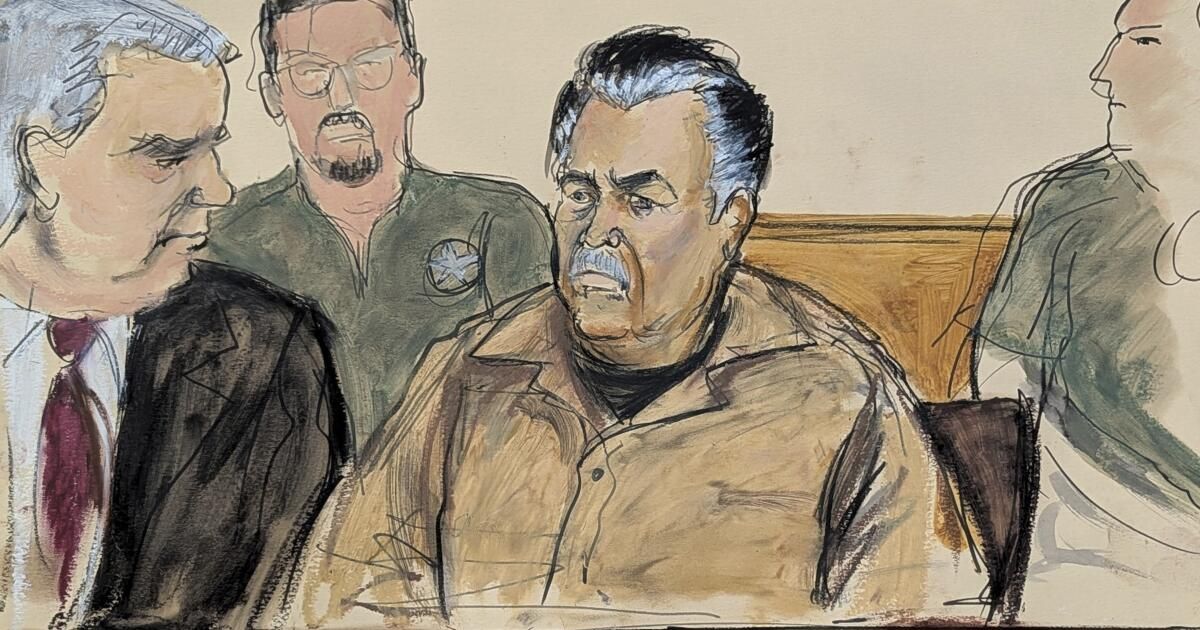
Zambada pleaded guilty in August to charges of co-founding the Sinaloa cartel and trafficking thousands of tons of drugs. Appearing in federal court in Brooklyn, he said his business depended on “paying bribes to police and military commanders and politicians to allow us to operate freely.”
It was long speculated that Guzmán López had kidnapped Zambada in hopes of currying favor with US authorities. That theory was confirmed when he reached a plea deal in December in U.S. District Court in Chicago.
At the time of his surrender, Guzmán López was facing a series of US federal charges, which could have carried a life sentence. By cooperating, he will serve a much lesser sentence: a minimum of 10 years, according to a transcript of his plea hearing reviewed by The Times.

Joaquín Guzmán López, 39, son of the Sinaloa cartel leader known as “El Chapo,” was arrested on July 25, 2024 in New Mexico, along with his godfather, Ismael “El Mayo” Zambada.
(Associated Press)
His plea agreement said that U.S. authorities “did not request, induce, sanction, condone, or tolerate the kidnapping” of Zambada, known as “Individual A.” The agreement said that Guzmán López acted “in the hope of receiving cooperation credit.”
At his plea hearing in Chicago, he told the judge that he had studied finance in college before joining his brothers in the drug trade. He said he was taking medication for anxiety and depression.
“He's only in the business because his brothers are thugs,” said a law enforcement source familiar with his case who is not authorized to speak publicly.
One of those brothers is Ovidio Guzmán López, who has been in US custody since 2023. He pleaded guilty to several charges last July, when court documents revealed that he is also cooperating with US authorities.

Ovidio Guzmán López, leader of the Sinaloa cartel faction known as Los Chapitos, was arrested on October 17, 2019 by Mexican security forces. He is now detained in the United States.
(Uncredited / Associated Press)
His half-brother is the alleged ringleader of Los Chapitos: Iván Archivaldo Guzmán Salazar. US authorities have offered a reward of $10 million for his capture.
Guzmán Salazar, 42, is a key figure in the case against Rocha Moya, and the prosecution claims he ordered his army of “hitmen” to carry out a campaign of terror to secure the gubernatorial election in 2021.
Two sources familiar with the ongoing cases but not authorized to speak publicly said Guzmán Salazar and his younger brother have been in contact with U.S. authorities about the possibility of a negotiated surrender. One of the sources said discussions had been underway for a year and suspected the brothers had been waiting to see how their half-siblings' cases would develop before making the decision.
The brothers' attorney, Jeffrey Lichtman, did not respond to questions from the Times.
If Guzmán Salazar ever faces justice in the United States, where he faces multiple federal indictments, it is unclear whether he would be charged with any crimes related to Zambada's kidnapping.
So far, no one has been held accountable for the murder of Héctor Melesio Cuén Ojeda, a political rival of Rocha Moya who, according to Zambada, was shot to death during his kidnapping. Zambada also said that two of his bodyguards, one of them a Sinaloa state police commander, have not been “seen or heard from since.”
Sources who spoke to The Times said that the plane that took Zambada to the United States belonged to Guzmán Salazar, suggesting that he orchestrated the plot.
The pilot was apparently released after landing and allowed to return to Mexico. He was subsequently arrested in Sinaloa by Mexican security forces and quietly handed over to the Trump administration last August, along with more than two dozen other suspected cartel figures.
Sources familiar with the case identified him as Mauro Alberto Núñez Ojeda, alias Jondo.
Court records show he pleaded guilty to federal charges last month in Washington, D.C., admitting that his job with the cartel was to “work directly” for Guzmán Salazar, supervising his fleet of planes, serving as his personal pilot and transporting shipments of drugs and weapons.
Court documents do not mention Zambada's kidnapping, and Núñez Ojeda's lawyer did not respond to a question about his client's alleged role in the matter. A Justice Department spokesperson declined to comment.

In a press conference held on July 26, 2024, the then president of Mexico, Andrés Manuel López Obrador, spoke about the arrest of Ismael “El Mayo” Zambada and a son of Joaquín “El Chapo” Guzmán by US federal agents.
(Alfredo Estrella/AFP via Getty Images)
Zambada, who faces life in prison without parole, is being held pending a sentencing hearing on July 20 in the same federal prison in Brooklyn that houses former Venezuelan leader Nicolás Maduro.
Given the possibility of being sent to the remote “supermax” prison in Colorado where his former partner El Chapo has been held in extreme isolation since his conviction in 2019, some have speculated that Zambada might try to help himself by revealing secrets about Rocha Moya and others.
Zambada's lawyer, Frank Pérez, has denied this.
“Reports circulating in the media claiming that Mr. Zambada has entered into a cooperation agreement with the United States government are categorically false,” Pérez said in a statement to the Times. “Mr. Zambada has not entered into any cooperative agreement, has not entered into any cooperative agreement, and is not cooperating with the United States government in any capacity.”
It remains to be seen whether Zambada's kidnapping was a masterstroke or a blunder by Los Chapitos. The betrayal sparked a civil war within the cartel, and factions loyal to El Chapo's sons have been severely weakened over the past year, losing territory across Sinaloa.
The indictment against Rocha Moya appears to deal another blow, and interim federal prosecutor. Gen. Todd Blanche said last week that more charges could soon be filed against other Mexican officials.
Regardless of what happens next, a source familiar with the Chapitos cases said Zambada's kidnapping was “a legitimate gangster move, without a doubt.”