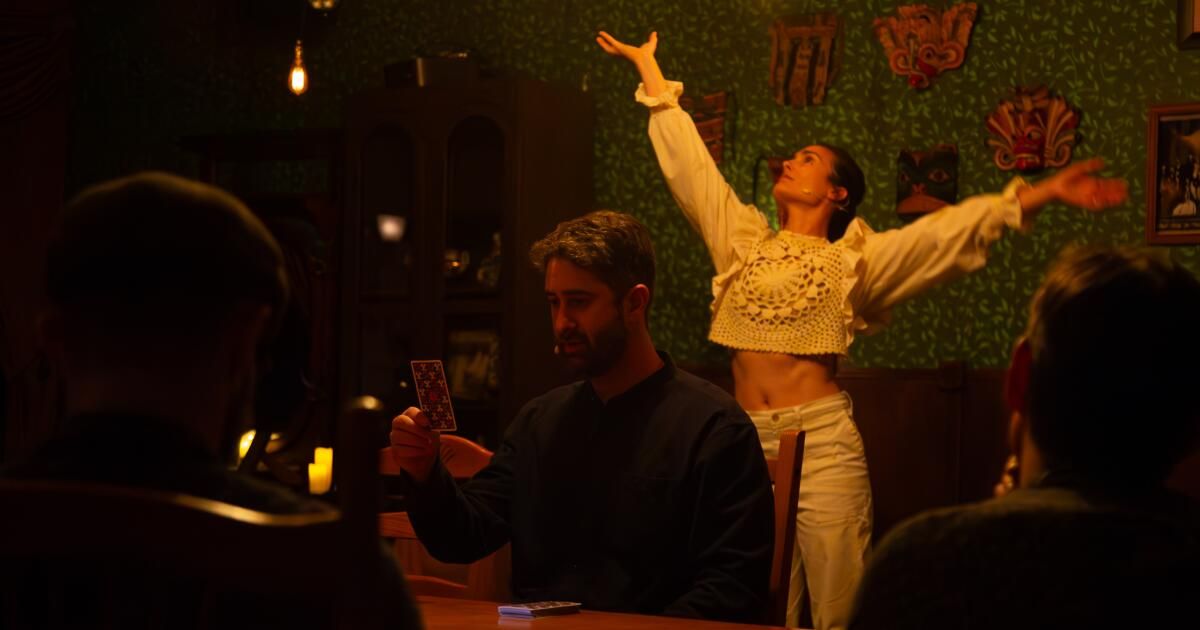
There is a sense of quiet mystery in tarot. That's why during my reading last week, it was more peculiar than disturbing when a dancer jumped onto a table to lie down at a 90-degree angle and throw her feet in the air.
Despite such activity, the tone was contemplative, and moments later, when I was asked to describe the colors and mood of a card from the Ten of Swords, I was tapped on the shoulder. After a gesture of following me, they handed me a flashlight.
The way he swung the light would now dictate the artist's movements. We may not have been dancing, but it was close. Melancholic and intimate, the performer (Haylee Nichele) quietly guided me to become comfortable in my discomfort, to sit with the night's themes of longing, loss, confusion, and impending pain.
Sam Alper's Bill, close-up, and Haylee Nichele's Constance in Koryn Wicks' “You Should Be Here for the Reading,” an immersive tarot performance.
(Daniel Kleen)
“You Should Be Here for the Reading,” running through June 20 at the After Hours Theater in North Hollywood, is part theater and dance performance, part tarot reading, and part cocktail hour. It's also personal, led by two actors who encourage attendees to open up, complete poems, and generally tune in to their vulnerability.
The 60-minute show, part written and part improvised, comes from the mind of Koryn Wicks. Trained in dance and choreography, Wicks' day job is themed entertainment, while her personal projects explore immersive space. They are theatrical works that experiment with audience interaction. “You should be here for the reading” is no different.
The Setup: Collectively, our group of eight has arrived for a tarot reading, only the famous reader we're there to work with, Constance, played by Nichele the night I saw, never arrives at her assigned role. We know his fate, but his partner, Bill (Sam Alper), who nervously tries to continue the performance in his absence, does not.
From there, “You Should Be Here for the Reading” becomes a program with a lot of audience participation. There are specific, written story beats, but the cards drawn (and the stories they tell) are, of course, random.

Sam Alper as Bill, an unsuspecting tarot card reader in “You Should Be Here for the Reading” by Koryn Wicks.
(Daniel Kleen)
“I knew I wanted the public to be the main driver of the tarot reading,” Wicks says. “I knew I wanted the presenter not to be a tarot reader and to have some kind of event where the audience had to take the reins and read the tarot.”
In turn, “You Should Be Here for the Reading” works for both those who are new to the space and those who are more experienced. During the pre-show, guests can explore tarot books and discover pieces of paper hidden in them that prompt us to answer questions or complete poems; the latter will figure in the performance. A worksheet given to us asks us to interpret some basic principles, as well as to begin reading with a question we would like to explore.
The show then focuses on how each attendee's desires, concerns, or lived experiences shape the perception of the reading.
“What draws me to tarot is the way it is based on symbolism and the way symbolism is embedded in the collective unconscious,” Wicks says. “I think it's really fascinating that we have this artifact that has the ability to give us insight into many shared experiences. When I read different books on tarot, or different people read my cards, there is an openness to interpenetration.
“The task I gave myself for this piece,” Wicks continues, “was to create an experience where a group of people would come together and go through the process of defining the symbolism and meaning of the cards in real time.”
And yet, the show also draws on Wicks' experience in dance. While Constance never appears for the reading, her presence is still felt, often floating or circling around the table with movements designed to interpret the tone of the reading. He is a ghostly presence, whose grace enhances the somber emotions of the night. Although she and Bill never interact directly, much of the dance seeks to explore their invisible bond. At times, Constance may ask several audience members to act as dance partners.

Koryn Wicks, creator of “You Should Be Here for the Reading,” an immersive tarot interpretation in which the audience is tasked with deciphering their own cards while a melancholic story unfolds around them.
(Kayla Bartkowski / Los Angeles Times)
“I truly believe that one of the most beautiful things that art does for us is remind us that we are not alone,” Wicks says.
Immersive art allows for a sense of participation, which Wicks hopes will increase appreciation of dance.
“Dance is an embodied art form,” says Wicks. “There is science that shows that part of the pleasure of watching dance comes from imagining yourself moving. In North America, many people have had no experience or education with dance, especially not concert dance. We then ask them to sit in a dark auditorium on a small chair and not move to enjoy it. Through my research, both practical and academic, I discovered that there is something about inviting the audience to participate in the dance that allows them to derive meaning from it.”
'You should be here for the reading'
While there isn't enough time in the show for everyone to have a one-on-one experience with the dancer, watching the audience and cast member try to synchronize with each other underscores the night's themes of connection. Ultimately, that is the space where the show resides. “You Should Be Here for the Reading” uses tarot as a means to bring some structure to our often disconnected lives.
“It's at odds with our current historical moment,” Wicks says of the show. “It's very anti-AI. It asks people to sit with books and find little seeds and not necessarily look for solutions or puzzles. It asks us to connect, sometimes with strangers.”
I kept the question I presented in the reading a secret, but found that the program provided a hopeful answer. Not because the cards offered a solution. Instead, they provided a community.