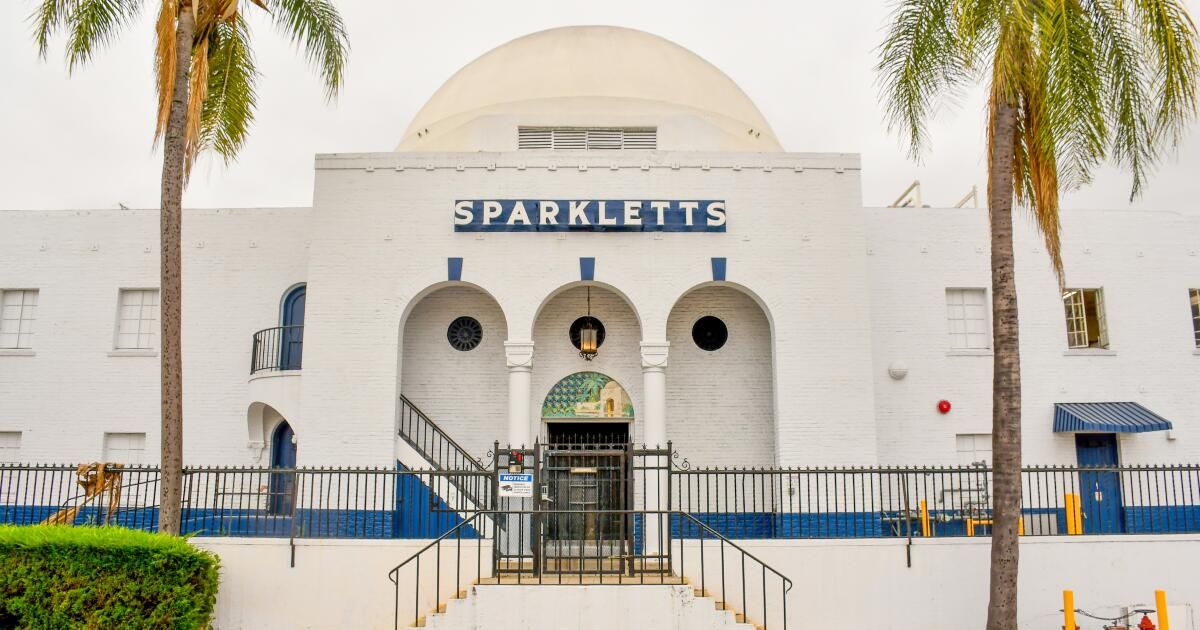
For nearly a century, Sparkletts has bottled its water in a massive building on Lincoln Avenue designed to look like an Arab palace, or perhaps an industrial oasis.
Now Sparkletts has moved out, the owners are not talking, and Los Angeles city officials, hoping to save the building, have named the site a historic-cultural monument.
“We've always had our eye on the building because it's an icon in the community,” said Frank Parrello, president of Monuments and Advocacy for the Eagle Rock Valley Historical Society. “We want to make sure that whatever happens in the future, the building is taken into account.”
The plant, which drew water from underground springs and bottled it for distribution in Southern California, opened in 1929 on E. Lincoln Avenue along the border between Eagle Rock and Highland Park, filling the block between N. Avenue 45 and N. Avenue 46. Designed by architect Richard D. King, its main building features arches, towers and domes, a whitewashed brick exterior, and wrought-iron lanterns.
The LA Conservancy calls it a bold example of the Moorish Revival industrial style and an excellent illustration of “the industrialization of drinking water in Los Angeles.”
Neighbors call it “the Taj Mahal,” says resident Anthony Carmona.
The Sparkletts Building, built in 1929, was designed in a neo-Moorish style. The building, inactive since 2025, has been added to the list of Historical-Cultural Monuments of the city of Los Angeles.
(Christopher Reynolds/Los Angeles Times)
Questions about the future of the building began to multiply in 2025, when Sparkletts ceased operations at the site. A 4.4-acre portion of the property was put up for sale and then for lease. The LA Conservancy warned that the building was “at risk of being redeveloped.”
Instagram site Save Iconic Architecture also sounded the alarm, saying the Sparkletts building “tells the story of innovation, design, and Los Angeles' relationship with its most precious resource: water.”
Meanwhile, the Eagle Rock Valley Historical Society nominated the building as a historic-cultural landmark, leading to a site visit and votes by the Los Angeles City Council and Cultural Affairs Commission.
On June 24, the council voted to protect the building as a monument. The designation “does not guarantee that the building cannot be demolished,” but it does allow city officials to delay demolition for up to 360 days “to allow time to preserve the monument.”
The city Planning Department staff report on the landmark nomination lists the owners as Sparkletts Drinking Water Corporation and Foremost Water Corporation. Neither man commented to the city about the monument's nomination, and Primo Brands (Sparkletts' parent company) did not respond to requests for information Monday.
The city staff report on the site says the architect may have been influenced by a Moorish design trend of the 1920s that included the film “The Thief of Bagdad” (1924). The El Capitan Theater on Hollywood Boulevard and the Shrine Auditorium near USC, both completed in 1926, are also known for their Moorish features.
Architectural historians David Gebhard and Robert Winter included the Sparkletts Building in their “Guide to Los Angeles Architecture,” noting its mosque-like presence and saying that “the best remaining element” is the tiled mosaic oasis scene above the entrance.
The building has undergone some changes. As the Eagle Rock Valley Historical Society's nomination notes, the building's largest Sparkletts sign was removed in July 2025. City records show that decades ago, during repairs after the 1971 San Fernando earthquake, at least one minaret was removed.
The entrance, however, remains virtually intact, with three arches and a series of steps framed by a pair of tall palm trees. Just above the front door and beneath a surviving Sparkletts sign, hang the tiles that Gebhard and Winter enjoyed.
Plus, “the interior is very impressive,” Parrello said. “It's a big open industrial floor plan, which could be used for a lot of things.”

The Sparkletts Building, inactive since 2025, has been added to the list of Historical-Cultural Monuments of the city of Los Angeles.
(Christopher Reynolds/Los Angeles Times)
If a public agency or nonprofit can play a role in the property's future, Parrello added, “it could become a housing complex or a community center for a housing complex.”
A similar response came from Carmona, 51, a restaurant worker who lives in a mobile home a block from the Sparkletts building. Carmona said he would love to see it become a gathering place where neighbors can exchange products, services, ideas, “lemons, oranges, whatever.” In a perfect world, Carmona said, “there should be free water for everyone, but of course that's not going to happen.”
The city of Los Angeles began designating historic-cultural monuments in 1962 and has granted that status to more than 1,000 buildings and other structures.
The closing of the Eagle Rock Sparkletts operation followed a 2024 merger between Sparkletts' parent company, Primo Water, and another bottled water company, BlueTriton, to form Primo Brands.