Get ready, Coronado. The hospitality expert who brought San Diego his most over-the-top maximalist hotel, the Lafayette in North Park, is back with another dazzling project, this time in the wealthy island city known for its traditional bent.
Opening Thursday, Baby Grand includes a 35-foot faux rock wall, a 20-foot waterfall, a Mediterranean restaurant that looks like a Greek ruin consumed by a jungle, and a hidden oyster bar filled with glass and mirrors. All of this, including Spanish statues, Moroccan accessories, and Murano glass, is located on an Orange Avenue lot that once housed a 1950s motel. If Liberace had run off with an art historian, they might have landed here.
The idea was “to create this little mirage within the mirage that is Coronado,” said Arsalun Tafazoli, founder of CH Projects, the group behind a multitude of design-intensive establishments across San Diego, including speakeasy Raised by Wolves, hi-fi bar Part Time Lover and Middle Eastern restaurant Leila.
The Baby Grand hotel and its Night Hawk restaurant are located along Orange Avenue, about a block from the Hotel del Coronado.

The patio dining room at Coronado's new Night Hawk seats about 150 people.
Baby Grand's high-density, high-gloss environment, which cost around $17 million and took about five years to complete, will come as no surprise to those who have followed Tafazoli's previous projects.
When asked about the design philosophy behind the 2023 renovation of the Lafayette, the company's first hotel, Tafazoli had a simple answer: “More is more.”
The Baby Grand project, crafted in collaboration with design studio Post Company, is cut from the same cloth and describes itself as a “polychromatic pastiche” on its website. The goal, Tafazoli said, is to enrich Coronado's culture and give people a break in a time rife with anxiety. But “it's different,” he said. “I don't know if it will be accepted.”
Obtaining the necessary city permits “was definitely a struggle,” Tafazoli said. “If I had known how difficult this was going to be, I don't know…”
In the days before the hotel opened, Tafazoli, 44, led a tour of the site. The businessman, whose heritage is Persian, wore his hair in braids and a Supreme button-down shirt depicting Barack Obama.


The rooms at the Baby Grand hotel feature a separate bathtub and shower.
“I have a very one-dimensional existence. I am single and have no children. This It's what I do,” said Tafazoli, who grew up in San Diego and studied at UC San Diego. He now lives in the East Village in downtown San Diego, where his company is based and where he opened his first CH company, Neighborhood, in 2007.
Although his company started with food and beverage establishments, Tafazoli said, his goals were always to create and manage hotels, “the pinnacle of hospitality.” As a child of divorce, he said, you may have a greater awareness of when the energy feels good in a room and when it doesn't. Creating social environments, he said, gives him some control over that. Furthermore, he later added, “beauty is important to me because it conveys care.”
To make the most of Baby Grand's compact location (2/3 of an acre), the CH team has exported parking. Instead of leaving their cars on site, guests will hand over keys to valets who will deposit the vehicles in a Bank of America parking lot a block away. That move freed up space not only for palm trees, torches, tables, stalls and 21 statues of Spain, but also for a small fake beach with a 4-foot-deep wading pool that can hold a handful of people.
“I can't tell you how many iterations of sand were brought in and taken out,” Tafazoli said. “The sand is its own universe. You want local sand. But the local sand was not conducive to that feeling.” So the sand is from Türkiye.


1. Guest shower in an en suite bathroom. 2. Hotel design touches include guest bathroom door handles. 3. Fiberglass clamshells serve as headboard in guest rooms.
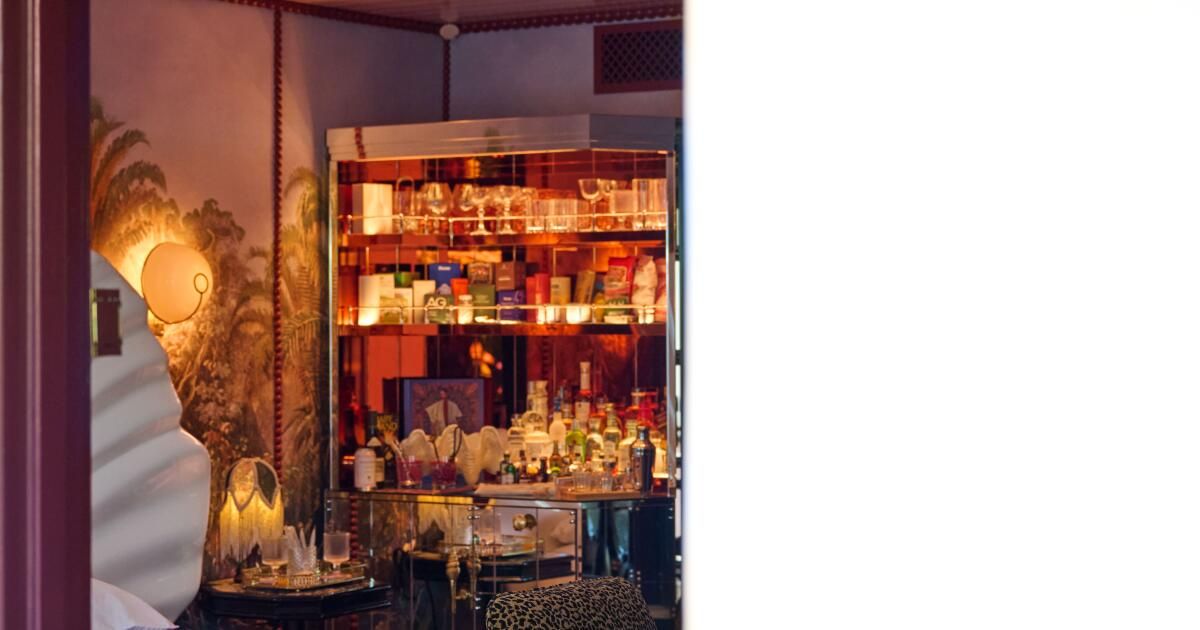
The property’s main restaurant, Night Hawk, is Mediterranean, with cooking by open fire, a Greek ruins vibe and seating for about 150. The second restaurant lurks behind the lobby — a hidden oyster-and-Champagne bar that holds about 35 people, reservation only. The space, called Fallen Empire, features red mohair booths, built-in Champagne buckets, mirrored walls and chandeliers, sconces and lamps from the Italian glass-blowing island of Murano. The floor is a custom mosaic of sea creatures.
There are 31 guest rooms, beginning at $350 per night. Each is dominated by a custom-made clamshell headboard (fiberglass). Beds are surrounded by animal-print seating, parquet oak flooring, marble tables, mirrored cabinets and custom wallpaper. The rooms measure roughly 300 square feet each, nearly half of that space taken up by their elaborate bathrooms, each with separate tub and shower, sinks from Morocco.
Now picture all of that placed in the heart of Coronado (population 20,192), which sits next to Naval Air Station North Island and is known for attracting well-heeled retirees. The median home value is $2.5 million.
Up the block from the Baby Grand is the grand dame of San Diego County tourism, the Hotel del Coronado, which went up in 1888, completed a $550-million renovation last year and starts its rates north of $600. Another option is the Bower Coronado, also a dramatically upgraded motel that reopened in 2025 with prices similar to Baby Grand’s but a much more buttoned-down style.

This view from above at the Night Hawk restaurant space shows a stone booth, elaborately patterned cushion and table top.
All of those properties stand close to Coronado’s wide, sandy beaches — which means they all face challenges as waters are often fouled by the northward flow of untreated sewage from greater Tijuana. The longstanding problem has worsened in recent years, and Coronado’s Central Beach was closed to bathers on 129 days in 2025 because of unsafe bacteria levels. The U.S. and Mexican government say they have sewage-treatment projects in progress, with improvements expected by the end of 2027.
“We are, unfortunately, not marine scientists just a group of deeply overcaffeinated hoteliers with strong opinions about lighting, linen textures, and good design. So please check local water conditions before swimming,” Tafazoli wrote in a statement.
Asked his target market for the new hotel, Tafazoli said he was looking close to home.
“I see this as a staycation for locals” from San Diego County, Tafazoli said. “The big risk is that we don’t get locals and it doesn’t resonate with tourists who like the status quo.”
That said, Baby Grand and Coronado might be a better match than some imagine. Christine Stokes, executive director of the Coronado Historical Assn. and Museum, sees at least a few parallels to Baby Grand in local history, beginning with the historical association’s own building. From the 1950s into the 1990s, Stokes noted in an email, Marco’s Restaurant operated in the space, with a “Roman Room” bar — “a dark and immersive hidden gem where bartenders performed sleight-of-hand magic tricks.”

Guest rooms, including No. 103, are labeled with inscribed brass clamshells.
Then there was the Hotel del Coronado’s Circus Room restaurant, open from the 1930s into the 1960s. That was “an immersive environment, using specialized murals and striped tents on the walls,” Stokes wrote. It’s also where, in 1950, the manager of an L.A. TV station spotted a promising young piano player and decided to give him a chance on screen. The pianist’s name was Liberace.
However people respond to the particulars of the new hotel, Tafazoli said, he knows that the larger setting of Coronado is a special place.
From his office in San Diego’s East Village, “it’s a six-minute drive,” he said. “I come off that bridge, and I feel like I’m in a different place.” It’s amazing, he said, “to be so close and feel so far away.”