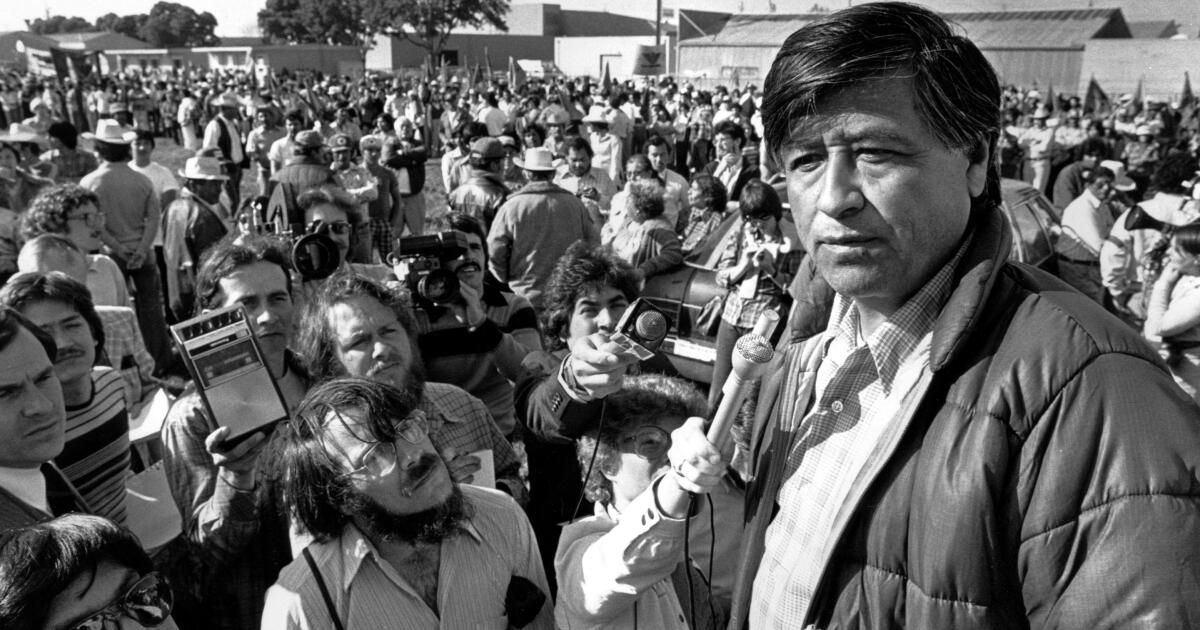
One summer day in 1988, before the sun came up, my parents loaded my three younger sisters and me into our beige Chevy station wagon. We drove from Oxnard to Delano, California, to support what would become Cesar Chavez's last fast. I remember the brutal heat, the packed store, the feeling that we were part of something bigger.
Chávez never came out to speak that day, he was too weak after 29 days of fasting. But we stayed. More than 3,000 of us waited there, believing in his campaign to draw attention to the use of pesticides in the fields where farm workers toiled with little protection from the chemicals he said caused cancer among the workers and birth defects in their children.
Knowing now the suffering that Chávez caused (the sexual and emotional violence against young women and against Dolores Huerta) is heartbreaking. It's infuriating. It forces a reckoning. Not just with who he was, but with the danger of turning people into symbols, placing them so high that their actions go unquestioned, and harm can occur in the shadow of that reverence.
There is no justification for his actions. It must be clearly named.
And yet, the work that so many people fought for: the protection of farm workers, pesticide awareness, the dignity of work, that work remains. It never belonged to just one person.
As a young bilingual teacher and community organizer in Oxnard, a farm town that smells of strawberries, celery, and sometimes fertilizer, I founded the first César Chávez March and Celebration in 1998. The celebration included a district-wide speech contest for fourth- through sixth-grade students. The march and speech contest continued long after I retired.
Just days before the news broke about Chavez, he was organizing a community work day at Rio Farm, a 10-acre pesticide-free farm in Ventura County owned and operated by a local school district. A young man named Enrique and I work side by side, removing nettles from rows of organic celery, which will be harvested and served in eleven school cafeterias. As we talked, he shared stories about which elementary school he had gone to. We realized that our paths had crossed years before, when I was a new teacher and he had just arrived in this country.
Enrique told me that years ago he competed in the César Chávez speech contest. “The first time I lost,” he said, weed roots hanging from his gloved hands. “I came back the next year determined to win, and I did.” He smiled and I could picture the 10-year-old standing on stage, holding his badge. “It helped me find my voice. It taught me to feel confident.”
Last year was probably the last César Chávez Speech Contest in Oxnard. I hope something new emerges that reflects the broader movement and recognizes the many people whose work has fought for the dignity and protection of farmworkers. This is important in a community like Oxnard, where many of our students are children and grandchildren of farmworkers, like Enrique. Like me.
Few remember that the march and the speech contest were my idea, and that's okay. I did not bring these events to life on my own. So it took many talented and dedicated people (and hundreds more over the years) to shape them, bring them forward, and keep them alive.
That is the nature of ideas. And collective action. Ideas take root. They grow longer root systems. They move and change shape with others often without being recognized. And recognition was never the point.
I also think of a large framed print that hung in our house for years: Chávez's face rising above the fields. Only when you looked closer did you see that every feature (her face, her hair) was made from images of many people.
Perhaps that is what this moment asks of us. To enlarge the lens; Not to honor a single figure, but the collective. To name the women in the movement. To name the contributions and sacrifices of Dolores Huerta. Recognize the organizers, the farm workers, the families, the artists, the people whose work and courage made change possible before Chávez, alongside him and long after.
Organizers of this year's march in Oxnard chose to go ahead rather than cancel it, unlike what many other cities have done. In doing so, those in Oxnard have broadened the perspective, shifting the focus toward farmworkers and toward the movement itself, a movement that will (and must) continue.
I keep coming back to that store in Delano. To the thousands of us gathered, waiting. At that moment I thought we were waiting for him. But we weren't. The power was already there. It was us. It's always been us. And it still is.
Florencia Ramírez is the author of “Eat less water” and the next “The kitchen activist.” She is the founder and director of the Pesticide-free soil project in Ventura County.