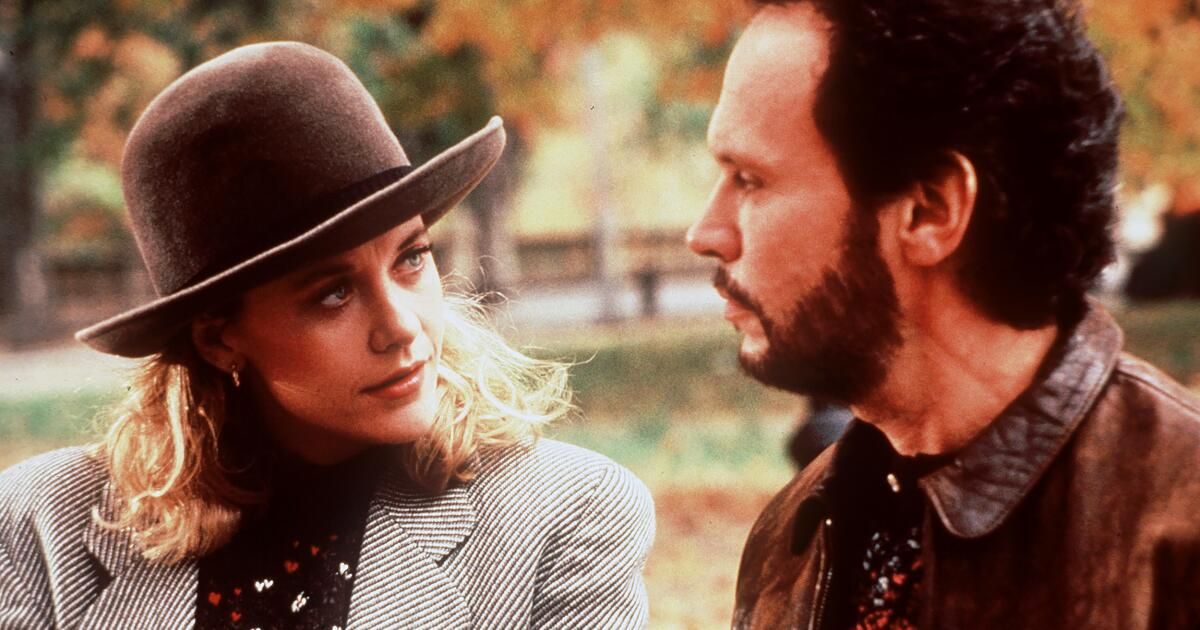
There was a time when Hollywood knew how to make audiences feel joy, leaving us feeling lighter when we left the theater than when we entered.
Today's movies can still stir emotions, but the optimism they once offered has become rare. Movies are more convenient than ever and most stories come to us via streaming, but the experience has been diminished. The television screen shines coldly in our living rooms, now just one of many designed to distract us. We no longer sit in the dark next to strangers, sharing the same breath when the lights go out. Ritual has been replaced by access and something vital has slipped away.
As that experience faded, so did the romance and tenderness that once lived in works by directors like Rob Reiner, Nancy Meyers, Nora Ephron, Sydney Pollack, Cameron Crowe, James L. Brooks, and Garry and Penny Marshall. His films held on to that optimism without pretending that everything was fine. Even the afternoon light streaming through the kitchen window could signal a turning point.
Now studios seem to pursue only what seems most marketable, where big budgets, star power and box office potential can outweigh the story itself. Everything feels heavy now, as if warmth has gone out of style.
Streaming accelerated that change. The economic engine that once supported mid-budget movies through long theatrical windows, DVD sales and cable television rotation disappeared almost overnight. Studios now prioritize stores that guarantee immediate returns, while movies that could be made for $30 or $40 million have nowhere to go. This feel-good film did not disappear by chance. The financial base collapsed.
In projects that receive significant support from studios, you can feel this change in tone. Even the most famous films often reveal a sense of seclusion. Guillermo del Toro's new “Frankenstein” is beautifully crafted, its dialogue elegant and its cinematography impressive. It offers a true cinematic experience, but lacks deeper emotional honesty. I found myself admiring his art but striving for a connection with his characters, a resonance that never fully came. Of course, it's not intended to be a feel-good movie, but its popularity hints at the empty emotional landscape we've come to accept, on and off screen.
When Reiner, one of the great architects of feel-good movies, died earlier this month, the outpouring of nostalgia for his work was a welcome reminder of the radiance he brought to theaters. We also recently lost Diane Keaton, whose films allowed themselves to be complex. She could navigate romance with wit and vulnerability; their white shirts and loose ties were an unapologetic statement of themselves. The late Robert Redford shared his same romantic spirit, with a charm that could make you feel good even when the story broke your heart.
These legends were from a time when feel-good movies weren't dismissed as lightweight. Actors like Keaton and Redford, Meg Ryan and Billy Crystal, Tom Hanks, Dustin Hoffman, Teri Garr, Jack Nicholson and Meryl Streep gave themselves to characters built on vulnerability and the small nuances of everyday life. And the scores of John Williams, Hans Zimmer, John Debney and Robert Folk were the heart of their stories.
“If my movies weren't comedies, they would be tragedies,” said Nancy Meyers, director of “Something's Gotta Give” and “The Holiday.” he once told Parade magazine. “I give them happy endings because I want life to be like that.”
Many of us still return again and again to feel-good classics as the world becomes cynical and skeptical of pleasure. Art is expected to diagnose rather than delight. Celebrating films like “Anora” and “Oppenheimer” reflects that impulse, confronting emotion with immense weight and trepidation.
By losing that lightness, Hollywood has lost its empathy.
Now there is a cultural vacuum. The city that was once known for making dreams come true now seems unsure if dreaming is allowed. The scripts feel anxious and cold, filtered by algorithms. However, audiences still want to believe that kindness matters and want stories that remind them of who they hope to become.
Hollywood has always reflected its times. During the Depression, “It Happened One Night” and “Top Hat” offered an escape. In the '70s, “The Way We Were” and “Annie Hall” showed that love could break your heart and still be worth it. In the early '80s, “Tootsie” proved that honesty could survive uncertainty. In the late '80s and early '90s, movies like “When Harry Met Sally…” and “Sleepless in Seattle” showed that connection itself could shape a love story. “The First Wives Club” reminded women that the end of a marriage did not mean the end of identity. After 9/11, “Love Actually” brought comfort to a world trying to find balance.
Imagine the city finding that heartbeat again, with studios that support stories based on sincerity and filmmakers who, like Reiner, Meyers and Ephron, consider comedy and romance to be vital.
A great feel-good movie captures moments of honest human dialogue and highlights the parts of ourselves we often keep hidden. The best ones endure because they are based on something elemental: the belief that connection is still possible.
Maybe if Hollywood remembered that, the city could regain its pulse. The world could do it too. People still come with hope in their hands. They want to believe that stories can save them, that light can still fall in a way that makes anything seem possible. The feel-good story never went away. He's waiting for someone to turn the camera on him, and so we keep staring at the screen, believing that for a moment, life may turn out well after all.
Alixandra Kupcik is a writer and performance artist based in Los Angeles.