It was beyond disconcerting to hear the Iranian foreign minister on Sunday sound like Ukrainian President Volodymyr Zelensky circa 2022. But that's the comparison that immediately came to mind when Abbas Araghchi said George Stephanopoulos on ABC's “This Week”: “What the United States is doing is an act of aggression. What we're doing is an act of self-defense. There are huge differences between these two.”
All you have to do is replace the United States with Russia and it will be very clear who and what we have become. An aggressor nation that kills people on Caribbean fishing boats without evidence or due process. That captures and removes the Venezuelan president and then claims Venezuela's oil. That assassinates Iran's supreme leader, Ayatollah Ali Khamenei, prompting retaliatory attacks by Iran across the Middle East.
Of course, there are differences. When Vladimir Putin invaded Ukraine and started the war that continues to this day, he targeted the democratically elected leader of a sovereign nation, intending to seize the territory and install a Russian puppet at the top. By contrast, President Trump removed a theocratic dictator who in January ordered his security forces to crush mass protests against him with lethal forcecausing thousands of deaths.
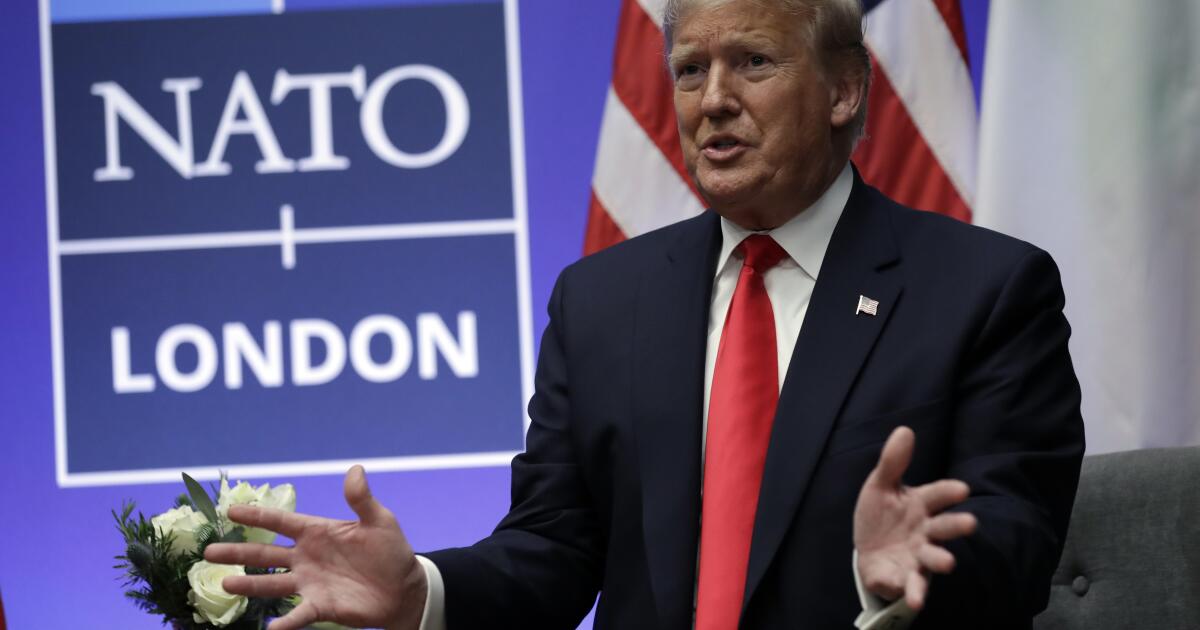
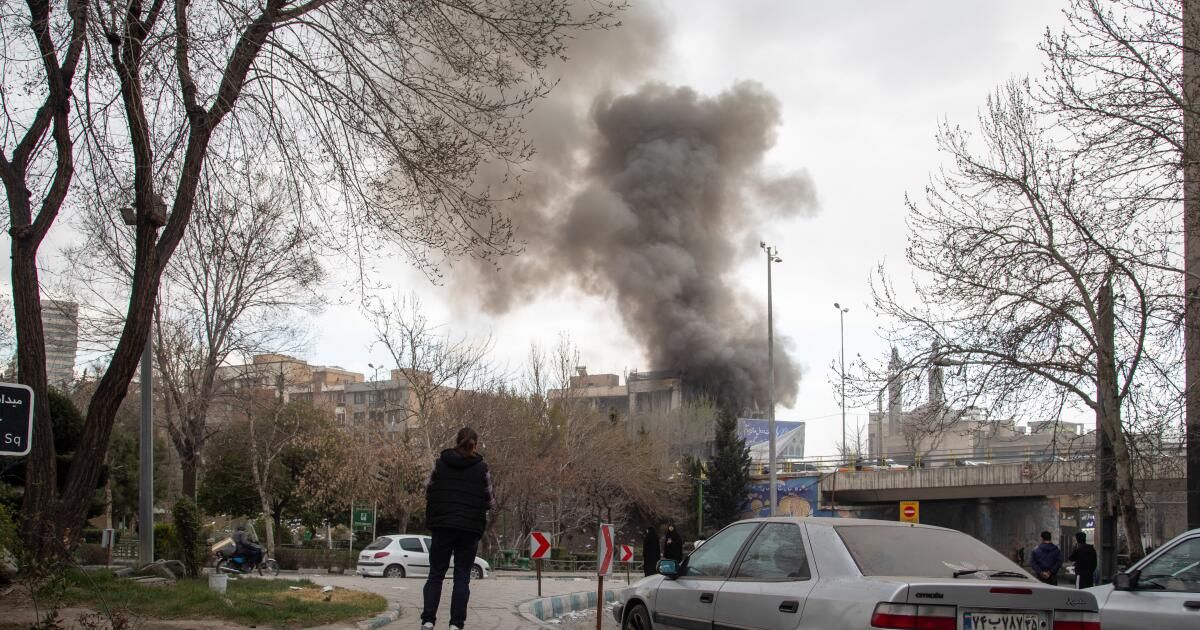
And still. Trump started this war with without constitutional authority. He force Declaring war or authorizing the use of force falls to Congress and, unless the United States has been attackedThat must happen in advance. Trump has also failed to come up with any coherence or compelling evidence about Iran's nuclear capability, one of the supposed reasons for this war of choice. And he has embarked on it with little apparent concern for the lives and consequences that so far include lots of children and other civilians killed in Iran; US military casualties, including six dead; and Iranian attacks in at least 10 nations: Israel, Jordan, Saudi Arabia, Bahrain, Iraq, Qatar, Kuwait, the United Arab Emirates, Cyprus and Oman.
When Trump suggested in a short address When he told the nation on Friday that there could be deaths and casualties in the United States, his words sounded rote and empty. “That happens often in war,” he said. “But we won't do it for now. We will do it for the future.”
The future? What future? Many of us remember President George W. Bush's grand ideas of exporting democracy to Afghanistan and Iraq. Trump's “future” seems more like a return to the eternal wars and failures of the past. Exactly what the “America First” candidate said. promised to avoid in their winning campaigns of 2016 and 2024.
Do you remember the Green Zone? The US protected zone in Baghdad during the Iraq war? It is now the site of the United States Embassy, and last weekend, also the site of pro-Iran protesters (some waving flags of pro-Iran armed groups, others throwing stones) were met with tear gas as they tried to storm towards the embassy.
Just the words “Green Zone” are a depressing reminder of lessons many of our leaders never learn. Iraq was an unfortunate misadventure, another war of choice, another war based on incorrect assumptions about weaponry; In the case of 2003, the non-existent Iraq war reservations of chemical and biological weapons of mass destruction; now, a nuclear program that, conveniently, always seems to be on the verge of being dangerous. And even more unfortunately, Bush the Iraq war began when he was still at the beginning of what would become a 20 years war in Afghanistan after the September 11, 2001 terrorist attacks on the World Trade Center and the Pentagon.
Afghanistan was a theocracy controlled by the Taliban extremists. Bush & Co. did not decide to simply bomb the camps where the Taliban trained terrorists. They decided to occupy Afghanistan and try to drag it into the modern era, with equal rights for girls and women. Wasn't it nice to think that? And naive, especially after the Soviet Union. spent a decade fighting in Afghanistan to put communist allies in charge, before withdrawing his troops in 1989 amid failure.
One of the most devastating documents I have seen was a 2020 State Department report on human rights abuses in Afghanistan. That was 19 years after we dropped the first bombs on the Taliban and began our quest to transform Afghanistan into a 21st century country where girls could go to school and grow up to get jobs, run for office, and wear whatever they wanted.
Beyond the raw brutality of the Taliban towards women, I believe wrote In 2021, the report cited injustice, neglect and cruelty by local governments and agencies: “Women imprisoned because they reported being victims of crimes, or at the request of family members, or as representatives of male relatives convicted of crimes.” And the inevitable and terrible conclusion: no matter how long the United States remained, we could not “make a country care about its own women.” Only Afghanistan could do that.
If Iran's foreign minister was correct in his insistence Sunday that there will be successors to the Khamenei regime and continuity in the Islamic Republic, does Trump expect co-opt The successors as he did in Venezuela, with his new best friend Delcy Rodríguez? If the Iranian resisters (some but not all of the population) miraculously manage to organize and advance, will they receive money or troops from Trump? Or do you just want Iran's oil?
Unfortunately for them, our president will most likely conclude, as always, that power is the most important thing, and will make deals with whoever has it, whether they be socialists in Venezuela, autocrats in Iran, or Putin in Russia.
Jill Lorenzo is a journalist and author of “The Art of the Political Deal: How Congress Beat the Odds and Broke the Deadline.” Blue sky: @jilldlawrence