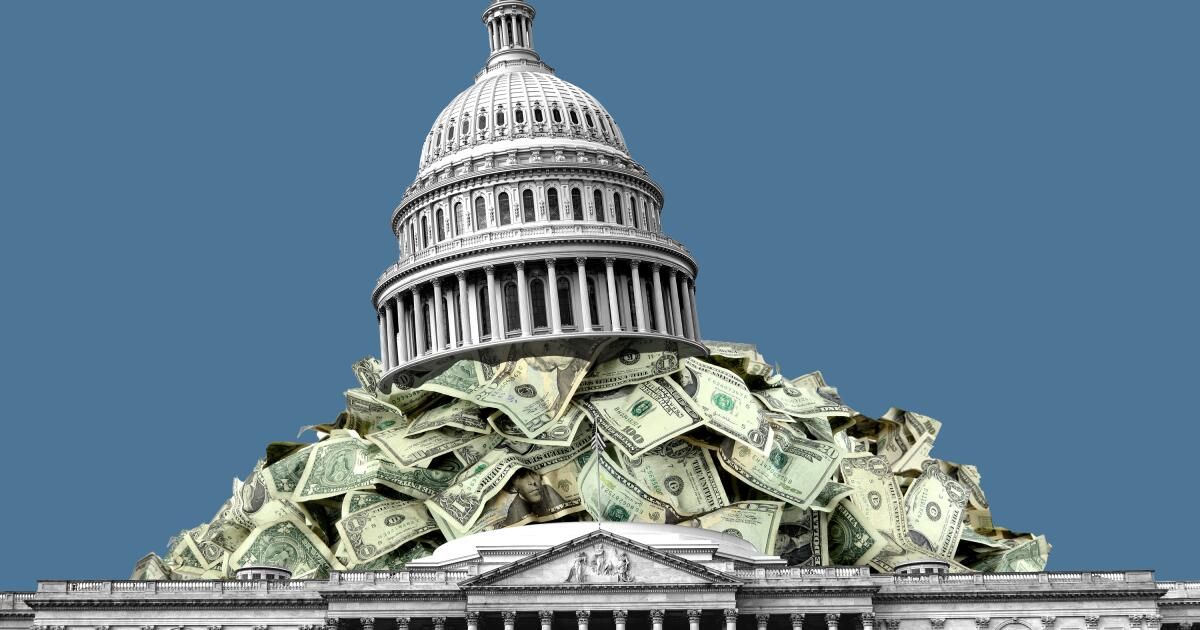
Despite what progressives have been arguing lately, the United States does not have a fiscal problem. Federal revenues, even after the extension of Trump's tax cuts last year, are surpassing their historical average as a share of gross domestic product. What the United States has is a spending problem so big that the Congressional Budget Office latest 10annual outlook It looks less like a fiscal forecast than a warning label.
Through 2036, the CBO projects $94.6 trillion in federal spending versus $70.2 trillion in revenue, a deficit of $24.4 trillion that lasts a decade. Outlays reached 23.1% of GDP in 2025, almost two percentage points above the 50-year average, meaning annual spending growth is outpacing the economy itself. Public debt is projected to reach 101% of GDP this year, surpassing the post-World War II record of 106% by 2030, and rising to 120% by 2036.
The Trump administration says it wants to reduce the deficit to 3% of GDP by the end of this term, about half the current trajectory. The CBO figures show how far that ambition is from reality.
The cost of paying interest is now the central story, and it is grim. Net interest outlays will rise from about $1 trillion this year to more than $2.1 trillion in 2036, when interest payments alone are projected to consume more than a quarter of total tax revenues. The federal government will spend more on past borrowing costs than it does on many of the programs the loans were supposed to fund.
The interest problem reflects both the increase in debt and the compound effect of all that debt. As deficits increase debt, interest payments increase, financed by additional borrowing. If interest rates rise more than projected, the dynamic accelerates.
These fiscal problems are further intensified by spending on autopilot. Social Security, Medicare, Medicaid, and net interest are projected to account for approximately 73% of total outlays by 2036 and absorb nearly all federal income.
Think about it: Virtually every dollar the government collects in taxes will go toward fees and interest before Congress appropriates even a single cent for defense, infrastructure, research, or anything else. Congress's room for maneuver shrinks every year, not so much because of the decisions it is making but because of the decisions it is not willing to make.
However, politicians have been busy making matters worse by further increasing the number of tax breaks, which are better understood as spending through the tax code. The CBO notes that these tax expenditures, including no tax on tips and a new tax credit for seniors, are equivalent to 8% of GDP. Over the next decade, that cumulative revenue loss will amount to more than $34 trillion.
As always, the CBO report is based on several optimistic assumptions: that the temporary tax provisions are allowed to expire as planned; that planned spending reductions actually occur; that controversial tariffs remain in force; that interest rates remain where they are now. It also assumes that in 2032, when the Social Security Trust fund is depleted, Congress will borrow enough to keep all benefits at their current level without creating more inflation. Not all of these things will happen.
On the other hand, the report incorporates several assumptions that could be tipping the outlook in a more pessimistic direction. The CBO assumes lower economic growth than some private sector forecastswhich could suppress projected revenues and raise projected debt ratios. Greater productivity or growth in the workforce would materially improve the fiscal outlook. And, of course, if Congress decides, against all expectations, to reform Social Security (rather than put an expensive bandage on it), once the trust fund is depleted, the long-term outlook would stabilize.
This is a two-party failure. The growth of social rights reflects demographic realities and long-standing, fixable design flaws. Recent tax legislation reduced revenues despite some welcome expense offsets. The honest accounting is that both sides have contributed to this problem and neither has offered a plan equal to its scale. That's why both sides should care.
It is simply not possible to treat persistent trillion-dollar budget deficits as an abstraction much longer. They divert capital from productive private investment, raise real interest rates and slow growth. They also empty politicians' own fiscal capacity. When the next emergency comes, the government will start from a position of weakness. And in a stressed environment, each additional dollar of emergency borrowing costs more than it should.
If authorities refuse to align spending with income to assure investors that the United States will pay its debt, the market adjustment will be painful. It will trigger higher inflation.
President Trump must deliver on his promise to reduce the deficit. Democrats must sign. Reform is a choice. Disorder is what happens when that choice is postponed.
Rugy Veronica He is a senior fellow at the Mercatus Center at George Mason University. This article was produced in collaboration with Creators Syndicate.